Focaccia

An olive-oil flatbread with a dimpled surface and a crisp, golden base.

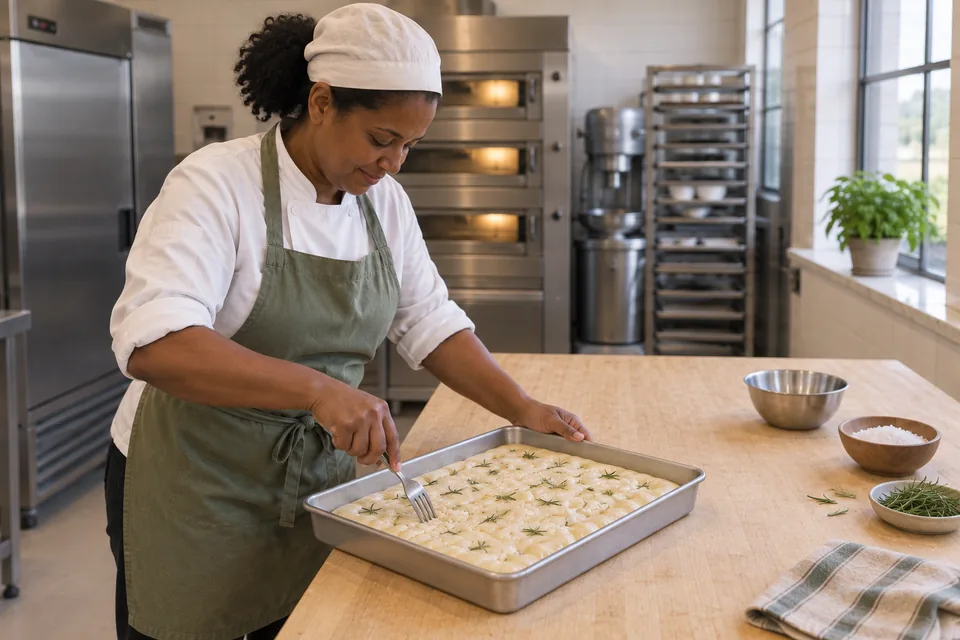
One plain golden focaccia cut into matching broad strips on a board.
Makes
One 800 g dough focaccia on a 30 × 43 cm sheet; see size note
Heat
260°C
Baking time
12–15 min as a starting range

Preheat fully; finish when golden with a firm bottom and fully cooked centre.

View

Focaccia Genovese

Makes
One 800 g dough focaccia on a 30 × 43 cm sheet; see size note
Heat
260°C
Baking time
12–15 min as a starting range

Preheat fully; finish when golden with a firm bottom and fully cooked centre.

Focaccia

Focaccia Genovese

Focaccia Genovese.

Prepare first · Overnight Pizza Dough with Poolish

Method

  1. 01 · Relax dough

    About 2 hours

    Use: Prepared dough

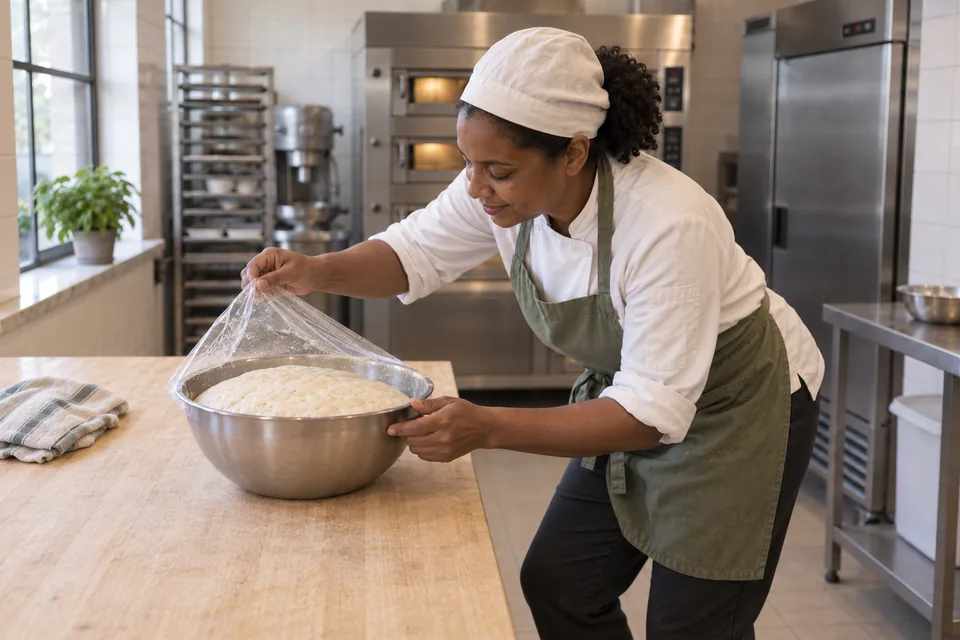
    Take covered dough from refrigerator about 2 hours before baking, allowing it to warm, relax and become gassy.

    Ready when: Soft dough that stretches and holds fingertip dimples.
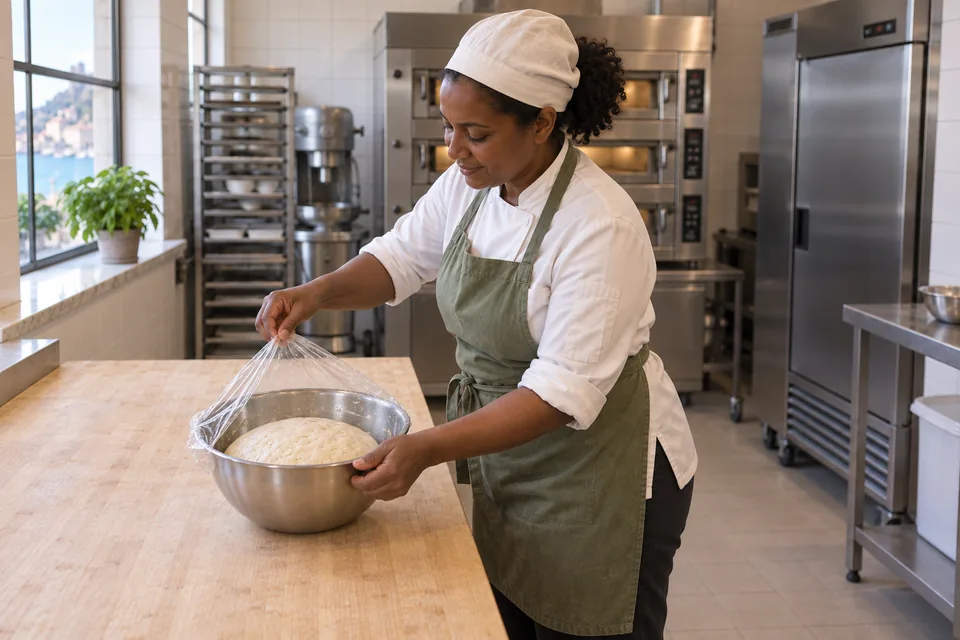
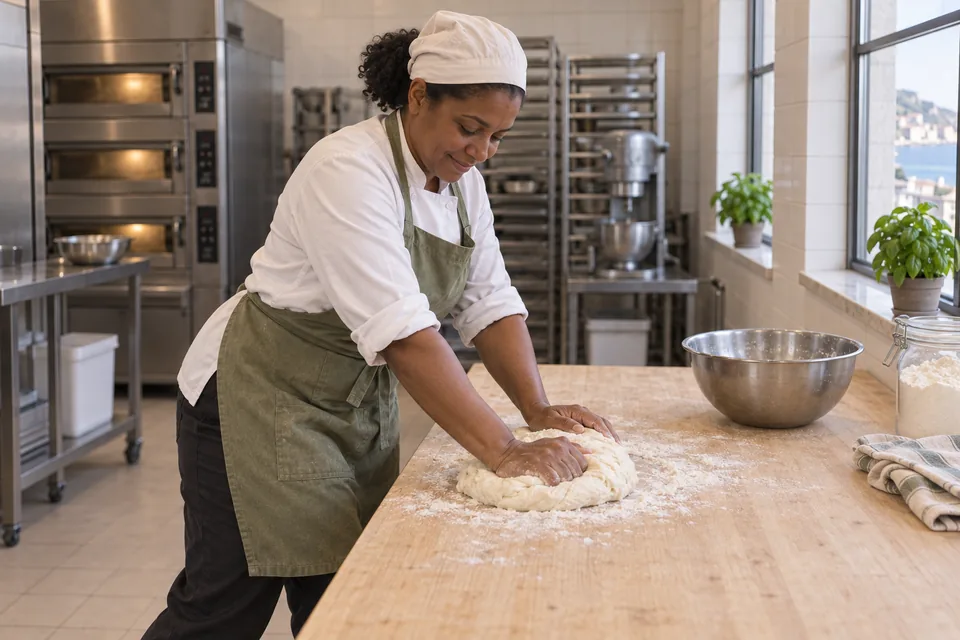
    Baker uncovering one relaxed and gassy dough portion.
    01 Relax doughLet the covered dough warm and become soft, relaxed and gassy.
  2. 02 · Preheat

    Until heated

    Use: Oven and rimmed sheet

    Preheat to 260°C. Prepare the pan as directed below.

    Ready when: Use an oven-safe rimmed sheet.
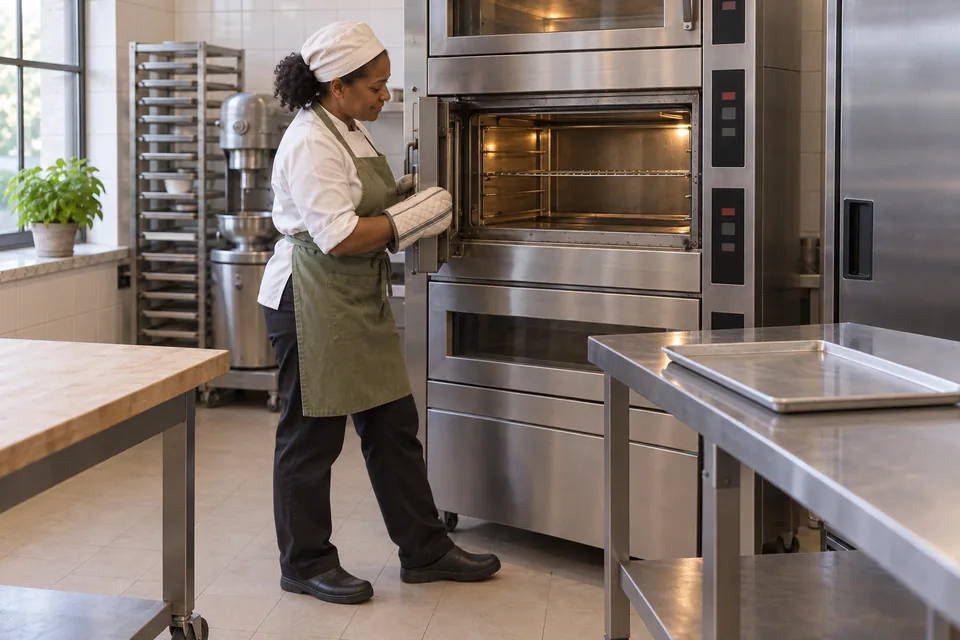
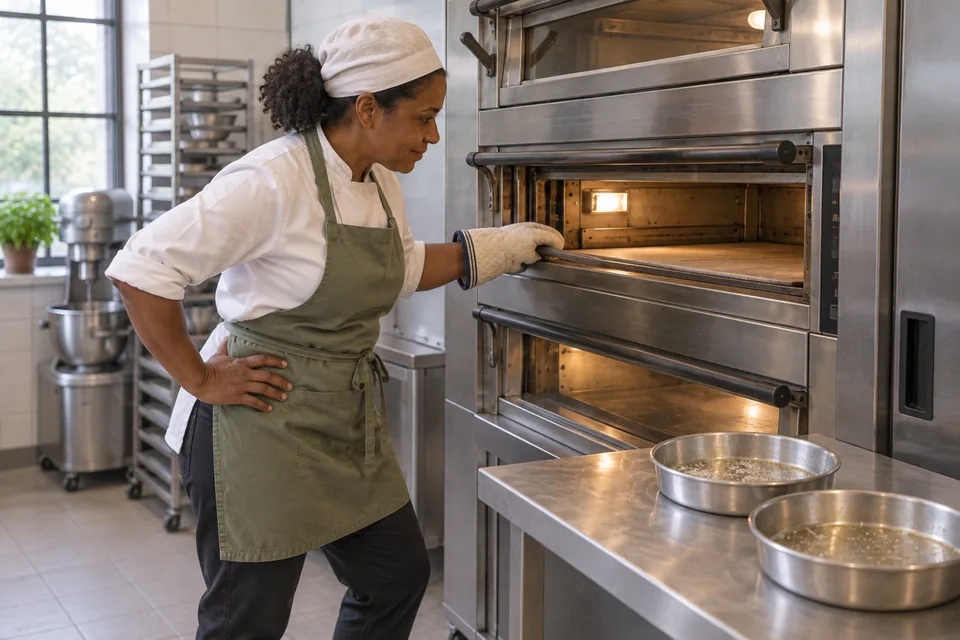
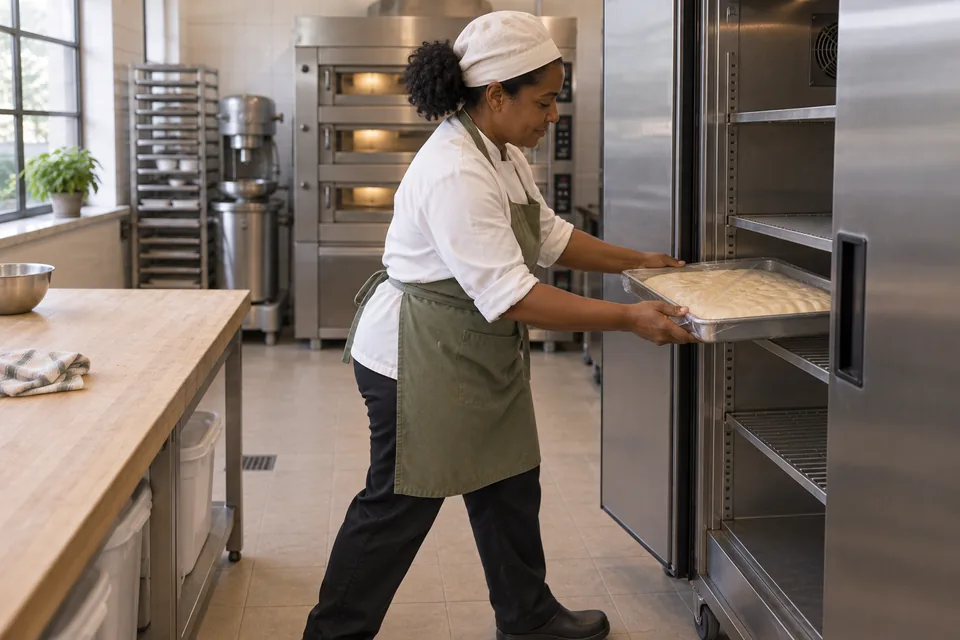
    Baker checking an empty oven with an empty rimmed sheet nearby.
    02 PreheatPreheat the oven and have an oven-safe rimmed sheet ready.
  3. 03 · Stretch + dimple

    A few minutes, plus rests if needed

    Use: Relaxed dough and handling ingredients

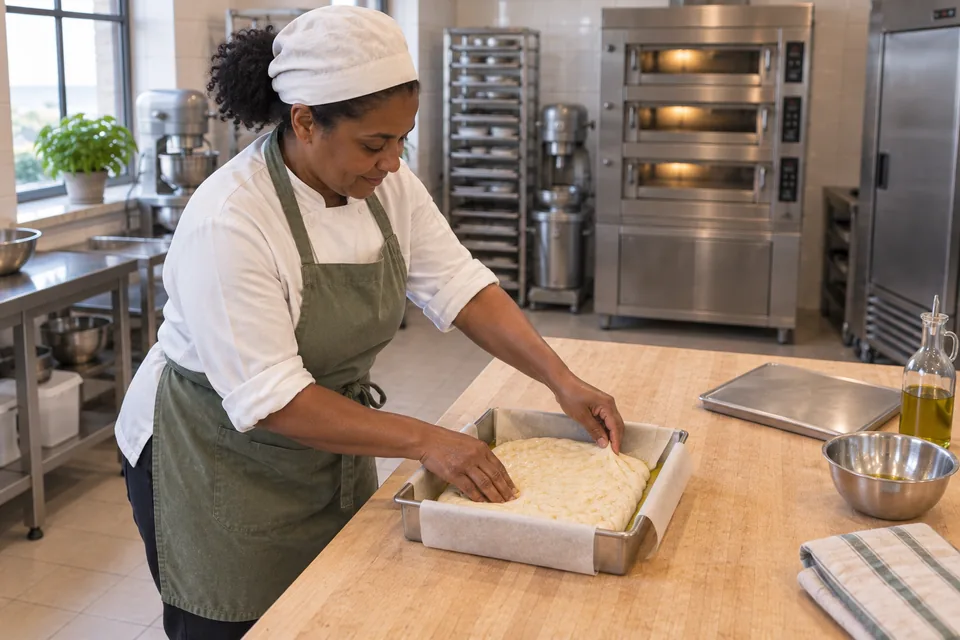
    Very lightly oil only the pan area under dough. Flour both faces of dough, flatten to about half-sheet size, and gently lift/stretch around its rim. Transfer to sheet.

    Ready when: Even dough thickness; dimples remain.
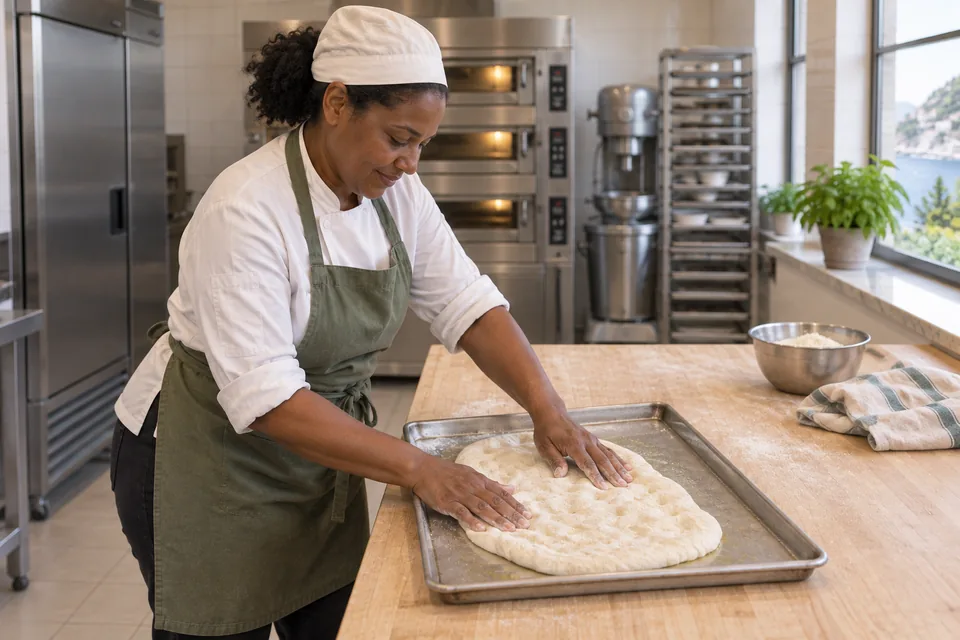
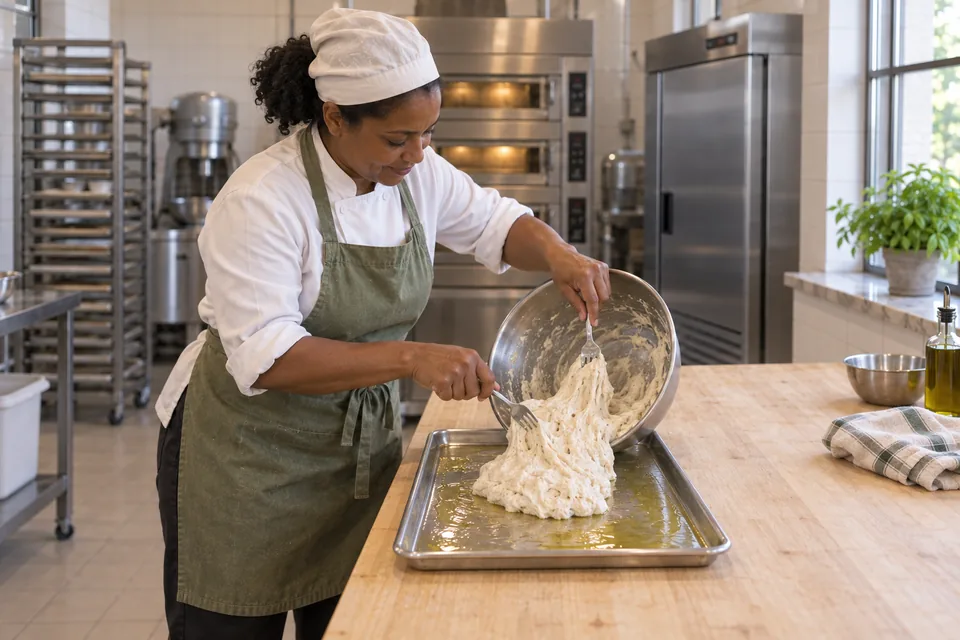
    Baker shaping one oblong dough on a lightly oiled sheet.
    03 Stretch + dimpleStretch an even oblong on a very lightly oiled sheet and leave gentle dimples.
  4. 04 · Top

    Before baking

    Use: Topping ingredients

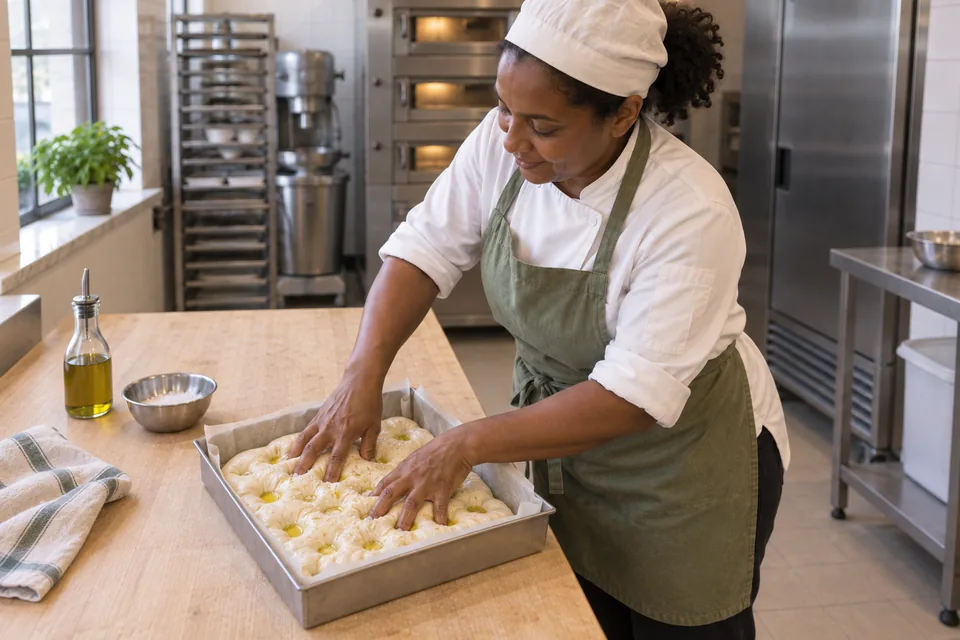
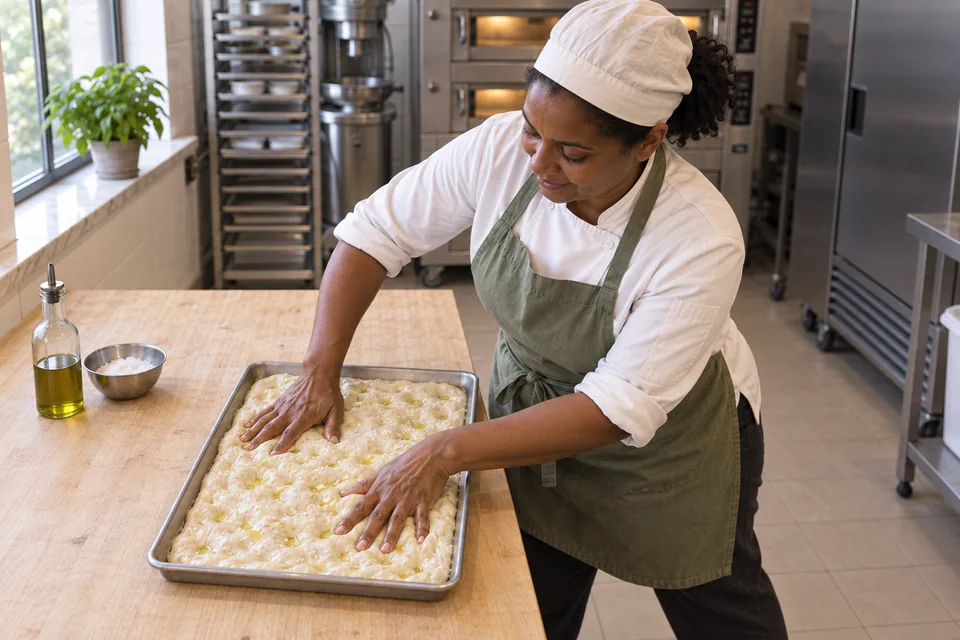
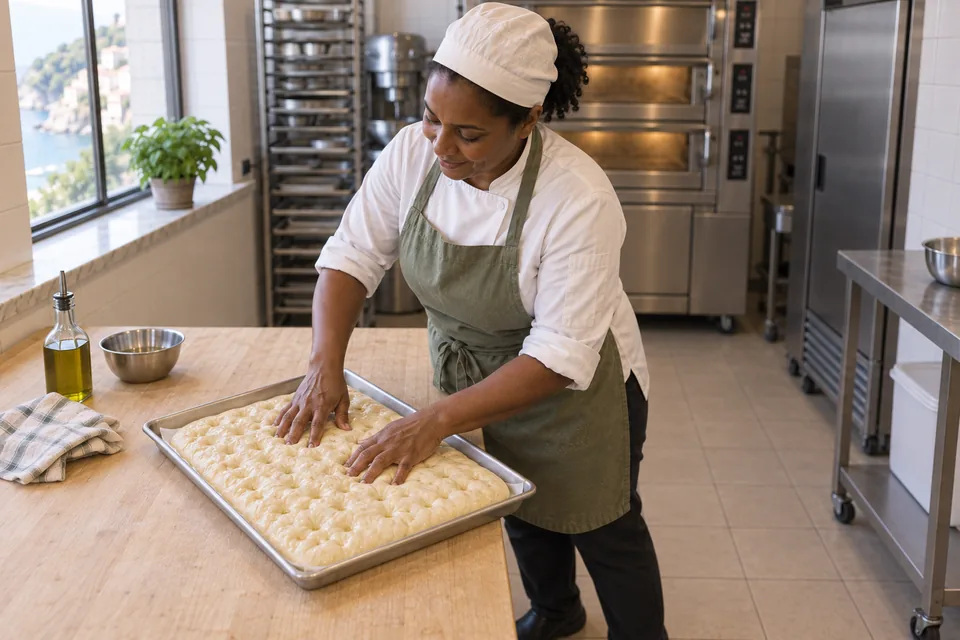
    Pour the measured olive oil over dough. With both hands spread the oil while easing dough outward, then press fingertips down to dimple evenly. If it resists, rest 10 minutes and continue.

    Ready when: Even, moderate topping coverage.
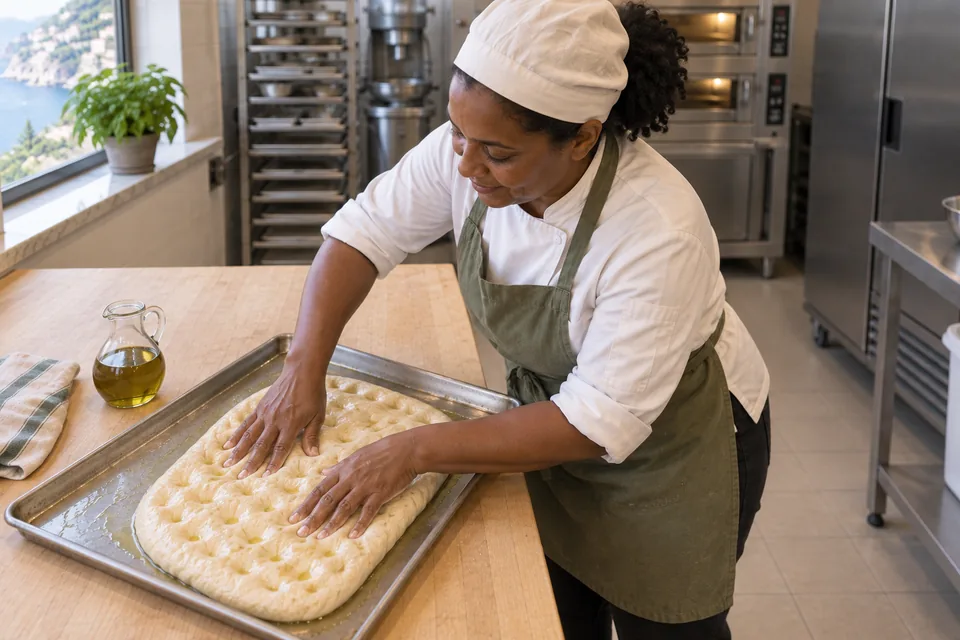
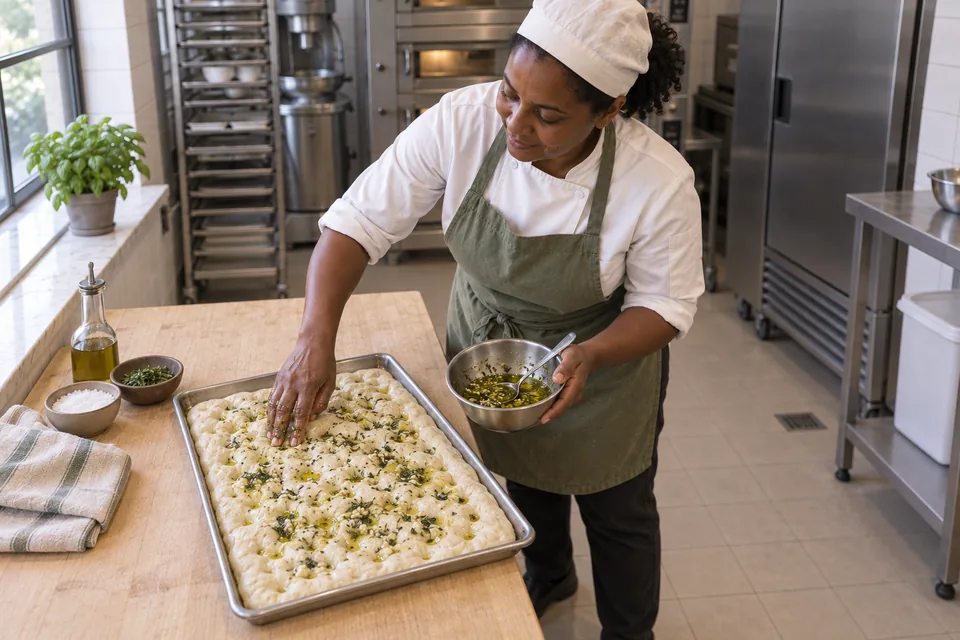
    Olive oil pooling in deep dimples on one plain oblong focaccia dough.
    04 TopSpread the olive oil and press it into deep, even fingertip dimples.
  5. 05 · Bake

    12–15 minutes as a starting range

    Use: Topped focaccia

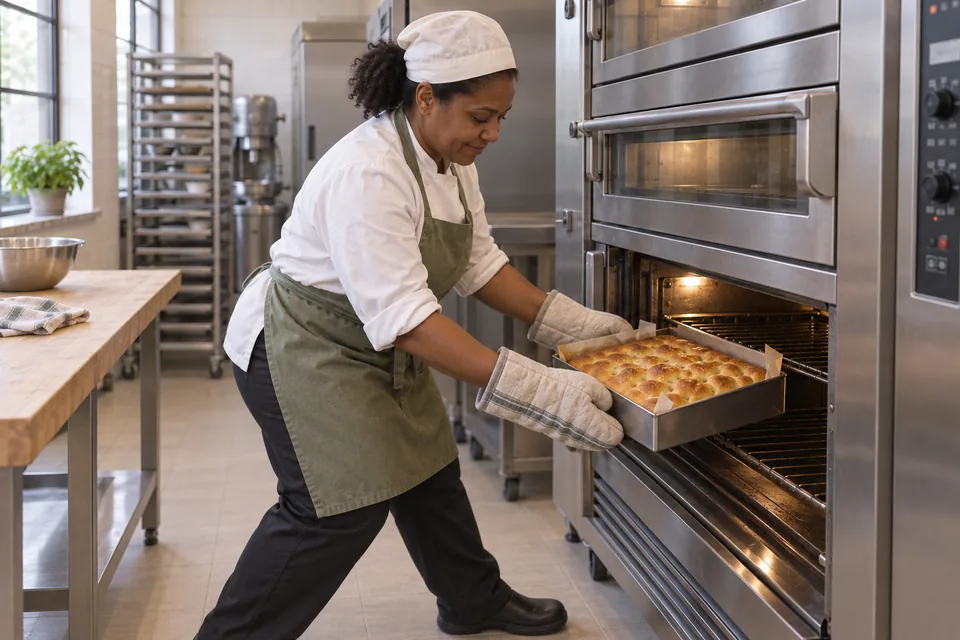
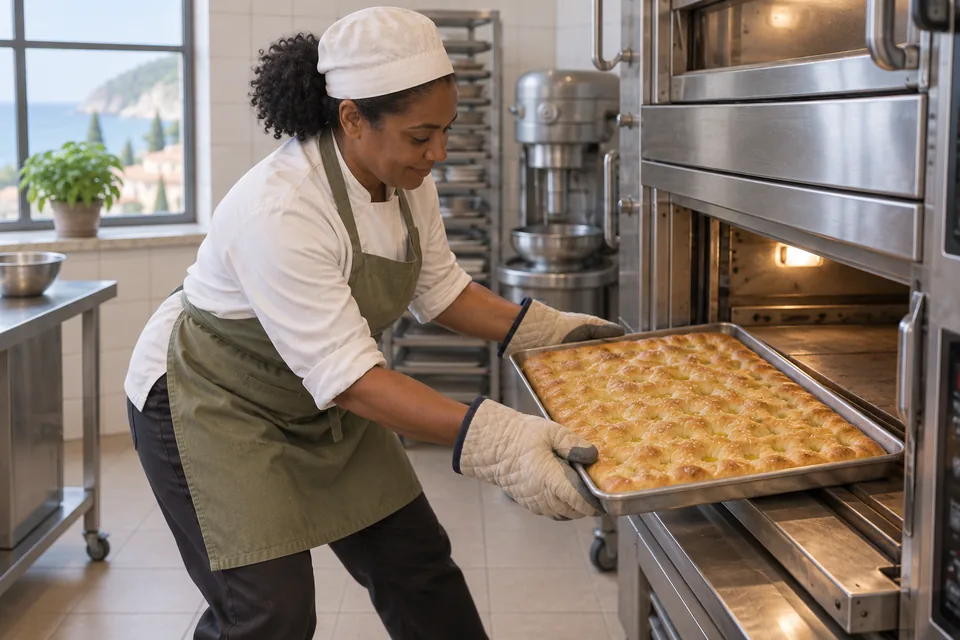
    Bake until golden on top, firm underneath and fully set in the middle. If unsure, cut a small opening in the rim to inspect for raw dough.

    Ready when: No wet raw dough; golden, firm bottom.
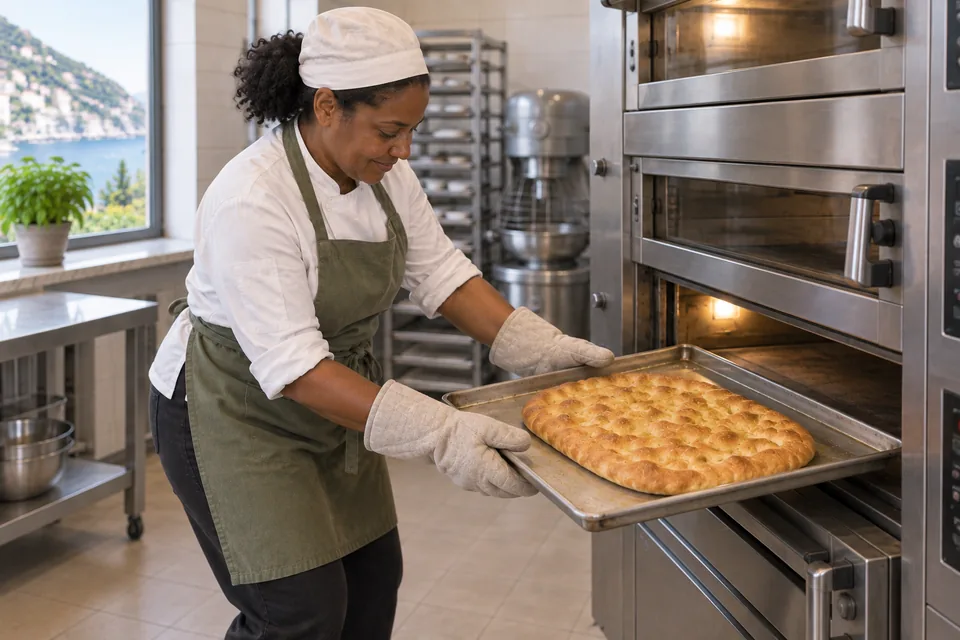
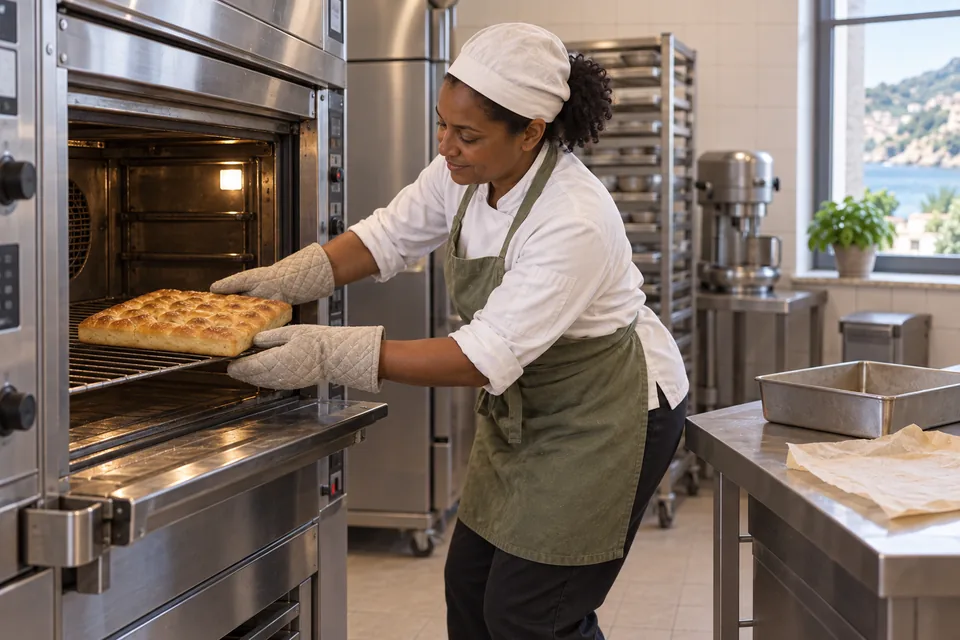
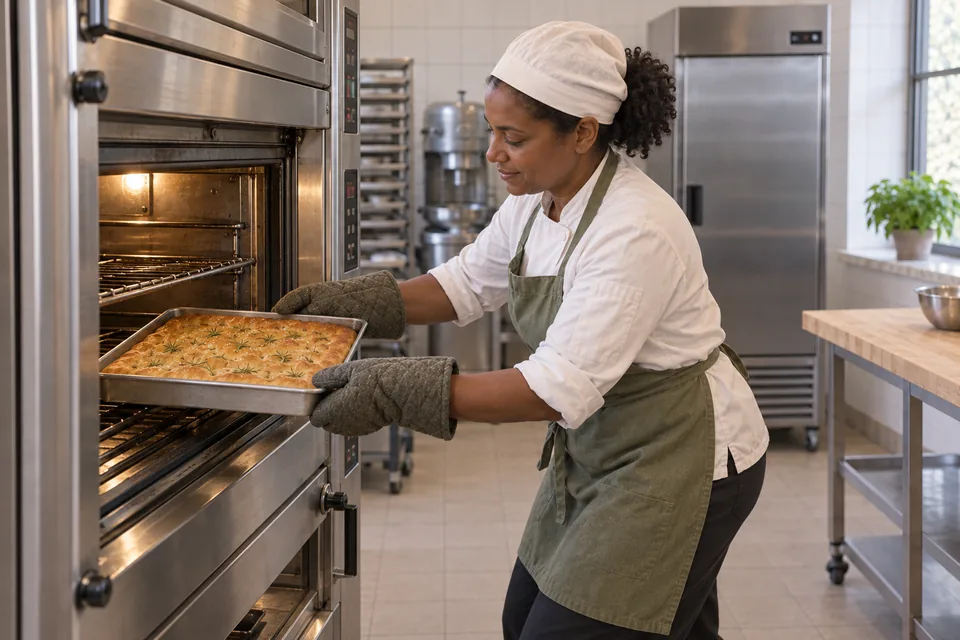
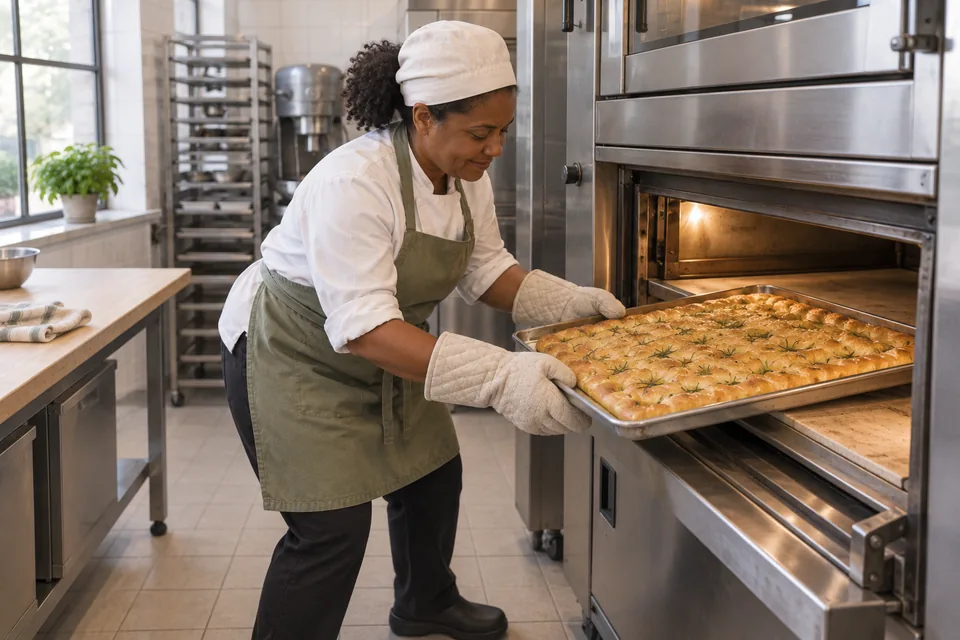
    Baker removing one golden plain oblong focaccia on a silver sheet.
    05 BakeBake until the surface is golden and the underside and centre are set.
  6. 06 · Serve

    While hot or warm

    Use: Baked focaccia

    Sprinkle salt to taste, cut into strips and serve.

    Ready when: Set middle and firm bottom.
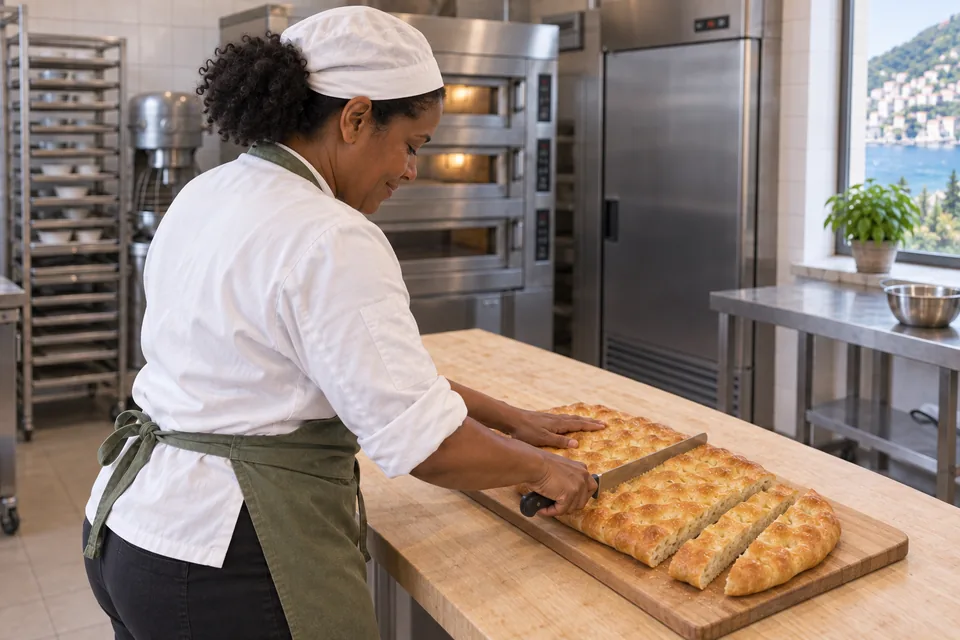
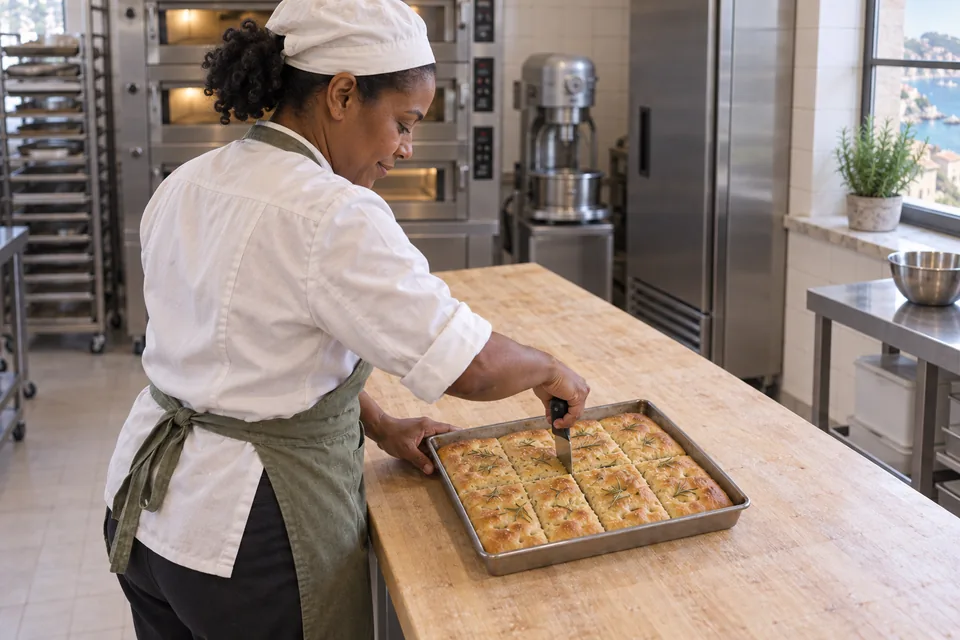
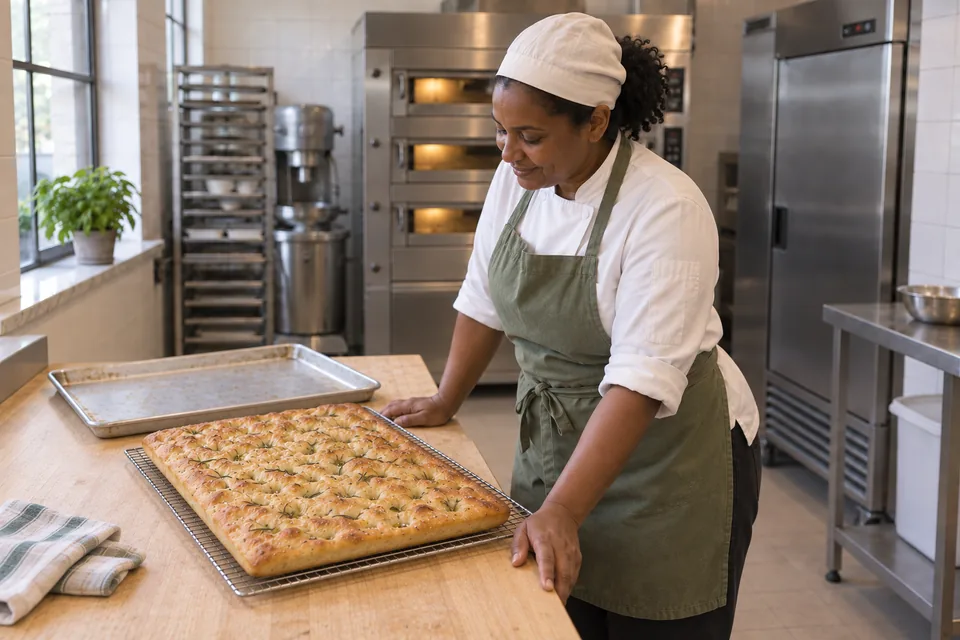
    One plain golden focaccia cut into matching broad strips on a board.
    06 ServeSeason to taste and cut the baked focaccia into broad strips.

What to look for

StageLook and feelNeeds attention
Before toppingDough stretches without snapping back and holds dimples.Forcing resistant dough until it tears.
Bake endpointGolden surface and bottom; middle completely cooked.A browned surface over a wet dough layer.

Troubleshooting

If you seeLikely causeWhat to do nowNext time
Dough will not spreadGluten still tight or dough coldCover and rest 10 minutes, then resume gently.Allow the room-temperature relaxation.
Soggy middleWet/heavy topping or thick doughContinue baking to a set centre; reduce top heat if already dark.Drain toppings and match dough amount to the pan.

Recipe notes

  • Use a 30 × 43 cm sheet and judge the thin-to-medium dough thickness; a freeform piece need not fill every corner. Finished dimensions are approximate. Thicker dough needs longer than 15 minutes: bake until the centre sets.
Show ingredient flow

Recipe

Focaccia Genovese

Start with the prepared dough listed below. The dents you press into the top with your fingertips are called dimples.

Prepare first: Overnight Pizza Dough with Poolish

How do I make it?

  1. Let the dough warm up

    About 2 hours

    Take the covered dough out of the fridge about 2 hours before baking. Keep it covered as it warms and softens.

    Baker uncovering one relaxed and gassy dough portion.
    Let the covered dough warm and become soft, relaxed and gassy.

    Ready when: Soft dough that stretches and holds fingertip dimples.

  2. Heat the oven

    Until heated

    Heat the oven to 260°C and use the rimmed baking sheet described below.

    Baker checking an empty oven with an empty rimmed sheet nearby.
    Preheat the oven and have an oven-safe rimmed sheet ready.

    Ready when: Use an oven-safe rimmed sheet.

  3. Stretch the dough

    A few minutes, plus rests if needed

    Lightly oil only the area of the pan that the dough will cover. Flour both sides of the dough, flatten it to about half-sheet size, then gently lift and stretch around the edges before moving it onto the sheet.

    Baker shaping one oblong dough on a lightly oiled sheet.
    Stretch an even oblong on a very lightly oiled sheet and leave gentle dimples.

    Ready when: Even dough thickness; dimples remain.

  4. Add oil and dents

    Before baking

    Pour the measured olive oil over the dough and spread it with both hands while gently pushing the dough outward. Press your fingertips down evenly across the top; if the dough resists stretching, rest it for 10 minutes and try again.

    Olive oil pooling in deep dimples on one plain oblong focaccia dough.
    Spread the olive oil and press it into deep, even fingertip dimples.

    Ready when: Even, moderate topping coverage.

  5. Bake until cooked through

    12–15 minutes as a starting range

    Bake until the top is golden, the bottom is firm and the middle is fully cooked. If you are unsure, cut a small opening at the edge and check for raw dough.

    Baker removing one golden plain oblong focaccia on a silver sheet.
    Bake until the surface is golden and the underside and centre are set.

    Ready when: No wet raw dough; golden, firm bottom.

  6. Finish and serve

    While hot or warm

    Add salt to taste, cut the focaccia into strips and serve it.

    One plain golden focaccia cut into matching broad strips on a board.
    Season to taste and cut the baked focaccia into broad strips.

    Ready when: Set middle and firm bottom.

What can go wrong, and how can I fix it?

What you noticeLikely causeWhat to do
Dough will not spreadGluten still tight or dough coldCover and rest 10 minutes, then resume gently. Allow the room-temperature relaxation.
Soggy middleWet/heavy topping or thick doughContinue baking to a set centre; reduce top heat if already dark. Drain toppings and match dough amount to the pan.
Useful recipe notes

Use a 30 × 43 cm sheet and judge the thin-to-medium dough thickness; a freeform piece need not fill every corner. Finished dimensions are approximate. Thicker dough needs longer than 15 minutes: bake until the centre sets.

See the detailed method and ratios in , or follow ingredients through the .

Ingredient proportions & recipe details

Focaccia Genovese at a glance

Makes
One 800 g dough focaccia on a 30 × 43 cm sheet; see size note
Heat
260°C
Baking time
12–15 min as a starting range

Pissaladière-style focaccia

Makes
One 800 g dough focaccia on a 30 × 43 cm sheet; see size note
Heat
260°C oven; medium-high then lower heat for onions
Baking time
Focaccia: 12–15 min as a starting range; onions: about 25 min total

Cook onions for 5 min on medium-high, then lower the heat. Preheat oven fully; bake until the centre is cooked.

Focaccia

Pissaladière-style focaccia

Pissaladière-style focaccia.

Prepare first · Overnight Pizza Dough with Poolish

Method

  1. 01 · Relax dough

    About 2 hours

    Use: Prepared dough

    Take covered dough from refrigerator about 2 hours before baking, allowing it to warm, relax and become gassy.

    Ready when: Soft dough that stretches and holds fingertip dimples.

    Baker uncovering one relaxed and gassy dough portion.
    01 Relax doughWarm the covered dough until relaxed enough to stretch without tearing.
  2. 02 · Caramelize onion

    About 25 minutes total

    Use: Onion, butter, some salt

    Cook over medium-high heat, stirring often, 5 minutes. Lower heat and continue, stirring and scraping browned bits, until soft and evenly brown. Set aside.

    Ready when: Soft brown onion; no scorched pieces.

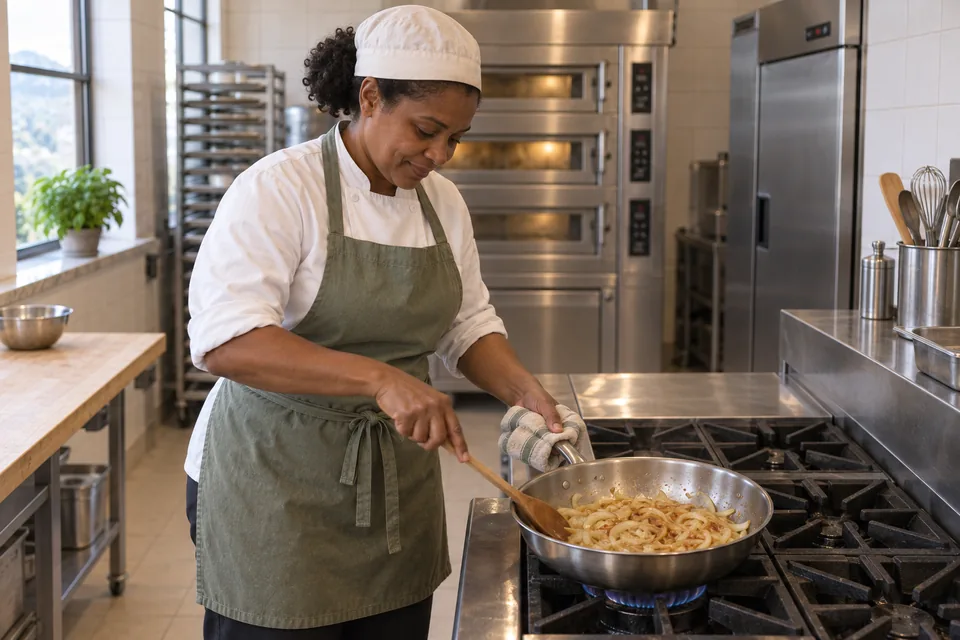
    Baker stirring soft golden onions in a stovetop saute pan.
    02 Caramelize onionStir the onions as they soften and brown; avoid scorched pieces.
  3. 03 · Preheat

    Until heated

    Use: Oven and rimmed sheet

    Preheat to 260°C. Prepare the pan as directed below.

    Ready when: Use an oven-safe rimmed sheet.

    Baker checking an empty oven with an empty rimmed sheet nearby.
    03 PreheatPreheat the oven while preparing the rimmed sheet.
  4. 04 · Stretch + dimple

    A few minutes, plus rests if needed

    Use: Relaxed dough and handling ingredients

    Flour dough on both faces. Flatten with fist and fingers and stretch to medium-thin. Very lightly coat the pan and one face of the dough with the 9.9 mL olive oil; put oiled face down and dimple.

    Ready when: Even dough thickness; dimples remain.

    Baker shaping one oblong dough on a lightly oiled sheet.
    04 Stretch + dimpleStretch the lightly floured dough evenly and dimple it on the oiled sheet.
  5. 05 · Top

    Before baking

    Use: Topping ingredients

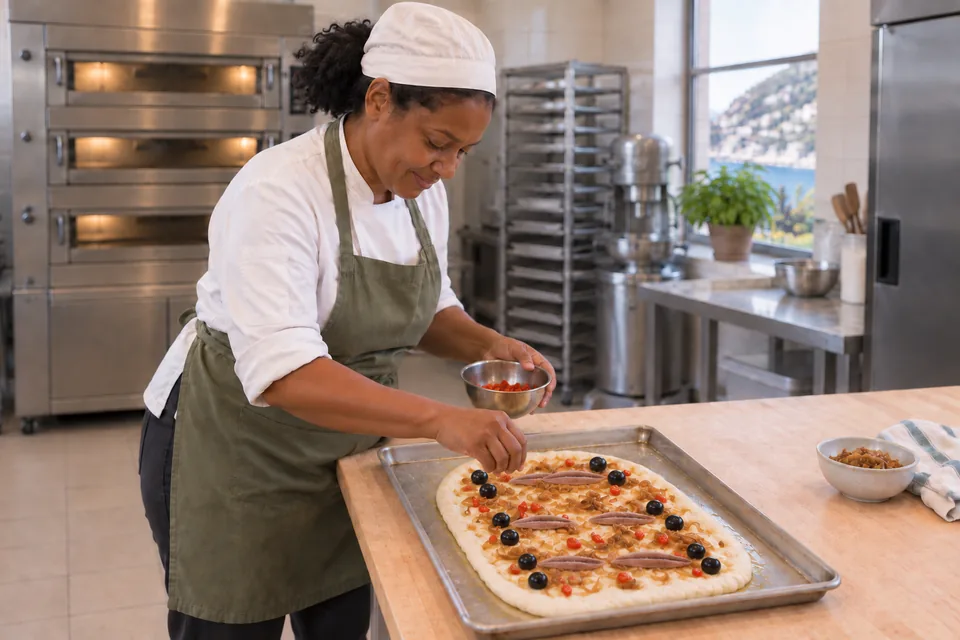
    Distribute caramelized onions, olives, anchovies and chopped red chiles without overloading.

    Ready when: Even, moderate topping coverage.

    Baker adding chile to raw focaccia topped with onions, black olives and anchovies.
    05 TopSpread onions, olives, anchovies and chile in a moderate, even layer.
  6. 06 · Bake

    12–15 minutes as a starting range

    Use: Topped focaccia

    Bake until golden on top, firm underneath and fully set in the middle. If unsure, cut a small opening in the rim to inspect for raw dough.

    Ready when: No wet raw dough; golden, firm bottom.

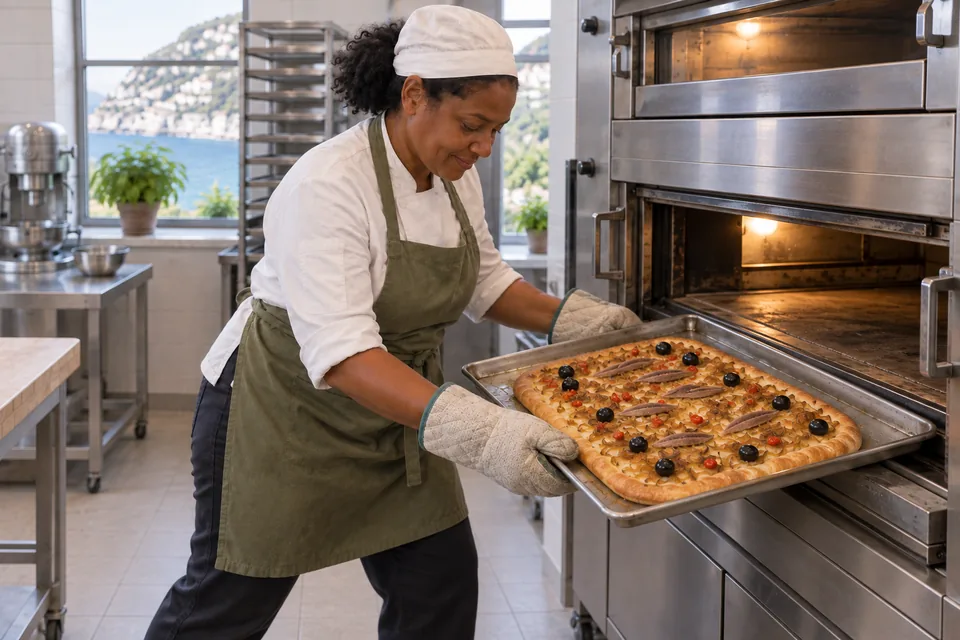
    One golden onion, olive and anchovy focaccia coming from the oven.
    06 BakeBake the topped focaccia until its edges and underside are golden and firm.
  7. 07 · Serve

    While hot or warm

    Use: Baked focaccia

    Cut into strips and serve.

    Ready when: Set middle and firm bottom.

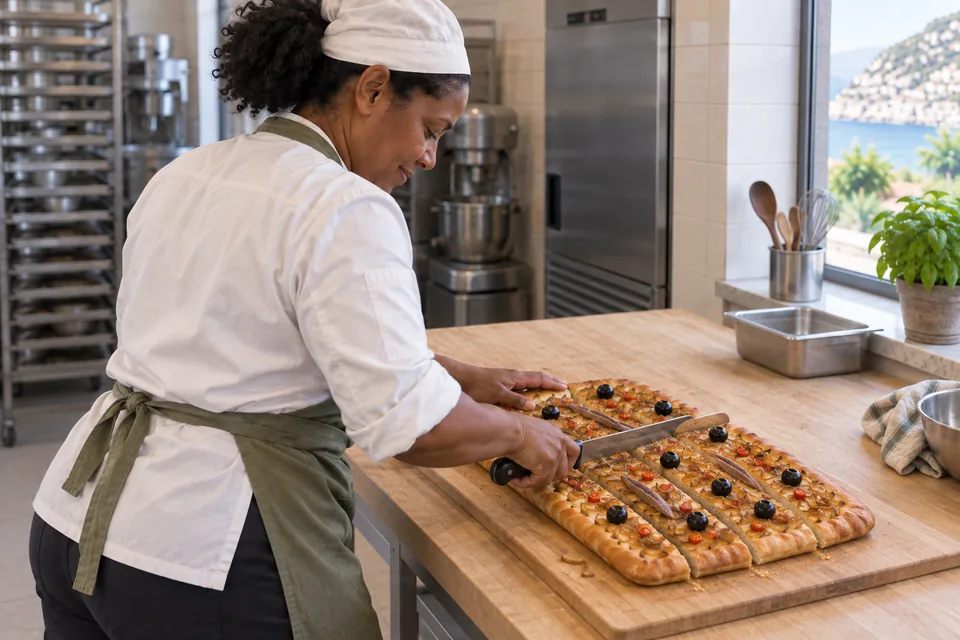
    Baker slicing one onion, olive and anchovy focaccia into broad strips.
    07 ServeCut the set onion focaccia into strips, keeping the toppings with each piece.

What to look for

StageLook and feelNeeds attention
Before toppingDough stretches without snapping back and holds dimples.Forcing resistant dough until it tears.
Bake endpointGolden surface and bottom; middle completely cooked.A browned surface over a wet dough layer.

Troubleshooting

If you seeLikely causeWhat to do nowNext time
Dough will not spreadGluten still tight or dough coldCover and rest 10 minutes, then resume gently.Allow the room-temperature relaxation.
Soggy middleWet/heavy topping or thick doughContinue baking to a set centre; reduce top heat if already dark.Drain toppings and match dough amount to the pan.

Recipe notes

  • Use a 30 × 43 cm sheet and judge the thin-to-medium dough thickness; a freeform piece need not fill every corner. Finished dimensions are approximate. Thicker dough needs longer than 15 minutes: bake until the centre sets.
Show ingredient flow

Recipe

Pissaladière-style focaccia

Start with the prepared dough listed below. The dents you press into the top with your fingertips are called dimples.

Prepare first: Overnight Pizza Dough with Poolish

How do I make it?

  1. Let the dough warm up

    About 2 hours

    Take the covered dough out of the fridge about 2 hours before baking. Keep it covered as it warms and softens.

    Baker uncovering one relaxed and gassy dough portion.
    Warm the covered dough until relaxed enough to stretch without tearing.

    Ready when: Soft dough that stretches and holds fingertip dimples.

  2. Brown the onion

    About 25 minutes total

    Cook the onion, butter and some salt over medium-high heat for 5 minutes, stirring often. Lower the heat and keep stirring and scraping up the browned bits until the onion is soft and evenly brown, then set aside.

    Baker stirring soft golden onions in a stovetop saute pan.
    Stir the onions as they soften and brown; avoid scorched pieces.

    Ready when: Soft brown onion; no scorched pieces.

  3. Heat the oven

    Until heated

    Heat the oven to 260°C and use the rimmed baking sheet described below.

    Baker checking an empty oven with an empty rimmed sheet nearby.
    Preheat the oven while preparing the rimmed sheet.

    Ready when: Use an oven-safe rimmed sheet.

  4. Stretch the dough

    A few minutes, plus rests if needed

    Flour both sides of the dough, press it flat with your fist and fingers, then stretch it until medium-thin. Use the 9.9 mL olive oil to lightly coat the pan and one side of the dough; put that side down and press dents into the top with your fingertips.

    Baker shaping one oblong dough on a lightly oiled sheet.
    Stretch the lightly floured dough evenly and dimple it on the oiled sheet.

    Ready when: Even dough thickness; dimples remain.

  5. Add the toppings

    Before baking

    Spread the browned onions, olives, anchovies and chopped red chiles over the dough without piling them too thickly.

    Baker adding chile to raw focaccia topped with onions, black olives and anchovies.
    Spread onions, olives, anchovies and chile in a moderate, even layer.

    Ready when: Even, moderate topping coverage.

  6. Bake until cooked through

    12–15 minutes as a starting range

    Bake until the top is golden, the bottom is firm and the middle is fully cooked. If you are unsure, cut a small opening at the edge and check for raw dough.

    One golden onion, olive and anchovy focaccia coming from the oven.
    Bake the topped focaccia until its edges and underside are golden and firm.

    Ready when: No wet raw dough; golden, firm bottom.

  7. Cut and serve

    While hot or warm

    Slice the focaccia into strips and serve it.

    Baker slicing one onion, olive and anchovy focaccia into broad strips.
    Cut the set onion focaccia into strips, keeping the toppings with each piece.

    Ready when: Set middle and firm bottom.

What can go wrong, and how can I fix it?

What you noticeLikely causeWhat to do
Dough will not spreadGluten still tight or dough coldCover and rest 10 minutes, then resume gently. Allow the room-temperature relaxation.
Soggy middleWet/heavy topping or thick doughContinue baking to a set centre; reduce top heat if already dark. Drain toppings and match dough amount to the pan.
Useful recipe notes

Use a 30 × 43 cm sheet and judge the thin-to-medium dough thickness; a freeform piece need not fill every corner. Finished dimensions are approximate. Thicker dough needs longer than 15 minutes: bake until the centre sets.
See the detailed method and ratios in , or follow ingredients through the .

Ingredient proportions & recipe details

Pissaladière-style focaccia at a glance

Makes
One 800 g dough focaccia on a 30 × 43 cm sheet; see size note
Heat
260°C oven; medium-high then lower heat for onions
Baking time
Focaccia: 12–15 min as a starting range; onions: about 25 min total

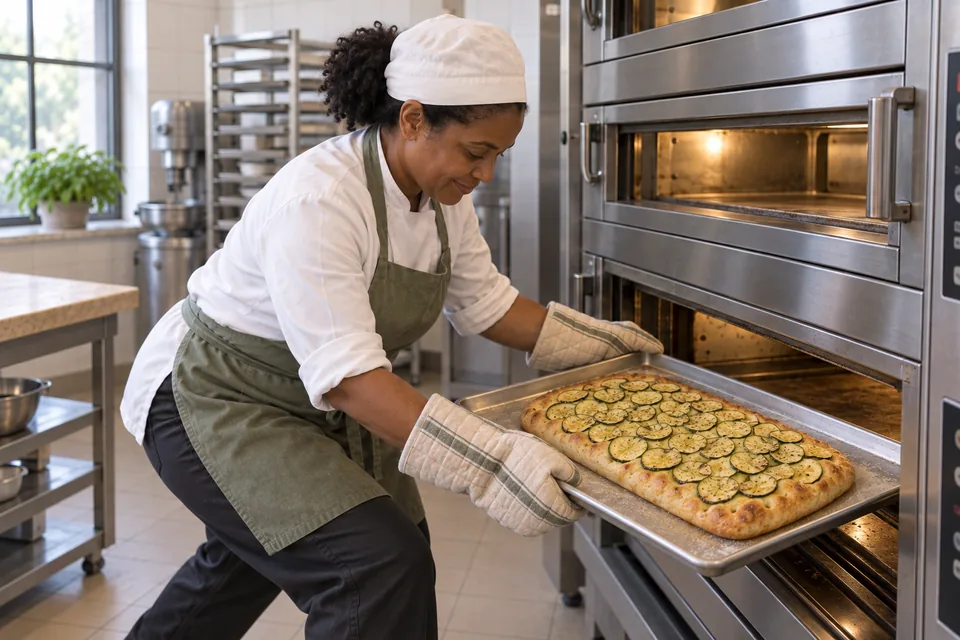
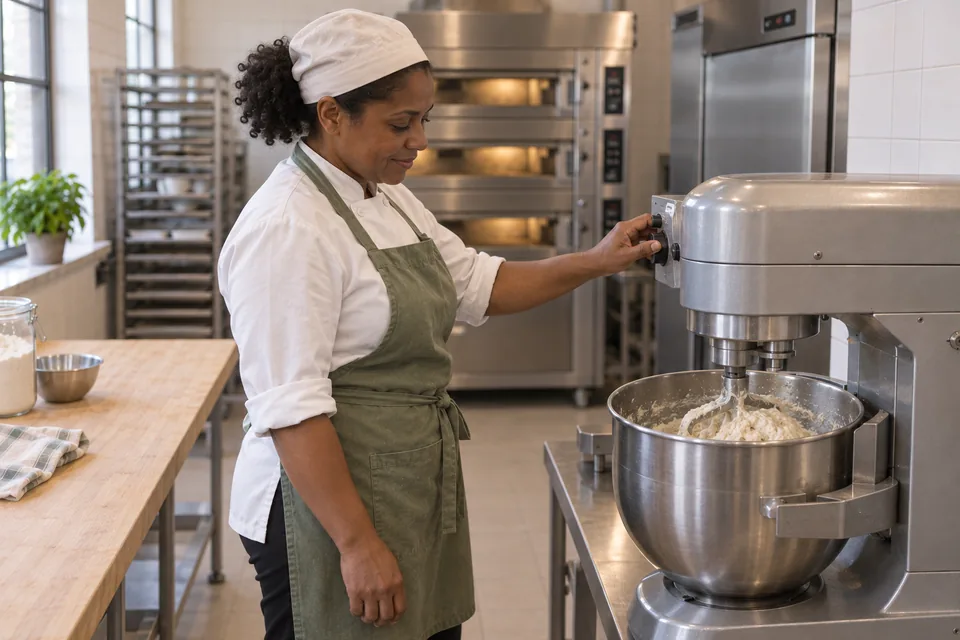
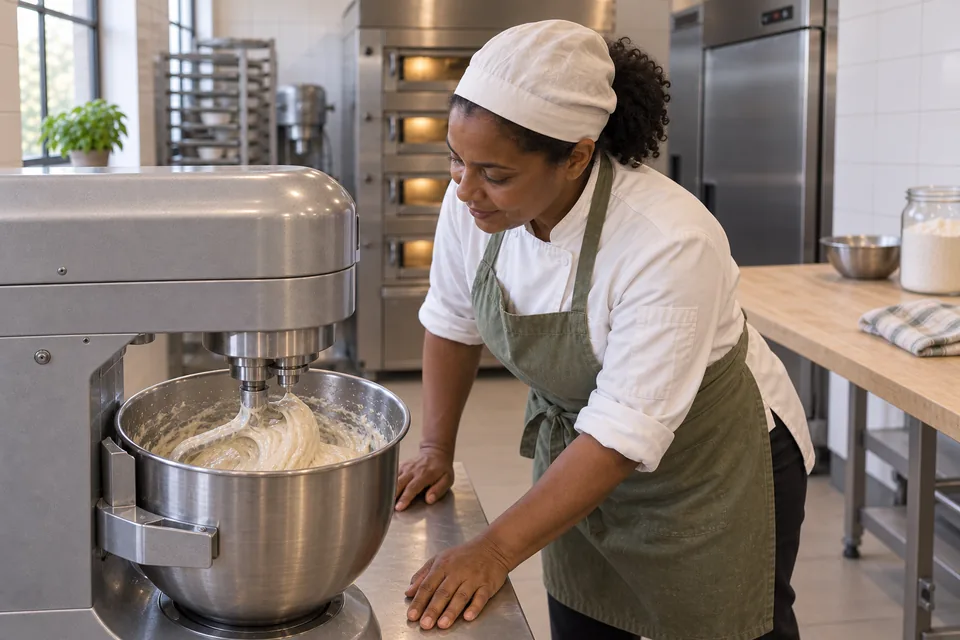
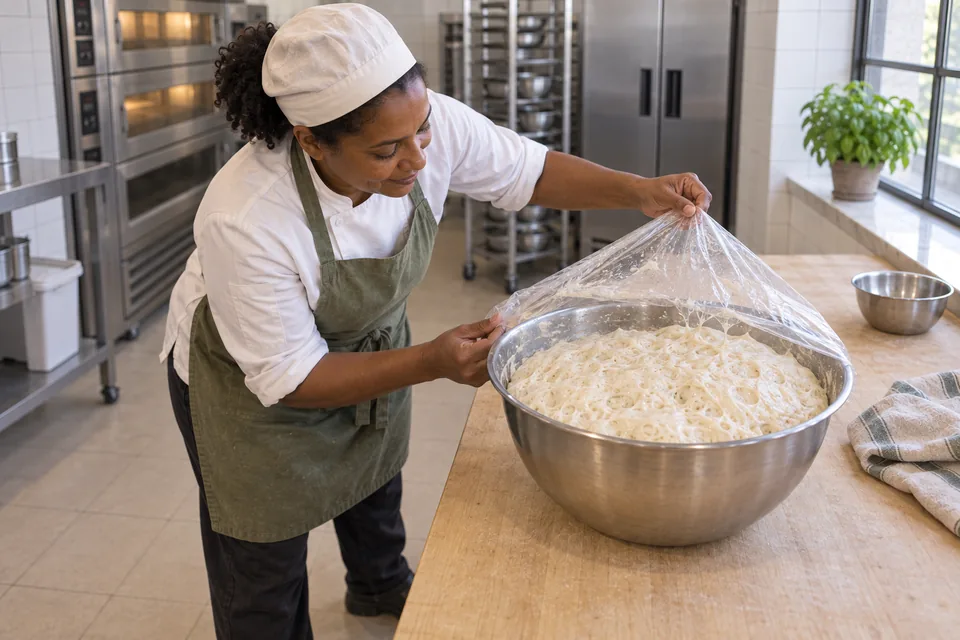
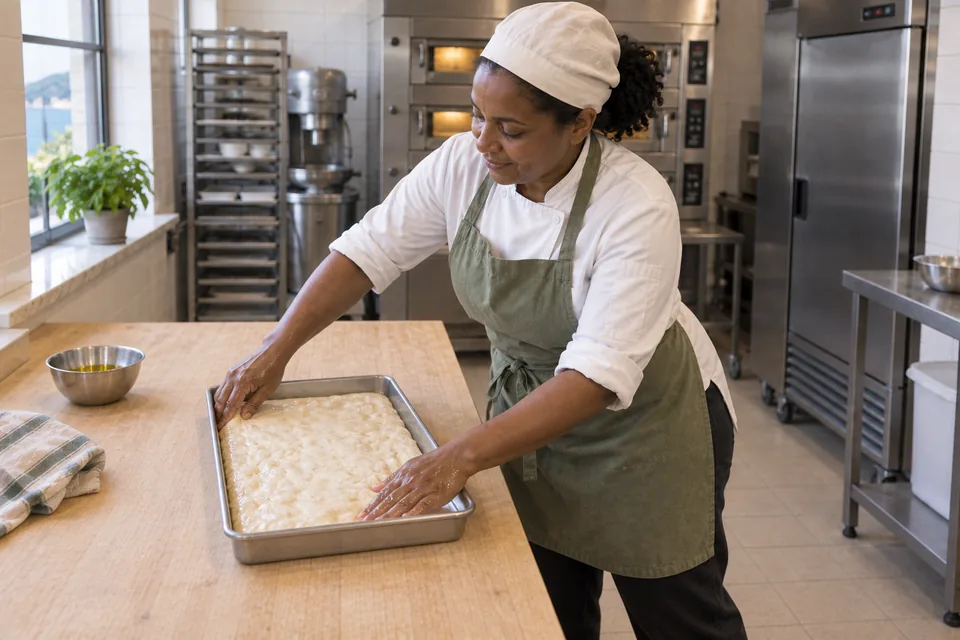
Zucchini Focaccia

Makes
One 800 g dough focaccia on a 30 × 43 cm sheet; see size note
Heat
260°C
Baking time
12–15 min as a starting range

Preheat fully; finish when golden with a firm bottom and fully cooked centre.

Focaccia

Zucchini Focaccia

Zucchini Focaccia.

Prepare first · Overnight Pizza Dough with Poolish

Method

  1. 01 · Relax dough

    About 2 hours

    Use: Prepared dough

    Take covered dough from refrigerator about 2 hours before baking, allowing it to warm, relax and become gassy.

    Ready when: Soft dough that stretches and holds fingertip dimples.

    Baker uncovering one relaxed and gassy dough portion.
    01 Relax doughAllow the covered dough to warm, relax and become gassy.
  2. 02 · Preheat

    Until heated

    Use: Oven and rimmed sheet

    Preheat to 260°C. Prepare the pan as directed below.

    Ready when: Use an oven-safe rimmed sheet.

    Baker checking an empty oven with an empty rimmed sheet nearby.
    02 PreheatHeat the oven and prepare the rimmed sheet before shaping.
  3. 03 · Stretch + dimple

    A few minutes, plus rests if needed

    Use: Relaxed dough and handling ingredients

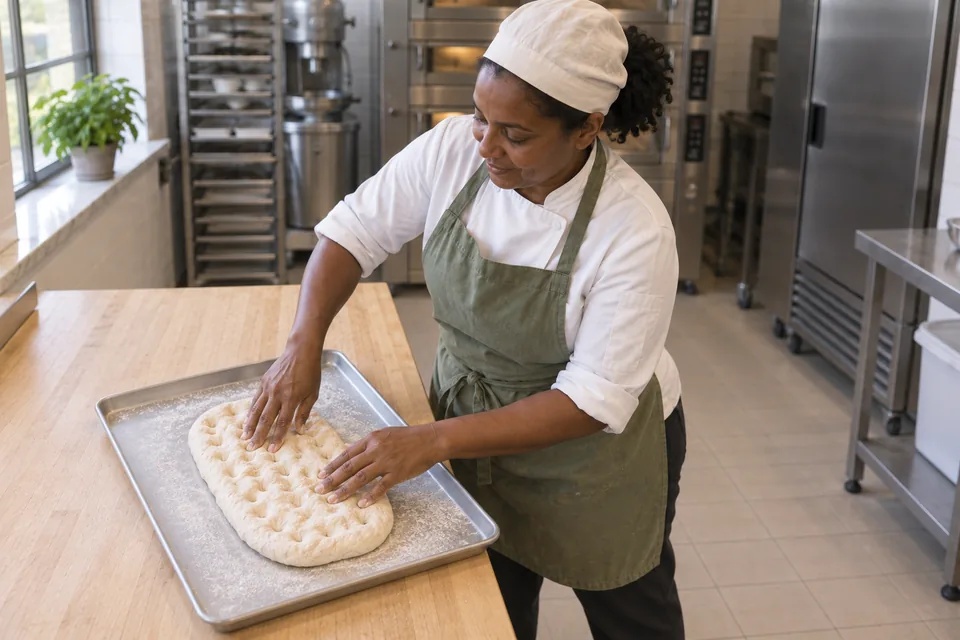
    Use an unoiled baking sheet as the recipe collection recommends. Flour both faces of dough, flatten and stretch to a freeform oblong, then transfer and refine the shape with floured hands. Press gentle fingertip dimples into the dough.

    Ready when: Even dough thickness, without tears; gentle dimples remain.

    Baker dimpling an oblong raw dough on a dry flour-dusted sheet.
    03 Stretch + dimpleStretch a lightly floured oblong on the unoiled sheet, keeping its surface intact.
  4. 04 · Top

    Before baking

    Use: Topping ingredients

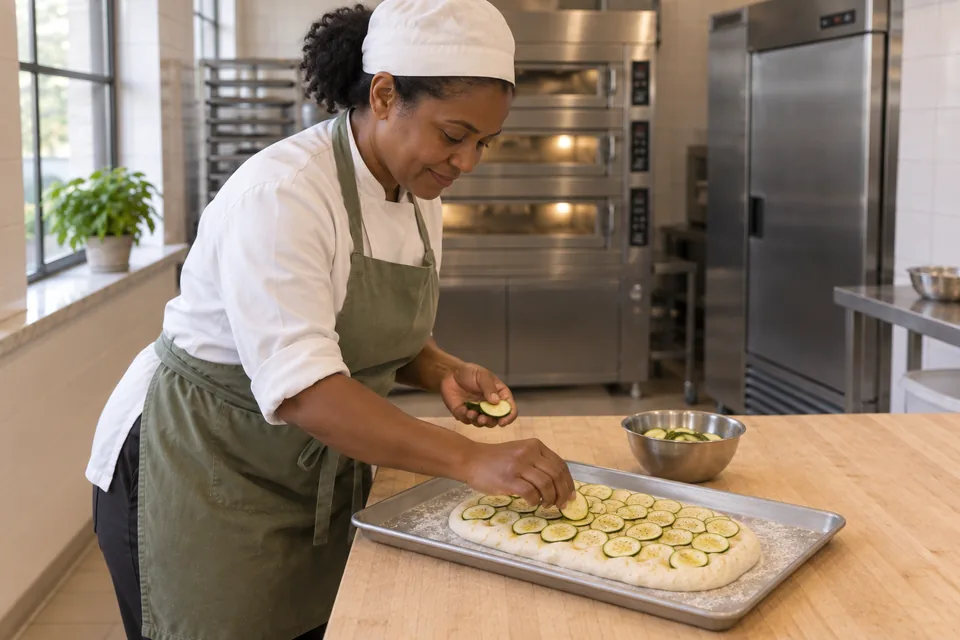
    Toss zucchini with 14.8 mL oil and a little salt. Spread the remaining 14.8 mL oil over dough, arrange overlapping zucchini slices, and season with black pepper.

    Ready when: Even, moderate topping coverage.

    Thin overlapping zucchini rounds arranged on an oblong raw focaccia.
    04 TopOverlap the thin zucchini slices on the oiled dough and season with pepper.
  5. 05 · Bake

    12–15 minutes as a starting range

    Use: Topped focaccia

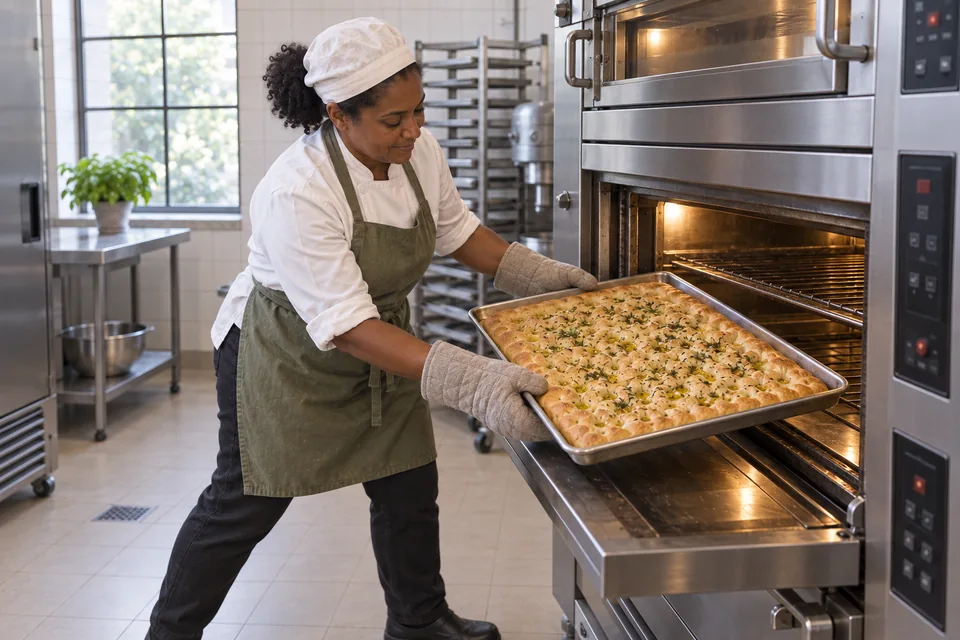
    Bake until golden on top, firm underneath and fully set in the middle. If unsure, cut a small opening in the rim to inspect for raw dough.

    Ready when: No wet raw dough; golden, firm bottom.

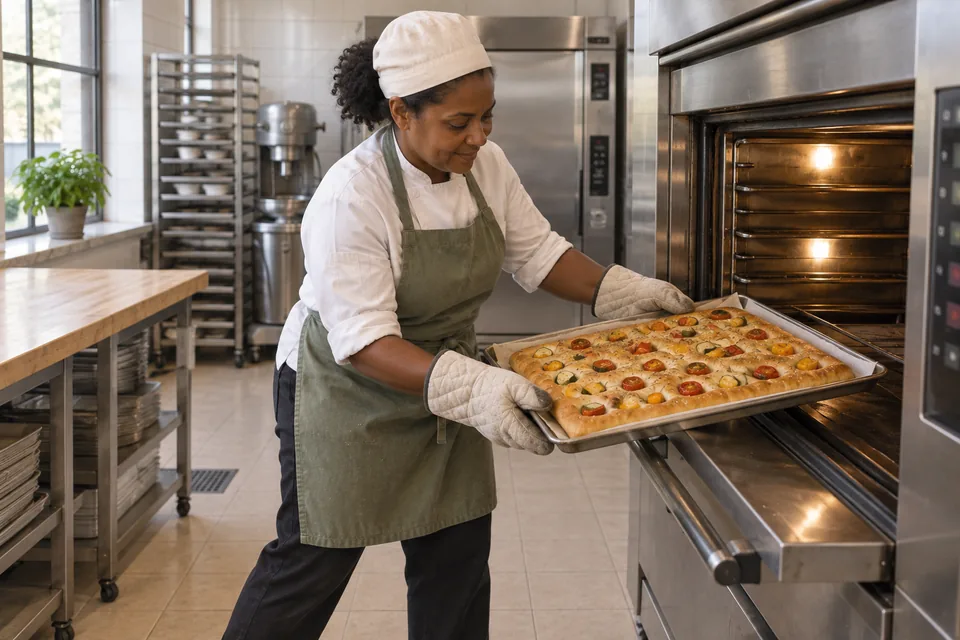
    Baker removing golden focaccia covered with thin softened zucchini rounds.
    05 BakeLook for softened zucchini and a golden crust with a fully set centre.
  6. 06 · Serve

    While hot or warm

    Use: Baked focaccia

    Cut into strips and serve with optional chile flakes.

    Ready when: Set middle and firm bottom.

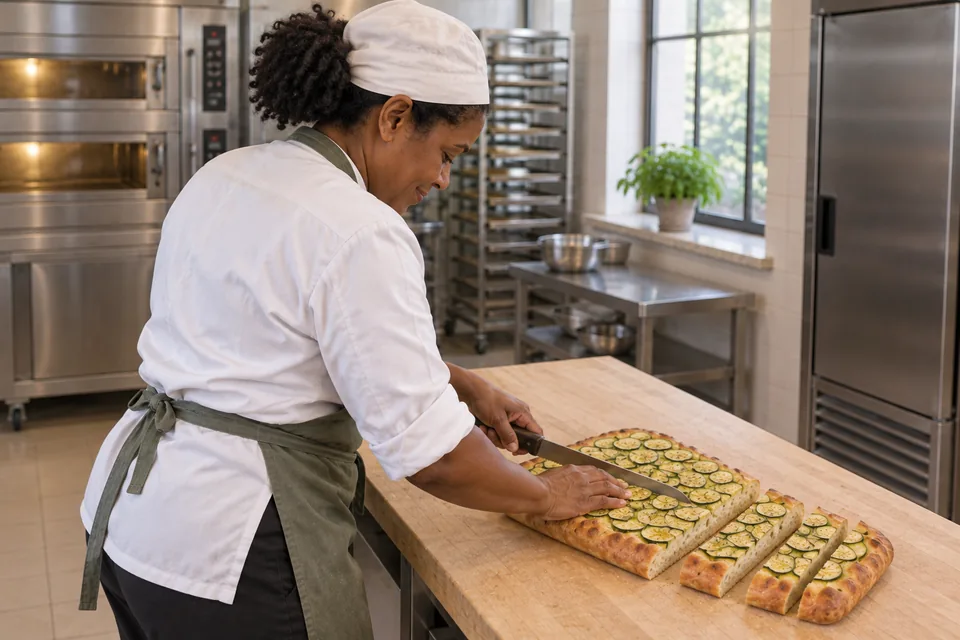
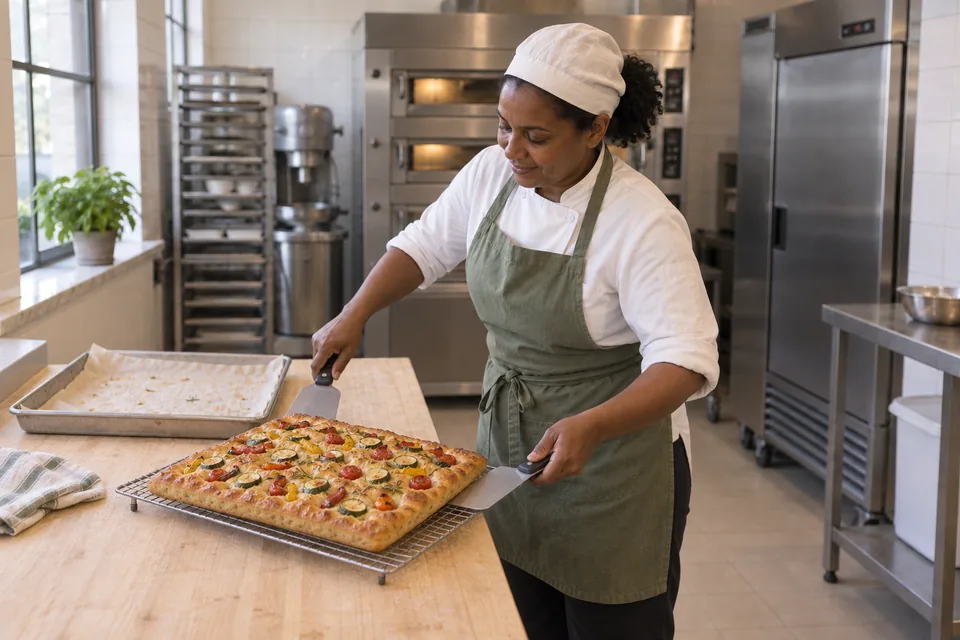
    One baked zucchini focaccia sliced into adjacent matching strips.
    06 ServeSlice into broad strips once the middle is set; add optional chile at serving.

What to look for

StageLook and feelNeeds attention
Before toppingDough stretches without snapping back and holds dimples.Forcing resistant dough until it tears.
Bake endpointGolden surface and bottom; middle completely cooked.A browned surface over a wet dough layer.

Troubleshooting

If you seeLikely causeWhat to do nowNext time
Dough will not spreadGluten still tight or dough coldCover and rest 10 minutes, then resume gently.Allow the room-temperature relaxation.
Soggy middleWet/heavy topping or thick doughContinue baking to a set centre; reduce top heat if already dark.Drain toppings and match dough amount to the pan.

Recipe notes

  • Use a 30 × 43 cm sheet and judge the thin-to-medium dough thickness; a freeform piece need not fill every corner. Finished dimensions are approximate. Thicker dough needs longer than 15 minutes: bake until the centre sets.
Show ingredient flow

Recipe

Zucchini Focaccia

Start with the prepared dough listed below. The dents you press into the top with your fingertips are called dimples.

Prepare first: Overnight Pizza Dough with Poolish

How do I make it?

  1. Let the dough warm up

    About 2 hours

    Take the covered dough out of the fridge about 2 hours before baking. Keep it covered as it warms and softens.

    Baker uncovering one relaxed and gassy dough portion.
    Allow the covered dough to warm, relax and become gassy.

    Ready when: Soft dough that stretches and holds fingertip dimples.

  2. Heat the oven

    Until heated

    Heat the oven to 260°C and use the rimmed baking sheet described below.

    Baker checking an empty oven with an empty rimmed sheet nearby.
    Heat the oven and prepare the rimmed sheet before shaping.

    Ready when: Use an oven-safe rimmed sheet.

  3. Stretch the dough

    A few minutes, plus rests if needed

    Keep the baking sheet unoiled. Flour both sides of the dough, flatten it and stretch it into a loose oblong, then move it to the sheet and adjust the shape with floured hands. Gently press your fingertips into the top to make shallow dents.

    Baker dimpling an oblong raw dough on a dry flour-dusted sheet.
    Stretch a lightly floured oblong on the unoiled sheet, keeping its surface intact.

    Ready when: Even dough thickness, without tears; gentle dimples remain.

  4. Add the zucchini

    Before baking

    Toss the zucchini with 14.8 mL oil and a little salt. Spread the other 14.8 mL oil over the dough, arrange the zucchini slices so they overlap and add black pepper.

    Thin overlapping zucchini rounds arranged on an oblong raw focaccia.
    Overlap the thin zucchini slices on the oiled dough and season with pepper.

    Ready when: Even, moderate topping coverage.

  5. Bake until cooked through

    12–15 minutes as a starting range

    Bake until the top is golden, the bottom is firm and the middle is fully cooked. If you are unsure, cut a small opening at the edge and check for raw dough.

    Baker removing golden focaccia covered with thin softened zucchini rounds.
    Look for softened zucchini and a golden crust with a fully set centre.

    Ready when: No wet raw dough; golden, firm bottom.

  6. Cut and serve

    While hot or warm

    Cut the focaccia into strips and offer chile flakes if you like.

    One baked zucchini focaccia sliced into adjacent matching strips.
    Slice into broad strips once the middle is set; add optional chile at serving.

    Ready when: Set middle and firm bottom.

What can go wrong, and how can I fix it?

What you noticeLikely causeWhat to do
Dough will not spreadGluten still tight or dough coldCover and rest 10 minutes, then resume gently. Allow the room-temperature relaxation.
Soggy middleWet/heavy topping or thick doughContinue baking to a set centre; reduce top heat if already dark. Drain toppings and match dough amount to the pan.
Useful recipe notes

Use a 30 × 43 cm sheet and judge the thin-to-medium dough thickness; a freeform piece need not fill every corner. Finished dimensions are approximate. Thicker dough needs longer than 15 minutes: bake until the centre sets.
See the detailed method and ratios in , or follow ingredients through the .

Ingredient proportions & recipe details

Zucchini Focaccia at a glance

Makes
One 800 g dough focaccia on a 30 × 43 cm sheet; see size note
Heat
260°C
Baking time
12–15 min as a starting range

Focaccia from Bread Dough

Makes
One 30 × 43 cm sheet focaccia; or divide for 23 cm skillets
Heat
260°C
Baking time
Start checking at 12–15 min for a sheet; thicker dough may take longer

Preheat fully and bake to a golden top, firm bottom and fully cooked centre.

Focaccia

Focaccia from Bread Dough

Use a portion of fermented bread dough to make pan focaccia.

Prepare first · Same-day white bread

Method

  1. 01 · Portion + relax

    Recipe proof + at least 1 hour

    Use: Bread dough

    After the bread dough’s bulk fermentation, portion and shape into rounds as in that bread recipe. Allow at least 1 hour beyond its normal proof time to relax; alternatively refrigerate shaped portions up to 2 days.

    Ready when: Relaxed, gassy dough that can spread without tearing.

    Baker uncovering one relaxed and gassy dough portion.
    01 Portion + relaxGive the portioned bread dough extra time to relax before spreading it.
  2. 02 · Shape

    A few minutes

    Use: Dough, flour

    Preheat to 260°C. Flour dough on both faces and press out gas; stretch to fit the chosen pan shape. Lightly oil only the pan area under the dough and dimple dough with fingertips.

    Ready when: Even thickness and lasting dimples.

    Baker shaping one oblong dough on a lightly oiled sheet.
    02 ShapeStretch evenly over the lightly oiled sheet and press lasting dimples.
  3. 03 · Top + bake

    Bake to doneness

    Use: Dough, oil and salt

    Coat top lightly with olive oil and salt. Bake until golden above and below with a completely cooked centre. Start checking at 12–15 minutes for a sheet; thicker dough may take longer.

    Ready when: Firm bottom and no raw layer in the centre.

    Baker removing one golden plain oblong focaccia on a silver sheet.
    03 Top + bakeOil and salt the surface, then bake until golden with no raw layer inside.
  4. 04 · Serve

    Immediately or bake up to 1 hour ahead

    Use: Focaccia

    Drizzle a little more oil if desired; cut and serve hot or at room temperature.

    Ready when: A set crumb, with a crisp surface.

    One plain golden focaccia cut into matching broad strips on a board.
    04 ServeCut the set focaccia into strips and serve warm or at room temperature.

What to look for

StageLook and feelNeeds attention
Before toppingDough stretches without snapping back and holds dimples.Forcing resistant dough until it tears.
Bake endpointGolden surface and bottom; middle completely cooked.A browned surface over a wet dough layer.

Troubleshooting

If you seeLikely causeWhat to do nowNext time
Dough will not spreadGluten still tight or dough coldCover and rest 10 minutes, then resume gently.Allow the room-temperature relaxation.
Soggy middleWet/heavy topping or thick doughContinue baking to a set centre; reduce top heat if already dark.Drain toppings and match dough amount to the pan.

Recipe notes

  • This focaccia method allows any bread dough, including whole wheat or rye. Use the full mixing and fermentation process of the selected bread formula. Focaccia support from the pan allows softer dough than a launched stone pizza.
Show ingredient flow

Recipe

Focaccia from Bread Dough

Make and raise the bread dough using its own recipe first, then finish it as focaccia here.

Prepare first: Same-day white bread

How do I make it?

  1. Portion and rest

    Recipe proof + at least 1 hour

    After the bread dough finishes its first rise, divide and shape it into rounds as directed in that bread recipe. Give it its usual final rise plus at least 1 extra hour to relax, or refrigerate the shaped pieces for up to 2 days.

    Baker uncovering one relaxed and gassy dough portion.
    Give the portioned bread dough extra time to relax before spreading it.

    Ready when: Relaxed, gassy dough that can spread without tearing.

  2. Stretch into the pan

    A few minutes

    Heat the oven to 260°C. Flour both sides of the dough, press out the gas and stretch it to the pan’s shape; lightly oil only the area beneath it. Press dents into the dough with your fingertips.

    Baker shaping one oblong dough on a lightly oiled sheet.
    Stretch evenly over the lightly oiled sheet and press lasting dimples.

    Ready when: Even thickness and lasting dimples.

  3. Add oil and bake

    Bake to doneness

    Lightly coat the top with olive oil and salt, then bake until golden above and below and cooked through in the middle. For a sheet pan, start checking after 12–15 minutes; thicker dough may need longer.

    Baker removing one golden plain oblong focaccia on a silver sheet.
    Oil and salt the surface, then bake until golden with no raw layer inside.

    Ready when: Firm bottom and no raw layer in the centre.

  4. Cut and serve

    Immediately or bake up to 1 hour ahead

    Add a little more oil if you like, then cut and serve hot or at room temperature.

    One plain golden focaccia cut into matching broad strips on a board.
    Cut the set focaccia into strips and serve warm or at room temperature.

    Ready when: A set crumb, with a crisp surface.

What can go wrong, and how can I fix it?

What you noticeLikely causeWhat to do
Dough will not spreadGluten still tight or dough coldCover and rest 10 minutes, then resume gently. Allow the room-temperature relaxation.
Soggy middleWet/heavy topping or thick doughContinue baking to a set centre; reduce top heat if already dark. Drain toppings and match dough amount to the pan.
Useful recipe notes

This focaccia method allows any bread dough, including whole wheat or rye. Use the full mixing and fermentation process of the selected bread formula. Focaccia support from the pan allows softer dough than a launched stone pizza.

See the detailed method and ratios in , or follow ingredients through the .

Ingredient proportions & recipe details

Focaccia from Bread Dough at a glance

Makes
One 30 × 43 cm sheet focaccia; or divide for 23 cm skillets
Heat
260°C
Baking time
Start checking at 12–15 min for a sheet; thicker dough may take longer

Folded focaccia

Makes
One 23 cm square
Heat
245°C; oven off for crisping
Baking time
15–18 min + 5–7 min crisping

Unmould and remove parchment before crisping in the switched-off oven.

King Arthur Baking · reference variation

Folded focaccia

Method

  1. 01 · Mix

    15 min

    Use: Dough

    Combine; cover.

    Ready when: No dry flour

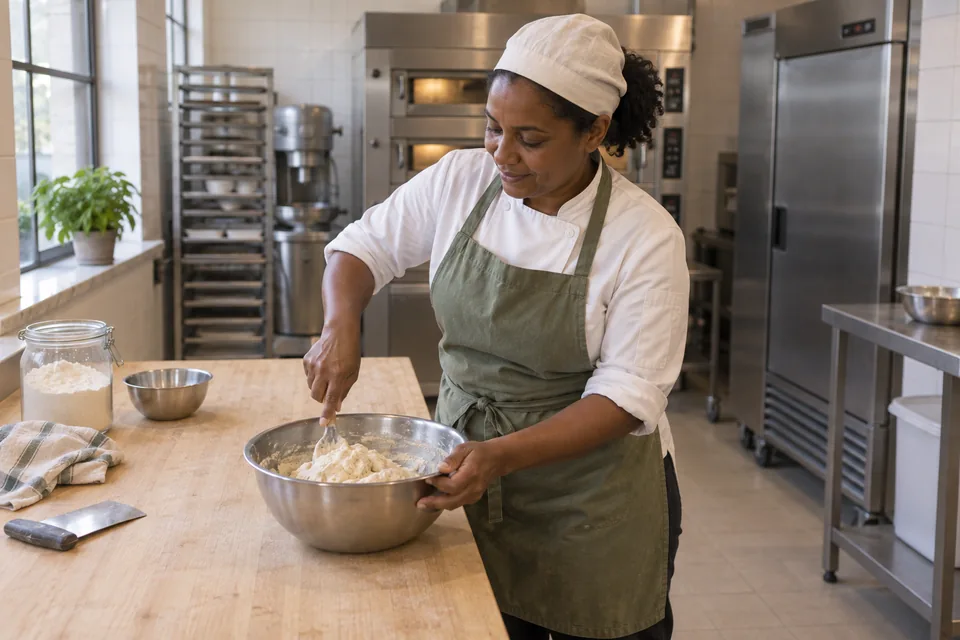
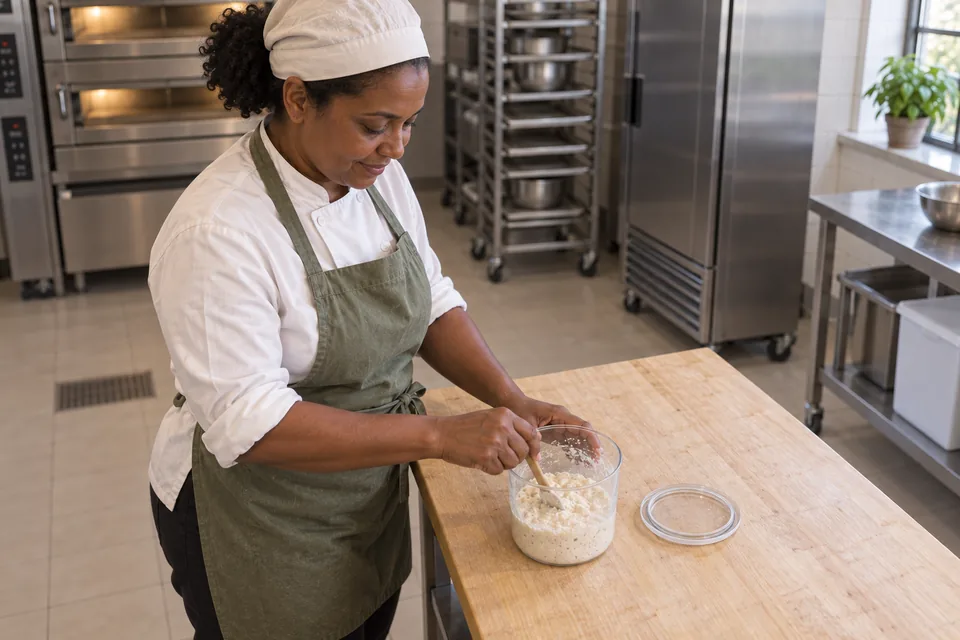
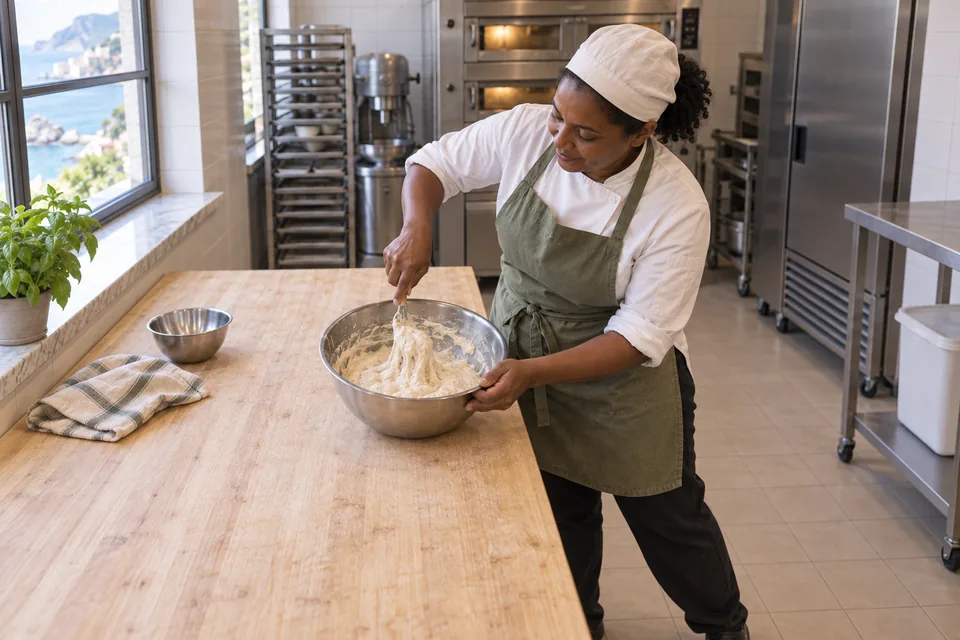
    Baker stirring a moist white focaccia dough in a steel bowl.
    01 MixMix until all the flour is moistened, then cover.
  2. 02 · Fold

    45 min

    Use: Dough

    Fold inward 8–12 times; flip. Repeat three times, 15 minutes apart.

    Ready when: Strengthening

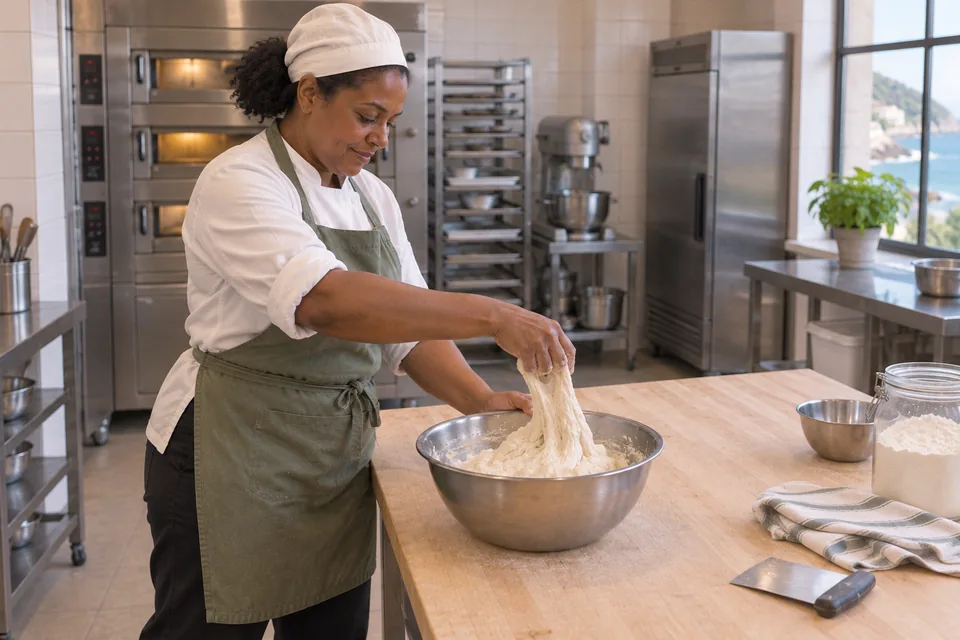
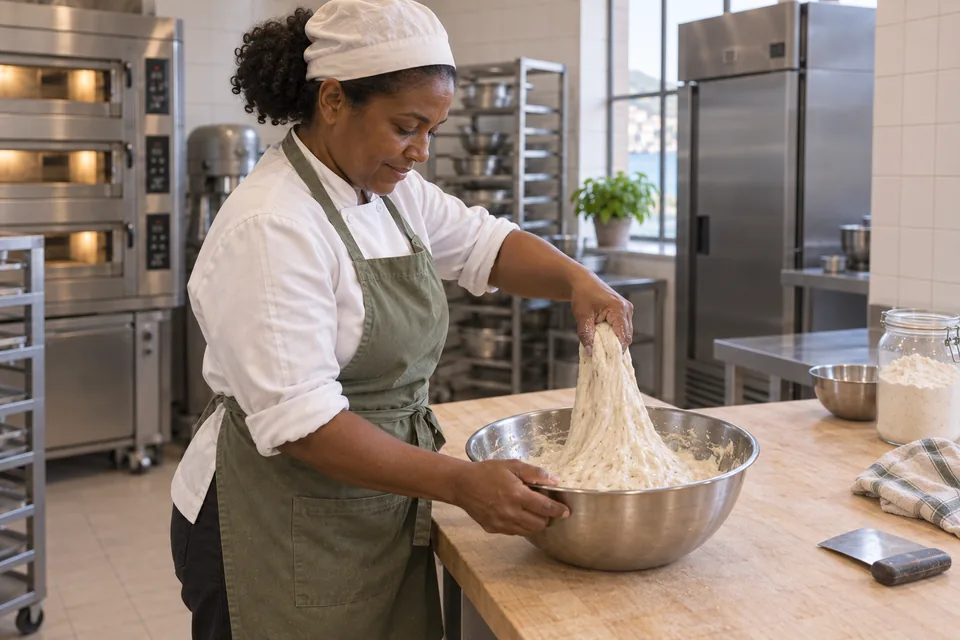
    Baker lifting a connected flap of soft white dough from a bowl.
    02 FoldFold the soft dough inward in repeated sets to build strength.
  3. 03 · Rise

    1 h

    Use: Dough

    Cover at 21–24°C.

    Ready when: Nearly doubled

    Baker uncovering a puffy white dough dome in a bowl.
    03 RiseLet the covered dough become puffy and nearly double.
  4. 04 · Pan

    60–90 min

    Use: 13 g oil

    Spray pan; add parchment sling and oil. Transfer dough; flip; cover. Preheat oven to 245°C near rise’s end.

    Ready when: Jiggly, near rim

    Soft dough being spread in an oiled square pan with a parchment sling.
    04 PanTransfer to the oiled square pan with its parchment sling and let it rise.
  5. 05 · Finish

    —

    Use: Oil + salt

    Dimple to pan bottom, 4 cm apart; add remaining oil and salt.

    Ready when: Bubbly

    Deep fingertip dimples in plain dough in a parchment-lined square pan.
    05 FinishPress deep dimples and finish with the remaining oil and salt.
  6. 06 · Bake

    15–18 min

    Use: Dough

    Bake lower rack at 245°C.

    Ready when: Brown peaks

    One golden square focaccia in its parchment-lined pan at the oven.
    06 BakeBake the square focaccia until its raised peaks are browned.
  7. 07 · Crisp

    5–7 min

    Use: Bread

    Unmould; remove parchment. Return to rack with oven off; cool.

    Ready when: Crisp sides

    One unmoulded square focaccia directly on an oven rack, with pan and parchment removed.
    07 CrispRemove the pan and parchment; crisp the loaf directly on the rack as directed.

What to look for

StageLook / feel forNeeds attention
Before dimplingWobbling, aerated doughDense dough

Troubleshooting

If you see thisLikely causeWhat to do nowNext time
Pale sidesPoor pan heat transferFinish unpannedUse metal

Ingredient choices & substitutions
IngredientSpecified typeBrandStatus
FlourUnbleached all-purpose, 11.7% proteinKing Arthurnamed formulation; matching type is the practical alternative
Finishing saltFlakesCurio Spice Co. Cyprus Flake Saltnamed formulation; matching type is the practical alternative
IngredientAlternative / ratioAdjust handlingLikely outcome
FlourUnbleached AP near 11.7% protein1:1 by weightRetain folds; adjust to dough feel.Lower protein may reduce height; higher protein may increase chew.
Flaky saltMaldonTo tasteSprinkle lightly; crystal density differs.Similar finishing crunch.

Match the ingredient’s function and weight. See the flour, gluten, yeast and salt guide.

King Arthur Baking

Recipe

Folded focaccia

How do I make it?

  1. Mix the dough

    15 min

    Stir together all the dough ingredients until no dry flour remains, then cover the bowl.

    Baker stirring a moist white focaccia dough in a steel bowl.
    Mix until all the flour is moistened, then cover.

    Ready when: No dry flour

  2. Fold to strengthen

    45 min

    Pull an edge of the dough up and fold it into the middle 8–12 times, moving around the bowl, then turn the dough over. Do this again three times, leaving 15 minutes between sets.
    Baker lifting a connected flap of soft white dough from a bowl.
    Fold the soft dough inward in repeated sets to build strength.

    Ready when: Strengthening

  3. Let it rise

    1 h

    Keep the bowl covered at 21–24°C until the dough has nearly doubled.

    Baker uncovering a puffy white dough dome in a bowl.
    Let the covered dough become puffy and nearly double.

    Ready when: Nearly doubled

  4. Put it in the pan

    60–90 min

    Spray the pan with oil, line it with baking paper that overhangs so you can lift the bread out, then add 13 g oil. Put in the dough, turn it over to coat both sides and cover it. Heat the oven to 245°C near the end of this rise.

    Soft dough being spread in an oiled square pan with a parchment sling.
    Transfer to the oiled square pan with its parchment sling and let it rise.

    Ready when: Jiggly, near rim

  5. Add dents and oil

    —

    Press your fingertips right down to the bottom of the pan, making dents about 4 cm apart. Add the remaining oil and the finishing salt.

    Deep fingertip dimples in plain dough in a parchment-lined square pan.
    Press deep dimples and finish with the remaining oil and salt.

    Ready when: Bubbly

  6. Bake until browned

    15–18 min

    Bake the focaccia on the lower rack at 245°C until the raised parts are brown.

    One golden square focaccia in its parchment-lined pan at the oven.
    Bake the square focaccia until its raised peaks are browned.

    Ready when: Brown peaks

  7. Crisp the sides

    5–7 min

    Lift the bread out of the pan and take off the baking paper. Put it back directly on the oven rack with the heat switched off for 5–7 minutes, then let it cool.

    One unmoulded square focaccia directly on an oven rack, with pan and parchment removed.
    Remove the pan and parchment; crisp the loaf directly on the rack as directed.

    Ready when: Crisp sides

What can go wrong, and how can I fix it?

What you noticeLikely causeWhat to do
Pale sidesPoor pan heat transferFinish unpanned Use metal

See the detailed method and ratios in , or follow ingredients through the .

Ingredient proportions & recipe details

Folded focaccia at a glance

Makes
One 23 cm square
Heat
245°C; oven off for crisping
Baking time
15–18 min + 5–7 min crisping
Leavening
Yeast
How do the ingredient proportions compare?

Percentages compare each listed weight with the combined flour weight (100%). These are ingredient ratios, not dough hydration; milk, eggs and fillings contain other ingredients as well as water.

Formula componentGramsFlour = 100%
Unbleached all-purpose flour360 g100%
Table salt9 g2.5%
Sugar5 g1.4%
Instant yeast3 g0.8%
Water284 g78.9%
Extra-virgin olive oil18 g5%
Extra-virgin olive oil26 g7.2%

Rosemary focaccia with a sponge

Makes
Two 23 cm rounds
Heat
230°C bake; preheat 260°C
Baking time
25–30 min

Reduce on loading; rotate halfway.

America's Test Kitchen · reference variation

Rosemary focaccia with a sponge

Method

  1. 01 · Sponge

    6–24 h

    Use: Sponge

    Mix; cover.

    Ready when: Risen, beginning to fall

    Baker stirring a small bubbly white sponge in a clear container.
    01 SpongeMix and cover the sponge; wait until it has risen and begins to fall.
  2. 02 · Mix

    15 min + 30 min rest

    Use: Sponge + dough

    Mix except salt; rest. Add salt; mix one minute.

    Ready when: Combined

    Very loose sticky white dough stretching off a spoon into a steel bowl.
    02 MixMix the loose dough, rest it, then work in the salt.
  3. 03 · Fold

    30 min between; final 30–60 min

    Use: Dough

    Fold inward eight times; rest. Repeat twice.

    Ready when: Nearly doubled

    Baker folding a broad connected sheet of glossy wet dough.
    03 FoldFold the wet dough inward without tearing its connected sheet.
  4. 04 · Heat

    1 h

    Use: Oven

    Preheat stone; oil and salt pans.

    Ready when: Hot

    Baker checking an empty oven stone with two prepared round pans nearby.
    04 HeatPreheat the stone and prepare the two oiled, salted round pans.
  5. 05 · Pan

    5 min + 10 min

    Use: Dough

    Halve; round; coat in pan oil. Rest, stretch, fork-prick 25–30 times; add rosemary.

    Ready when: Slightly bubbly

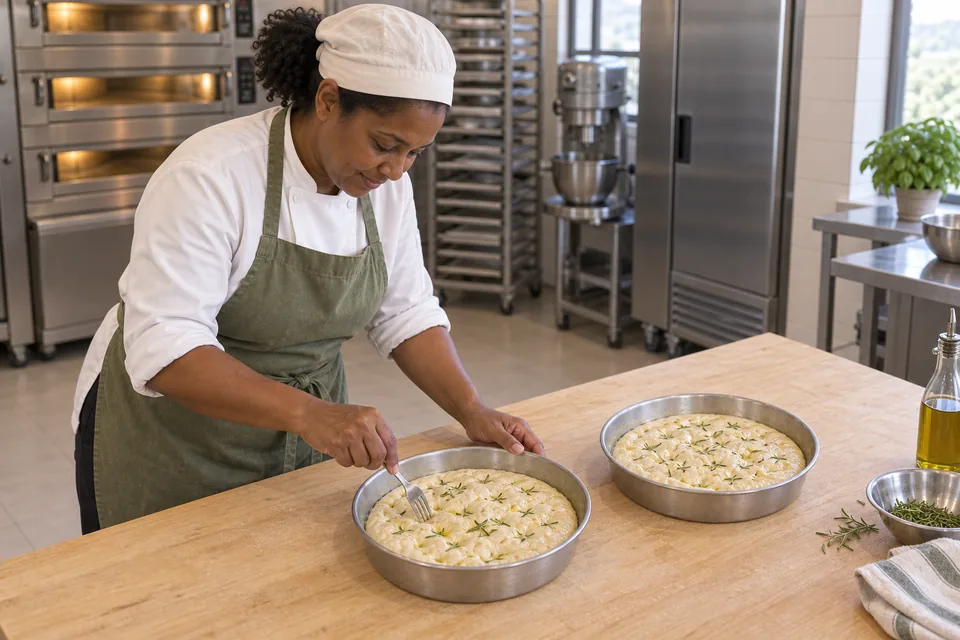
    Two round raw rosemary focaccias, one being pricked with a fork.
    05 PanSpread the two portions in their pans, prick with a fork and add rosemary.
  6. 06 · Bake

    25–30 min

    Use: Dough

    Load on stone; reduce to 230°C. Rotate halfway.

    Ready when: Golden

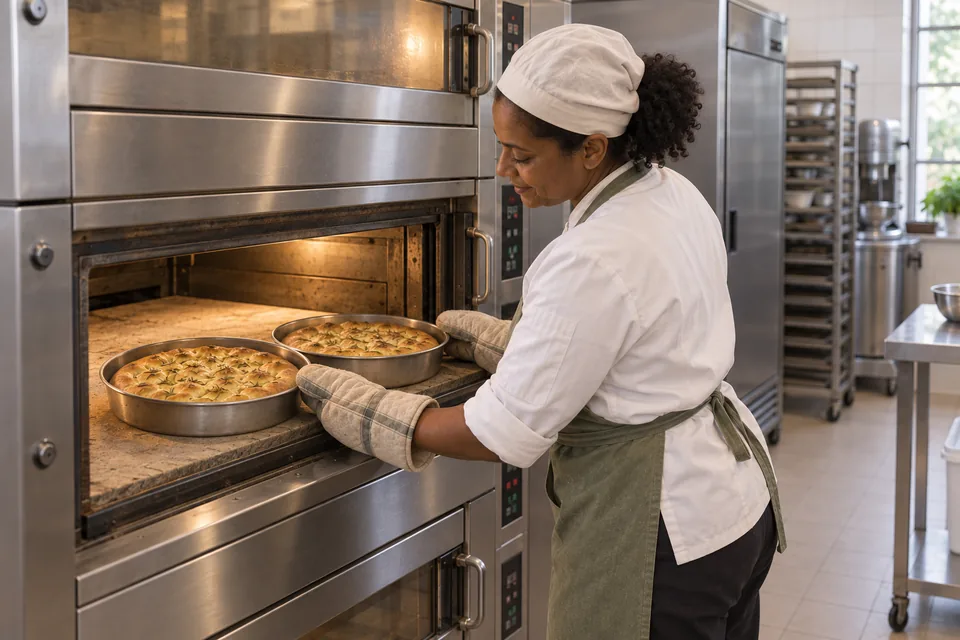
    Two golden rosemary focaccias in round pans on an oven stone.
    06 BakeBake both rounds on the stone until golden, rotating as directed.
  7. 07 · Cool

    30 min

    Use: Bread

    Rest five minutes; unmould. Brush with pan oil; cool.

    Ready when: Set

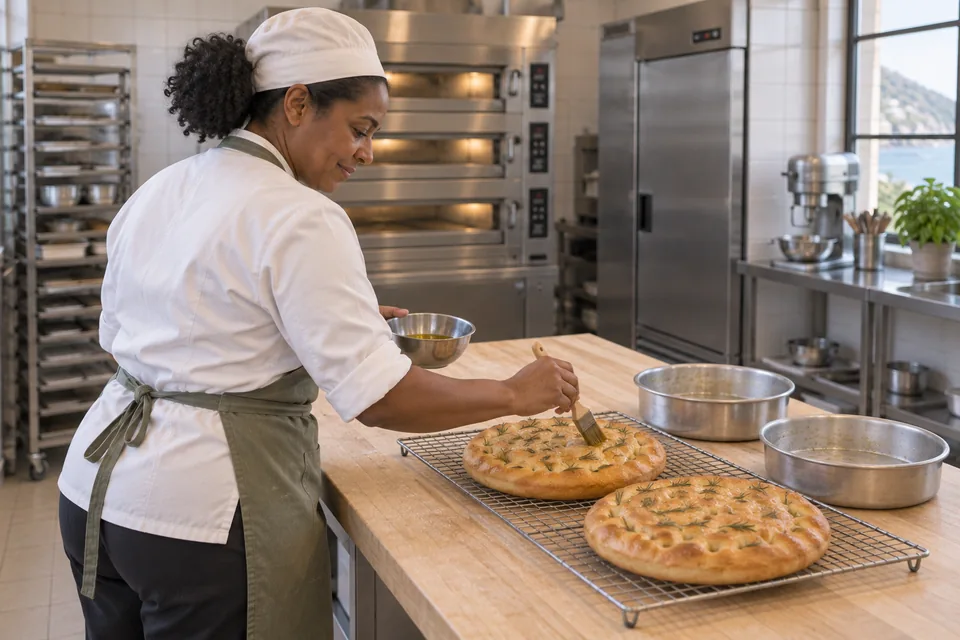
    Baker brushing oil on two whole round focaccias cooling on a rack.
    07 CoolUnmould both rounds, brush with pan oil and cool on a rack.

What to look for

StageLook / feel forNeeds attention
SpongeFalling surfaceUnrisen

Troubleshooting

If you see thisLikely causeWhat to do nowNext time
RetractionTensionRest 5–10 minStretch gently

Hydration is approximate because water is converted from US cups. Measure small ingredients by the listed volumes where a weight is unavailable.

Ingredient choices & substitutions
IngredientSpecified typeBrandStatus
FlourAll-purpose; brand unspecifiedNot specifiedspecified in recipe
SaltCoarse; brand unspecifiedNot specifiedspecified in recipe
YeastInstant or rapid-riseNot specifiedspecified in recipe
IngredientAlternative / ratioAdjust handlingLikely outcome
Coarse saltDifferent coarse brandMatch mass, not spoon volumeSource does not identify brand: 10 ml can weigh about 5.3–10.7 g across Diamond Crystal/Morton.Salt percentage cannot be uniquely verified.
All-purpose flourBread flour1:1 by weightCheck dough feel.Potentially stronger, chewier dough; not a tested substitution in this card.

Match the ingredient’s function and weight. See the flour, gluten, yeast and salt guide.

America's Test Kitchen
Source and measurement notes

Water volume converted from US cups; hydration is approximate. Spoon-only minor ingredients remain metric volumes when mass is unverified.

Recipe

Rosemary focaccia with a sponge

The sponge is a small flour, water and yeast mixture that rises before you mix the main dough.

How do I make it?

  1. Start the flour mixture

    6–24 h

    Mix the flour, water and yeast listed for the sponge, then cover it. This starter mixture is ready when it has risen and is just beginning to sink.

    Baker stirring a small bubbly white sponge in a clear container.
    Mix and cover the sponge; wait until it has risen and begins to fall.

    Ready when: Risen, beginning to fall

  2. Mix the dough

    15 min + 30 min rest

    Mix the sponge with the dough flour, water and yeast, keeping the dough salt aside, then let it rest. Add that salt and mix for one minute.

    Very loose sticky white dough stretching off a spoon into a steel bowl.
    Mix the loose dough, rest it, then work in the salt.

    Ready when: Combined

  3. Fold and rest

    30 min between; final 30–60 min

    Lift the dough’s edges and fold them into the middle eight times, then let it rest. Do two more sets, leaving 30 minutes between sets, then give it a final 30–60 minute rest.

    Baker folding a broad connected sheet of glossy wet dough.
    Fold the wet dough inward without tearing its connected sheet.

    Ready when: Nearly doubled

  4. Heat the oven and prepare pans

    1 h

    Heat the oven and stone to 260°C for 1 hour. Divide the pan oil and pan salt between the two pans.

    Baker checking an empty oven stone with two prepared round pans nearby.
    Preheat the stone and prepare the two oiled, salted round pans.

    Ready when: Hot

  5. Shape the focaccia

    5 min + 10 min

    Divide the dough in half, shape each piece into a ball, put one in each pan and turn to coat in the oil. Rest for 5 minutes, stretch it outward, then let it rest for 10 minutes. Prick each piece with a fork 25–30 times and add the rosemary.

    Two round raw rosemary focaccias, one being pricked with a fork.
    Spread the two portions in their pans, prick with a fork and add rosemary.

    Ready when: Slightly bubbly

  6. Bake until golden

    25–30 min

    Put the pans on the hot stone and lower the oven to 230°C. Turn the pans halfway through baking so they brown evenly.

    Two golden rosemary focaccias in round pans on an oven stone.
    Bake both rounds on the stone until golden, rotating as directed.

    Ready when: Golden

  7. Cool the bread

    30 min

    Leave the bread in the pans for five minutes, then take it out. Brush it with the oil left in the pans and let it cool.

    Baker brushing oil on two whole round focaccias cooling on a rack.
    Unmould both rounds, brush with pan oil and cool on a rack.

    Ready when: Set

What can go wrong, and how can I fix it?

What you noticeLikely causeWhat to do
RetractionTensionRest 5–10 min Stretch gently
Useful recipe notes

Hydration is approximate because water is converted from US cups. Measure small ingredients by the listed volumes where a weight is unavailable.

See the detailed method and ratios in , or follow ingredients through the .

Ingredient proportions & recipe details

Rosemary focaccia with a sponge at a glance

Makes
Two 23 cm rounds
Heat
230°C bake; preheat 260°C
Baking time
25–30 min
Leavening
Yeast
How do the ingredient proportions compare?

Percentages compare each listed weight with the combined flour weight (100%). These are ingredient ratios, not dough hydration; milk, eggs and fillings contain other ingredients as well as water.

Formula componentGramsFlour = 100%
All-purpose flour70.9 g16.7%
Instant yeast0.8 g0.2%
All-purpose flour354.4 g83.3%
Instant yeast3 g0.7%

Roman-Style Focaccia

Makes
Eight portions
Heat
230°C
Baking time
20–25 min
America's Test Kitchen · reference variation

Roman-Style Focaccia

Method

  1. 01 · Mix

    3–4 min + 10 min rest

    Use: Flour, yeast, sugar, water

    Paddle on low; pause.

    Ready when: No dry flour

    Wet white dough under a paddle in a stainless mixer bowl.
    01 MixUse the paddle to moisten all the flour before the short rest.
  2. 02 · Develop

    8 min

    Use: Dough salt

    Mix low 30 seconds, then medium-high.

    Ready when: Shiny, batter-like

    Shiny batter-like dough developing in the paddle mixer.
    02 DevelopContinue mixing until the dough becomes shiny and batter-like.
  3. 03 · Rise

    2–2½ h

    Use: Bowl oil

    Oil bowl; transfer, flip and cover dough. Preheat to 230°C.

    Ready when: Bubbly, nearly tripled

    Baker uncovering a very bubbly loose dough in an oiled bowl.
    03 RiseCover the oiled bowl and let the loose dough become very bubbly.
  4. 04 · Pan

    Rest 10 min if retracting

    Use: Pan oil + spray

    Spray/oil pan. Transfer and stretch dough.

    Ready when: Reaches corners

    Baker spreading loose dough toward the corners of an unlined rectangular pan.
    04 PanEase the soft dough into the oiled rectangular pan and toward its corners.
  5. 05 · Finish

    10 min

    Use: Rosemary + top salt

    Rest; fork-prick twenty times. Add toppings.

    Ready when: Aerated

    A fork making small punctures in rectangular rosemary focaccia dough.
    05 FinishRest, prick with a fork and add the rosemary and salt.
  6. 06 · Bake

    20–25 min

    Use: Dough

    Bake on middle rack at 230°C.

    Ready when: Golden

    Baker removing one golden rectangular rosemary focaccia in its pan.
    06 BakeBake on the middle rack until the surface is golden.
  7. 07 · Cool

    15 min

    Use: Bread

    Cool in pan; cut.

    Ready when: Set

    Eight portions of rosemary focaccia cut in a two-by-four grid in the pan.
    07 CoolLet the focaccia set in its pan before cutting into portions.

What to look for

StageLook / feel forNeeds attention
After mixingGlossy, extremely loose doughAdding flour to make a firm ball

Troubleshooting

If you see thisLikely causeWhat to do nowNext time
Snaps backTight doughRest ten minutesGentle stretching

Ingredient choices & substitutions
IngredientSpecified typeBrandStatus
FlourAll-purpose; brand unspecifiedNot specifiedspecified in recipe
SaltCoarse; brand unspecifiedNot specifiedspecified in recipe
YeastInstant or rapid-riseNot specifiedspecified in recipe
IngredientAlternative / ratioAdjust handlingLikely outcome
Coarse saltDifferent coarse brandMatch mass, not spoon volumeSource brand is unknown: 7.5 ml may weigh about 4–8 g across Diamond Crystal/Morton.Do not report a single verified salt percentage.
All-purpose flourBread flour1:1 by weightExpect greater water absorption.Could yield more chew and structure; editorial alternative.

Match the ingredient’s function and weight. See the flour, gluten, yeast and salt guide.

America's Test Kitchen

Recipe

Roman-Style Focaccia

How do I make it?

  1. Mix and pause

    3–4 min + 10 min rest

    Use a stand mixer with its flat paddle on low speed to mix the flour, yeast, sugar and water for 3–4 minutes. Let the mixture rest for 10 minutes.

    Wet white dough under a paddle in a stainless mixer bowl.
    Use the paddle to moisten all the flour before the short rest.

    Ready when: No dry flour

  2. Beat in the salt

    8 min

    Add the dough salt and mix on low for 30 seconds, then on medium-high for 8 minutes. The dough will look shiny and loose, more like thick batter.

    Shiny batter-like dough developing in the paddle mixer.
    Continue mixing until the dough becomes shiny and batter-like.

    Ready when: Shiny, batter-like

  3. Let it rise

    2–2½ h

    Coat a bowl with the bowl oil, add the dough, turn it over to coat and cover. Let it rise until nearly tripled, and heat the oven to 230°C.

    Baker uncovering a very bubbly loose dough in an oiled bowl.
    Cover the oiled bowl and let the loose dough become very bubbly.

    Ready when: Bubbly, nearly tripled

  4. Spread into the pan

    Rest 10 min if retracting

    Spray the pan and add the pan oil, then move in the dough and stretch it into the corners. If it pulls back, let it rest for 10 minutes before trying again.

    Baker spreading loose dough toward the corners of an unlined rectangular pan.
    Ease the soft dough into the oiled rectangular pan and toward its corners.

    Ready when: Reaches corners

  5. Add rosemary and salt

    10 min

    Rest the dough for 10 minutes, then prick it with a fork twenty times. Add the rosemary and top salt.

    A fork making small punctures in rectangular rosemary focaccia dough.
    Rest, prick with a fork and add the rosemary and salt.

    Ready when: Aerated

  6. Bake the focaccia

    20–25 min

    Put the pan on the middle rack and bake at 230°C until golden.

    Baker removing one golden rectangular rosemary focaccia in its pan.
    Bake on the middle rack until the surface is golden.

    Ready when: Golden

  7. Rest before cutting

    15 min

    Leave the focaccia in the pan to cool for 15 minutes, then cut it into pieces.

    Eight portions of rosemary focaccia cut in a two-by-four grid in the pan.
    Let the focaccia set in its pan before cutting into portions.

    Ready when: Set

What can go wrong, and how can I fix it?

What you noticeLikely causeWhat to do
Snaps backTight doughRest ten minutes Gentle stretching

See the detailed method and ratios in , or follow ingredients through the .

Ingredient proportions & recipe details

Roman-Style Focaccia at a glance

Makes
Eight portions
Heat
230°C
Baking time
20–25 min
Leavening
Yeast
How do the ingredient proportions compare?

Percentages compare each listed weight with the combined flour weight (100%). These are ingredient ratios, not dough hydration; milk, eggs and fillings contain other ingredients as well as water.

Formula componentGramsFlour = 100%
All-purpose flour425.2 g100%
Instant yeast4.5 g1.1%
Sugar6.2 g1.5%
Water382.7 g90%

Garlic and herb focaccia

Makes
24 pieces
Heat
232°C
Baking time
20–23 min
Sally’s Baking Addiction · reference variation

Garlic and herb focaccia

Method

  1. 01 · Activate

    5 min

    Use: A

    Whisk yeast/sugar with 240 mL water.

    Ready when:

    Baker whisking the yeast mixture in a bowl.
    01 ActivateWhisk the yeast and sugar into the first portion of water.
  2. 02 · Mix

    5 min

    Use: B

    Add remaining water and B gradually. Mix 2 minutes; knead.

    Ready when: Soft; tacky.

    Baker kneading a soft white focaccia dough on the workbench.
    02 MixAdd the remaining ingredients gradually, then knead a soft, tacky dough.
  3. 03 · Rise

    2–3 h

    Use: Dough

    Cover in oiled bowl.

    Ready when: Doubled.

    Baker uncovering a puffy white dough dome in a bowl.
    03 RiseLeave the dough covered in an oiled bowl until doubled.
  4. 04 · Pan

    Chill covered 1–24 h

    Use: C

    Oil pan (30 mL); deflate and stretch dough.

    Ready when: 12 h preferred.

    Covered dough in an oiled rectangular sheet ready for refrigeration.
    04 PanStretch into the oiled sheet and cover for the long cold rest.
  5. 05 · Top

    Preheat 232°C, 10–15 min

    Use: C

    Preheat with dough covered outside fridge. Dimple; add garlic/herbs mixed with remaining oil; season.

    Ready when:

    Dimpled dough topped with garlic, chopped herbs and oil.
    05 TopDimple the relaxed dough and spread the garlic, herbs and oil over it.
  6. 06 · Bake

    20–23 min

    Use:

    Bake; slice.

    Ready when: Lightly browned.

    One golden garlic-and-herb focaccia on its unlined baking sheet.
    06 BakeBake until lightly browned, then slice for serving.

What to look for

StageLook / feel forNeeds attention
PanPan covered.Tearing.

Troubleshooting

If you see thisLikely causeWhat to do nowNext time
RecoilTight glutenRest 5–10 minutes.Stretch gently.

Ingredient choices & substitutions
IngredientSpecified typeBrandStatus
SaltCoarseNot specifiedsuggested
IngredientAlternative / ratioAdjust handlingLikely outcome
Bread flourAll-purposeWithin stated rangeMay need 625 g.Less chewy.

Match the ingredient’s function and weight. See the flour, gluten, yeast and salt guide.

Sally’s Baking Addiction

Recipe

Garlic and herb focaccia

How do I make it?

  1. Mix yeast and water

    5 min

    Whisk the yeast and sugar with 240 mL of the water and leave for 5 minutes.

    Baker whisking the yeast mixture in a bowl.
    Whisk the yeast and sugar into the first portion of water.
  2. Make the dough

    5 min

    Gradually add the rest of the water with the dough oil, salt and flour. Mix for 2 minutes, then knead by folding and pressing until the dough is soft and slightly sticky.

    Baker kneading a soft white focaccia dough on the workbench.
    Add the remaining ingredients gradually, then knead a soft, tacky dough.

    Ready when: Soft; tacky.

  3. Let it double

    2–3 h

    Put the dough in an oiled bowl, cover and leave until doubled in size.

    Baker uncovering a puffy white dough dome in a bowl.
    Leave the dough covered in an oiled bowl until doubled.

    Ready when: Doubled.

  4. Spread and chill

    Chill covered 1–24 h

    Coat the pan with 30 mL oil. Press the air out of the dough, stretch it into the pan, then cover and chill for 1–24 hours; 12 hours is preferred.

    Covered dough in an oiled rectangular sheet ready for refrigeration.
    Stretch into the oiled sheet and cover for the long cold rest.

    Ready when: 12 h preferred.

  5. Warm and top

    Preheat 232°C, 10–15 min

    Take the dough out of the fridge, keep it covered and heat the oven to 232°C for 10–15 minutes. Press dents into the dough with your fingertips, mix the garlic and herbs with the remaining oil, spread that over the top and add salt and pepper to taste.

    Dimpled dough topped with garlic, chopped herbs and oil.
    Dimple the relaxed dough and spread the garlic, herbs and oil over it.
  6. Bake and serve

    20–23 min

    Bake until lightly browned, then cut the focaccia into slices.

    One golden garlic-and-herb focaccia on its unlined baking sheet.
    Bake until lightly browned, then slice for serving.

    Ready when: Lightly browned.

What can go wrong, and how can I fix it?

What you noticeLikely causeWhat to do
RecoilTight glutenRest 5–10 minutes. Stretch gently.

See the detailed method and ratios in , or follow ingredients through the .

Ingredient proportions & recipe details

Garlic and herb focaccia at a glance

Makes
24 pieces
Heat
232°C
Baking time
20–23 min
Leavening
Yeast

Focaccia for Sandwiches

Makes
About 12 sandwich portions
Heat
218°C
Baking time
20–25 min
Smitten Kitchen · reference variation

Focaccia for Sandwiches

Thin sandwich focaccia.

Method

  1. 01 · Mix

    1–1½ h warm

    Use: A

    Stir into a loose, sticky dough; cover.

    Ready when: Doubled.

    Very loose sticky white dough stretching off a spoon into a steel bowl.
    01 MixStir a loose, sticky dough and cover until doubled.
  2. 02 · Pan

    Rest 20 min

    Use: B

    Oil pan with 44 mL. Deflate dough with forks; transfer and turn in oil.

    Ready when:

    Two forks transferring one loose dough into a generously oiled unlined sheet.
    02 PanUse two forks to deflate and transfer the dough to the generously oiled pan.
  3. 03 · Shape

    Preheat 218°C

    Use: B

    Drizzle remaining oil; dimple and stretch to edges. Sprinkle flaky salt.

    Ready when:

    Baker dimpling plain oiled dough that fills the whole rectangular sheet.
    03 ShapeDimple and stretch right into the corners, then add flaky salt.
  4. 04 · Bake

    20–25 min

    Use:

    Bake, then cool completely on a rack.

    Ready when: Puffed; golden, crisp underside.

    One plain golden focaccia filling an unlined rectangular baking sheet.
    04 BakeBake until puffed and golden, then cool completely on a rack.

What to look for

StageLook / feel forNeeds attention
DoughLoose; sticky.Kneading in extra flour.

Troubleshooting

If you see thisLikely causeWhat to do nowNext time
Resists stretchingTight doughPause 5 minutes; retry.Allow pan rest.

Alternative: chill mixed dough 8–10 h; pan-rest 1 h.

Ingredient choices & substitutions
IngredientSpecified typeBrandStatus
SaltCoarse in dough; flaky on topNot specifiedspecified type
IngredientAlternative / ratioAdjust handlingLikely outcome
Instant yeastActive drySame volumeFoam in lukewarm recipe water with a sugar pinch, 10 minutes.Alternative yeast route.

Match the ingredient’s function and weight. See the flour, gluten, yeast and salt guide.

Smitten Kitchen

Recipe

Focaccia for Sandwiches

Thin sandwich focaccia.

How do I make it?

  1. Mix and let rise

    1–1½ h warm

    Stir the flour, salt, yeast and water into a loose, sticky dough. Cover and leave somewhere warm until doubled.

    Very loose sticky white dough stretching off a spoon into a steel bowl.
    Stir a loose, sticky dough and cover until doubled.

    Ready when: Doubled.

  2. Oil the pan

    Rest 20 min

    Coat the pan with 44 mL oil. Use forks to press the air out of the dough, move it into the pan and turn it over to coat both sides, then rest for 20 minutes.

    Two forks transferring one loose dough into a generously oiled unlined sheet.
    Use two forks to deflate and transfer the dough to the generously oiled pan.
  3. Stretch and add salt

    Preheat 218°C

    Pour over the remaining oil, then press your fingertips into the dough and stretch it to the pan’s edges. Sprinkle with flaky salt and heat the oven to 218°C.

    Baker dimpling plain oiled dough that fills the whole rectangular sheet.
    Dimple and stretch right into the corners, then add flaky salt.
  4. Bake and cool

    20–25 min

    Bake until puffed and golden with a crisp bottom, then move the focaccia to a rack and let it cool completely.

    One plain golden focaccia filling an unlined rectangular baking sheet.
    Bake until puffed and golden, then cool completely on a rack.

    Ready when: Puffed; golden, crisp underside.

What can go wrong, and how can I fix it?

What you noticeLikely causeWhat to do
Resists stretchingTight doughPause 5 minutes; retry. Allow pan rest.
Useful recipe notes

Alternative: chill mixed dough 8–10 h; pan-rest 1 h.

See the detailed method and ratios in , or follow ingredients through the .

Ingredient proportions & recipe details

Focaccia for Sandwiches at a glance

Makes
About 12 sandwich portions
Heat
218°C
Baking time
20–25 min
Leavening
Yeast
How do the ingredient proportions compare?

Percentages compare each listed weight with the combined flour weight (100%). These are ingredient ratios, not dough hydration; milk, eggs and fillings contain other ingredients as well as water.

Formula componentGramsFlour = 100%
All-purpose flour520 g100%

Vegetable focaccia

Makes
1 tray
Heat
230°C → 220°C
Baking time
15 min + about 10 min

Reduce after the first 15 min.

Bake from Scratch · reference variation

Vegetable focaccia

Method

  1. 01 · Mix

    6–7 min

    Use:

    Paddle dough ingredients slowly 4 minutes, then medium-low 2–3 minutes.

    Ready when: Smooth ball

    A smooth white dough ball mixed with a flat paddle.
    01 MixMix with the paddle until the dough comes together in a smooth ball.
  2. 02 · Rise

    90 min

    Use:

    Transfer to an oiled bowl; cover at 24°C. Fold four sides inward every 30 minutes.

    Ready when: Elastic

    Baker lifting a connected flap of soft white dough from a bowl.
    02 RiseFold the covered dough during its rise until it feels elastic.
  3. 03 · Pan

    30 min covered

    Use:

    Line 43.8 × 31.1 cm tray; add pan oil. Stretch dough across.

    Ready when: Relaxed

    Dough spread across a parchment-lined and oiled rectangular tray.
    03 PanStretch the dough across the parchment-lined, oiled tray.
  4. 04 · Dimple

    30 min

    Use:

    Dimple without tearing; cover. Preheat oven to 230°C during this rise.

    Ready when: Level with rim

    Baker dimpling dough in the parchment-lined vegetable-focaccia tray.
    04 DimpleDimple without tearing and let the dough rise toward the rim.
  5. 05 · Bake

    25 min

    Use:

    Add topping oil, vegetables and salt. Bake 230°C 15 minutes, then 220°C about 10.

    Ready when: Brown; centre 96°C

    One golden focaccia with peppers, zucchini and tomatoes in a parchment-lined tray.
    05 BakeAdd the vegetables, oil and salt, then bake through both temperature stages.
  6. 06 · Cool

    10 min

    Use:

    Cool in pan, then transfer to rack; add optional pepper.

    Ready when:

    One whole vegetable focaccia cooling on a rack beside its pan.
    06 CoolCool in the pan first, then move the whole focaccia to a rack.

What to look for

StageLook / feel forNeeds attention
HandlingElasticityTearing

Troubleshooting

If you see thisLikely causeWhat to do nowNext time
SpringbackTight doughRest 5–10 minutes.Stretch gently.

Use the gram quantities; the original cup equivalents are inconsistent.

Ingredient choices & substitutions
IngredientSpecified typeBrandStatus
FlourArtisan Bread FlourBob’s Red MillSpecified/tested; not uniquely required
IngredientAlternative / ratioAdjust handlingLikely outcome
Bread flourAP flour1:1 weightReserve some water; mix gently.Looser dough; reduced strength.

Match the ingredient’s function and weight. See the flour, gluten, yeast and salt guide.

Bake from Scratch
Source and measurement notes

Gram quantities take precedence over inconsistent PDF cup equivalents.
Recipe

Vegetable focaccia

How do I make it?

  1. Mix the dough

    6–7 min

    Use a stand mixer with its flat paddle to mix the dough ingredients slowly for 4 minutes, then at medium-low speed for 2–3 minutes. Stop when the dough makes a smooth ball.
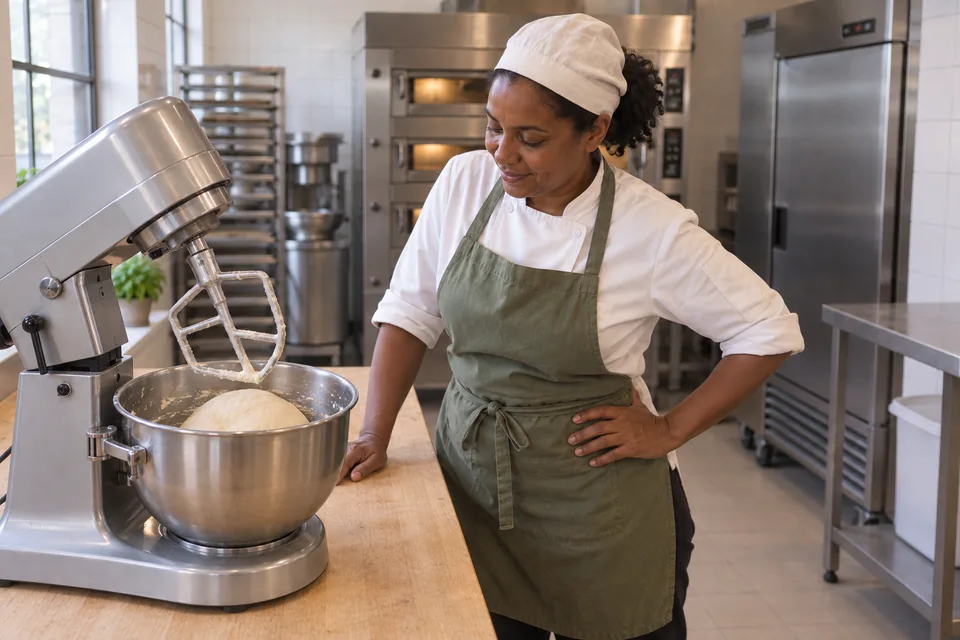
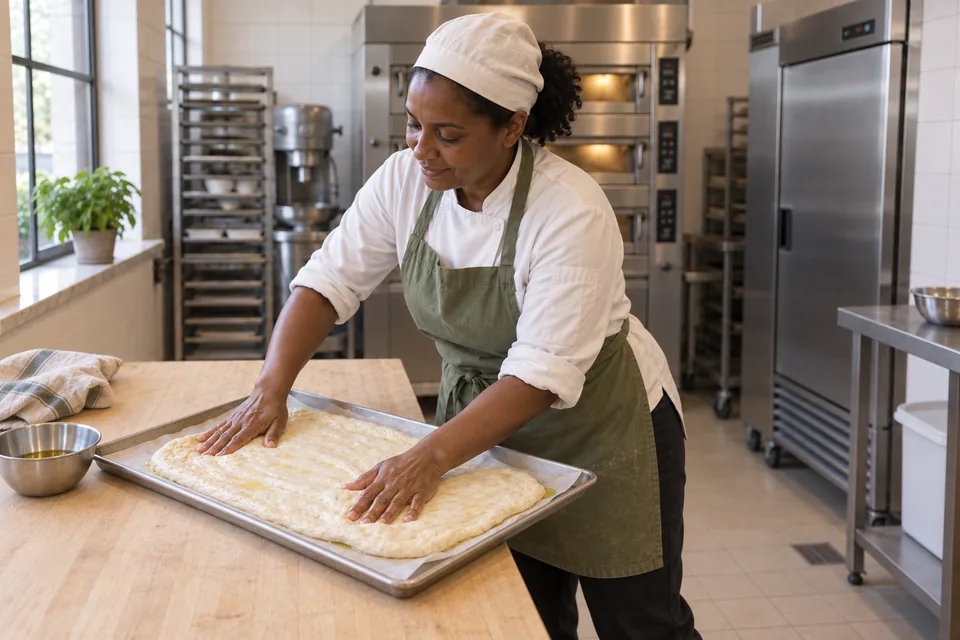
    A smooth white dough ball mixed with a flat paddle.
    Mix with the paddle until the dough comes together in a smooth ball.

    Ready when: Smooth ball

  2. Rise and fold

    90 min

    Move the dough to an oiled bowl, cover and leave at 24°C for 90 minutes. Every 30 minutes, lift each of its four sides and fold it into the middle.

    Baker lifting a connected flap of soft white dough from a bowl.
    Fold the covered dough during its rise until it feels elastic.

    Ready when: Elastic

  3. Spread into the tray

    30 min covered

    Line the 43.8 × 31.1 cm tray and add the pan oil. Stretch the dough across it, then cover and rest for 30 minutes.

    Dough spread across a parchment-lined and oiled rectangular tray.
    Stretch the dough across the parchment-lined, oiled tray.

    Ready when: Relaxed

  4. Make dents in the top

    30 min

    Press your fingertips into the dough without tearing it, then cover for another 30 minutes. Heat the oven to 230°C during this rise.

    Baker dimpling dough in the parchment-lined vegetable-focaccia tray.
    Dimple without tearing and let the dough rise toward the rim.

    Ready when: Level with rim

  5. Top and bake

    25 min

    Add the topping oil, vegetables and salt. Bake at 230°C for 15 minutes, then lower the heat to 220°C and bake for about 10 minutes more.

    One golden focaccia with peppers, zucchini and tomatoes in a parchment-lined tray.
    Add the vegetables, oil and salt, then bake through both temperature stages.

    Ready when: Brown; centre 96°C

  6. Rest and cool

    10 min

    Leave the focaccia in the pan for 10 minutes, then move it to a rack. Add the optional pepper if you like.

    One whole vegetable focaccia cooling on a rack beside its pan.
    Cool in the pan first, then move the whole focaccia to a rack.

What can go wrong, and how can I fix it?

What you noticeLikely causeWhat to do
SpringbackTight doughRest 5–10 minutes. Stretch gently.
Useful recipe notes

Use the gram quantities; the original cup equivalents are inconsistent.

See the detailed method and ratios in , or follow ingredients through the .

Ingredient proportions & recipe details

Vegetable focaccia at a glance

Makes
1 tray
Heat
230°C → 220°C
Baking time
15 min + about 10 min
Leavening
Yeast
How do the ingredient proportions compare?

Percentages compare each listed weight with the combined flour weight (100%). These are ingredient ratios, not dough hydration; milk, eggs and fillings contain other ingredients as well as water.

Formula componentGramsFlour = 100%
Bread flour762 g100%
Water560 g73.5%
Extra-virgin olive oil42 g5.5%
Coarse salt15 g2%
Instant yeast7 g0.9%
Extra-virgin olive oil28 g3.7%
Flaked sea salt4 g0.5%

Long-rise rosemary focaccia with brine

Makes
10 servings
Heat
230°C
Baking time
25–30 min
Handle the Heat · reference variation

Long-rise rosemary focaccia with brine

Method

  1. 01 · Mix

    Use:

    Combine dough water, yeast and sugar; add 9.9 mL rosemary, half the flour and dough salt. Add dough oil, then gradually add only enough remaining flour for the stated consistency.

    Ready when: Shaggy; slightly sticky

    Baker stirring shaggy dough with rosemary flecks throughout.
    01 MixMix a shaggy, slightly sticky dough with rosemary worked through it.
  2. 02 · Rise

    8–10 h

    Use:

    Cover in oiled bowl at room temperature.

    Ready when: Doubled

    Baker uncovering a doubled rosemary-flecked dough in a steel bowl.
    02 RiseCover the oiled bowl and let the rosemary dough double.
  3. 03 · Pan

    Use:

    Oil half-sheet tray; stretch dough across. Rest 10 minutes if resistant; dimple deeply.

    Ready when:

    Deeply dimpled rosemary dough filling a large oiled unlined tray.
    03 PanStretch across the oiled sheet and press deep dimples; rest if it resists.
  4. 04 · Brine

    45 min

    Use:

    Dissolve brine salt in brine water; pour over dough. Cover.

    Ready when: Puffy

    Clear salt-water brine pouring into dimples on rosemary focaccia dough.
    04 BrinePour the dissolved salt-water brine over the dimples, then cover until puffy.
  5. 05 · Bake

    25–30 min

    Use:

    Preheat stone or inverted heavy tray to 230°C. Add remaining rosemary and finishing salt; bake tray on stone.

    Ready when: Golden

    Golden rosemary focaccia in a rectangular tray on a hot oven stone.
    05 BakeAdd the finishing rosemary and salt and bake the tray on the hot stone.
  6. 06 · Cool

    Use:

    Cool until warm.

    Ready when:

    One whole uncut golden rosemary focaccia cooling on a wire rack.
    06 CoolCool the whole focaccia on a rack until it is warm enough to serve.

What to look for

StageLook / feel forNeeds attention
ProofPuffinessDry surface

Troubleshooting

If you see thisLikely causeWhat to do nowNext time
Pale edgesInsufficient heat/oilContinue browning.Preheat thoroughly.

Ingredient choices & substitutions
IngredientSpecified typeBrandStatus
FlourAll-purposeNone specifiedType specified
IngredientAlternative / ratioAdjust handlingLikely outcome
AP flourBread flour1:1 weightWatch stiffness.Chewier crust.

Match the ingredient’s function and weight. See the flour, gluten, yeast and salt guide.

Handle the Heat

Recipe

Long-rise rosemary focaccia with brine

How do I make it?

  1. Mix a soft dough

    Mix the dough water, yeast and sugar, then add 9.9 mL rosemary, half the flour and the dough salt. Add the dough oil, then gradually add just enough of the remaining flour to make a rough, slightly sticky dough.

    Baker stirring shaggy dough with rosemary flecks throughout.
    Mix a shaggy, slightly sticky dough with rosemary worked through it.

    Ready when: Shaggy; slightly sticky

  2. Let it rise overnight

    8–10 h

    Put the dough in an oiled bowl, cover and leave at room temperature until doubled.

    Baker uncovering a doubled rosemary-flecked dough in a steel bowl.
    Cover the oiled bowl and let the rosemary dough double.

    Ready when: Doubled

  3. Stretch into the pan

    Oil the half-sheet tray and stretch the dough across it. If it resists, rest it for 10 minutes, then press deep dents all over with your fingertips.

    Deeply dimpled rosemary dough filling a large oiled unlined tray.
    Stretch across the oiled sheet and press deep dimples; rest if it resists.
  4. Add the salt water

    45 min

    Dissolve the brine salt in the separate brine water, pour it over the dough and cover. This salt-water topping stays separate from the dough water.

    Clear salt-water brine pouring into dimples on rosemary focaccia dough.
    Pour the dissolved salt-water brine over the dimples, then cover until puffy.

    Ready when: Puffy

  5. Bake the focaccia

    25–30 min

    Heat a pizza stone or an upside-down heavy tray in the oven to 230°C. Add the remaining rosemary and finishing salt to the dough, then bake its tray on the hot stone or heavy tray.

    Golden rosemary focaccia in a rectangular tray on a hot oven stone.
    Add the finishing rosemary and salt and bake the tray on the hot stone.

    Ready when: Golden

  6. Let it cool a little

    Leave the focaccia until warm before serving.

    One whole uncut golden rosemary focaccia cooling on a wire rack.
    Cool the whole focaccia on a rack until it is warm enough to serve.

What can go wrong, and how can I fix it?

What you noticeLikely causeWhat to do
Pale edgesInsufficient heat/oilContinue browning. Preheat thoroughly.

See the detailed method and ratios in , or follow ingredients through the .

Ingredient proportions & recipe details

Long-rise rosemary focaccia with brine at a glance

Makes
10 servings
Heat
230°C
Baking time
25–30 min
Leavening
Yeast