Nepedia

Half whole-wheat bread with biga

Half-white, half-whole-wheat bread built with a white-flour biga; suited to focaccia.

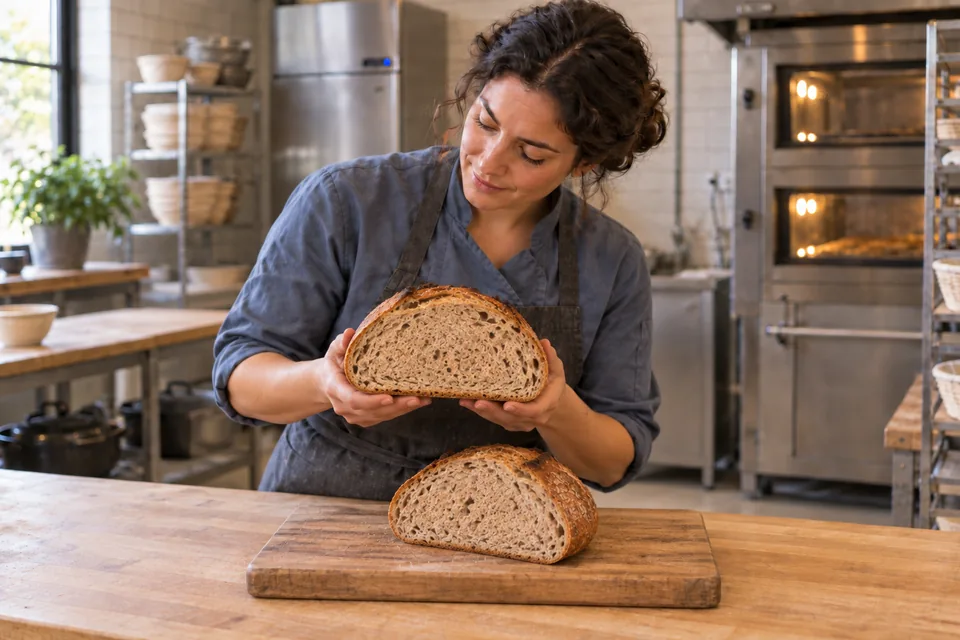
The established baker holds one half of a round whole-wheat loaf near her body; its matching half rests on the board.
Makes
2 loaves, each about 680 g after baking
Heat
245°C conventional
Baking time
30 min covered + 20–25 min uncovered

Preheat covered pots for at least 45 min. Check the crust after 15 min uncovered.

View

Half whole-wheat bread with biga

Makes
2 loaves, each about 680 g after baking
Heat
245°C conventional
Baking time
30 min covered + 20–25 min uncovered

Preheat covered pots for at least 45 min. Check the crust after 15 min uncovered.

Breads with preferments

Half whole-wheat bread with biga

Half-white, half-whole-wheat bread built with a white-flour biga; suited to focaccia.

Method

  1. 01 · Build biga

    12–14 h at 18–21°C

    Use: P

    Take about 44.4 mL from the measured P water to wet the P yeast in a small cup; wait a few minutes and stir. Add to P flour, rinse the cup with another little portion of measured P water, then add all remaining P water. Pinch through with thumb and forefinger, alternating with folds until incorporated. Cover at 18–21°C.

    Ready when: About tripled, slightly domed and dotted with gas bubbles, with a ripe fermented aroma.
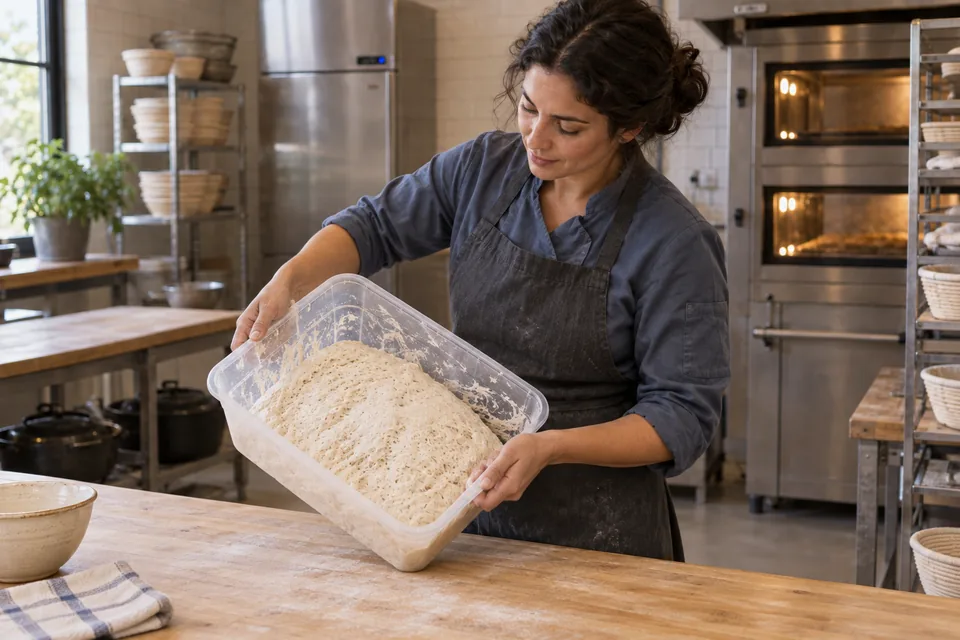
    A baker tilts a clear tub containing a cohesive, aerated ivory biga with a domed porous surface.
    01 Build bigaThe ripe biga should hold a soft dome and show gas bubbles while remaining a cohesive dough.
  2. 02 · Mix final dough

    A few minutes

    Use: D + all mature P

    Mix D flour, salt and yeast; add D water and combine briefly. Add all the mature biga. Wet your hand and alternate 5–6 thumb-and-forefinger pinch cuts with folds until the stiff biga and fresh dough are evenly blended.

    Ready when: Uniform dough with no unmixed lumps of preferment.
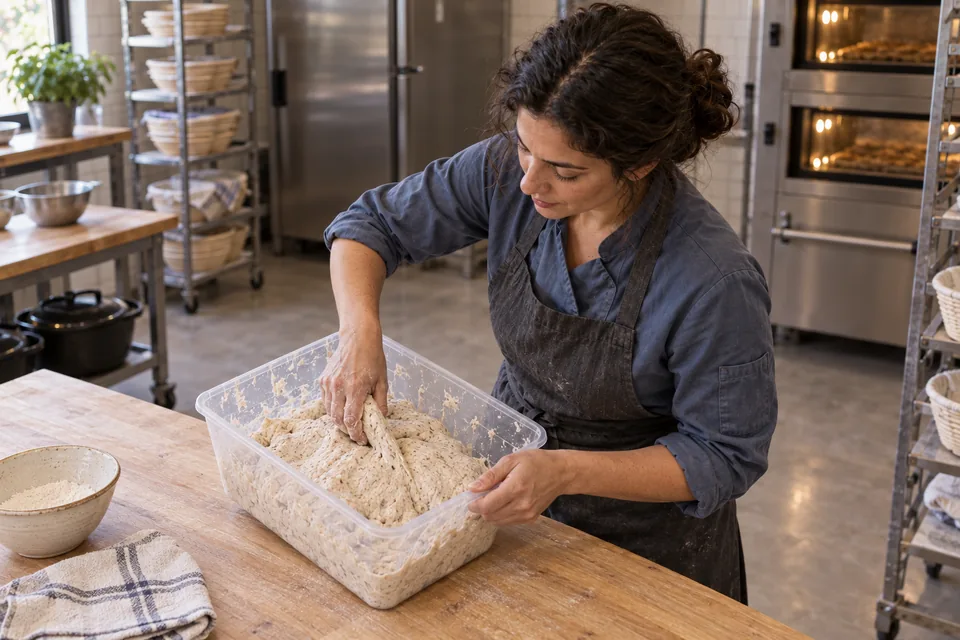
    Viewed from above, a baker pinches through uniform light-beige dough with fine wholegrain flecks.
    02 Mix final doughPinch the mature white-flour biga into the fresh whole-wheat dough until no separate lumps remain.
  3. 03 · Fold and bulk

    3–4 h from end of final mix

    Use: Mixed dough

    Apply 3–4 gentle sets during the first 1½ hours. For each set, wet your hand; stretch one edge upward only to resistance and fold across. Repeat around 4–5 edges until the dough firms, then turn the whole mass seam down. Let it relax before the next set. Cover between folds and during the remaining rise.

    Ready when: About 3 times its initial volume.
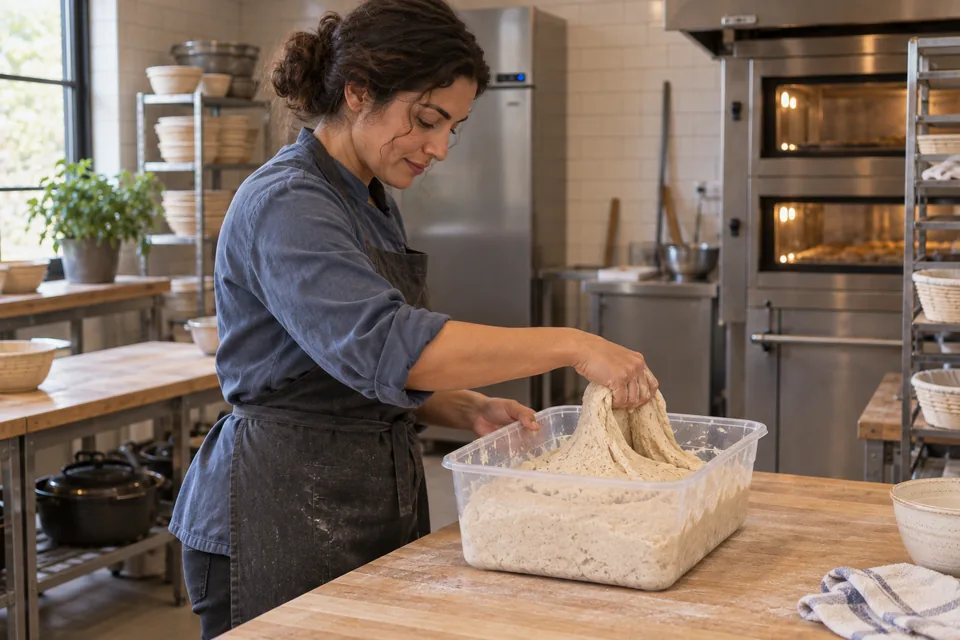
    A side-on baker lifts a connected edge of light-beige flecked dough in a tub.
    03 Fold and bulkFold gently to build strength while keeping the dough connected and untorn.
  4. 04 · Divide and shape

    A few minutes

    Use: Risen dough; dusting flour

    Ease dough onto a lightly floured counter without tearing. Divide equally. Fold each piece’s edges inward to enclose it, turn seam down onto a clean unfloured patch, and cup and drag toward you while turning to make a medium-tight ball. Set seam DOWN in a well-floured basket; flour the top and cover.

    Ready when: Two rounds with moderate tension and intact surfaces.
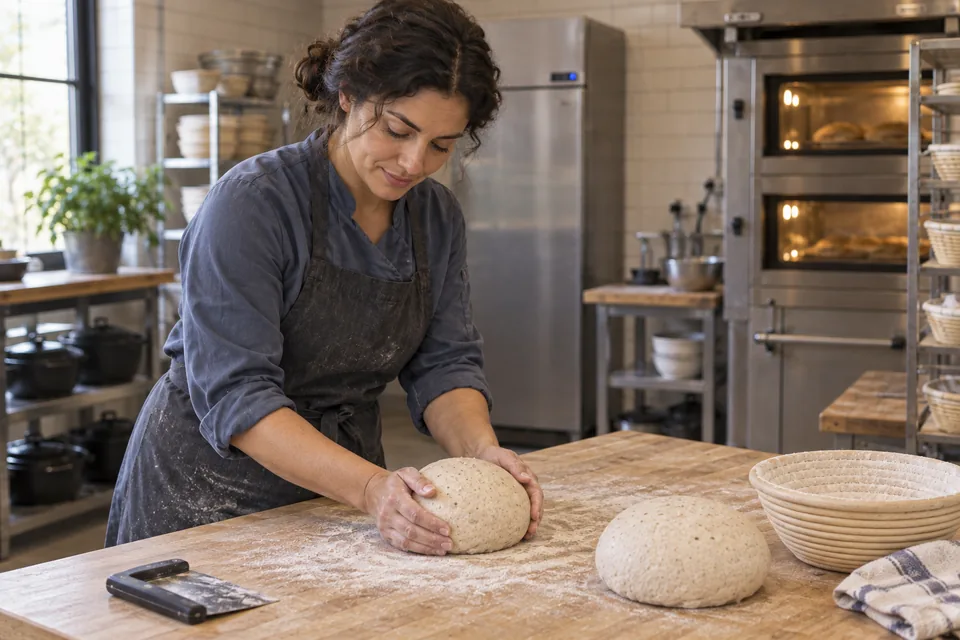
    A baker shapes one light-beige, finely flecked dough round with a second round beside it.
    04 Divide and shapeDivide evenly and cup the two rounds until their surfaces hold gentle tension.
  5. 05 · Proof

    About 1 h; preheat promptly

    Use: Shaped loaves

    Proof covered. Gently press the loaf with a floured fingertip to make a small dent: a slow, incomplete return indicates readiness; immediate spring-back means wait; no return with a slack loaf suggests overproofing.

    Ready when: Loaf aerated and expanded; indentation recovers slowly and incompletely.
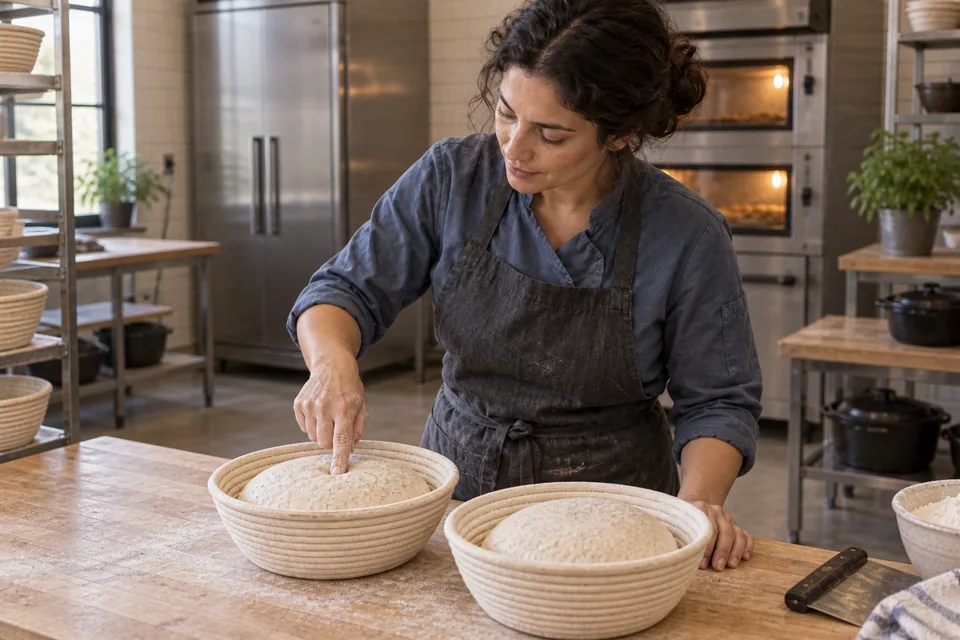
    A baker presses a small dent into one of two light-beige mixed-grain rounds in baskets.
    05 ProofThe rounds should expand without losing their shape; check with a gentle floured fingertip.
  6. 06 · Preheat during proof

    At least 45 min at 245°C

    Use: Oven and lidded pots

    Put lidded Dutch ovens on the middle rack and heat fully. If using one pot, refrigerate the second room-proofing loaf about 20 minutes before baking the first; reheat the empty pot 5 minutes between loaves.

    Ready when: Pots and oven fully heat-soaked.
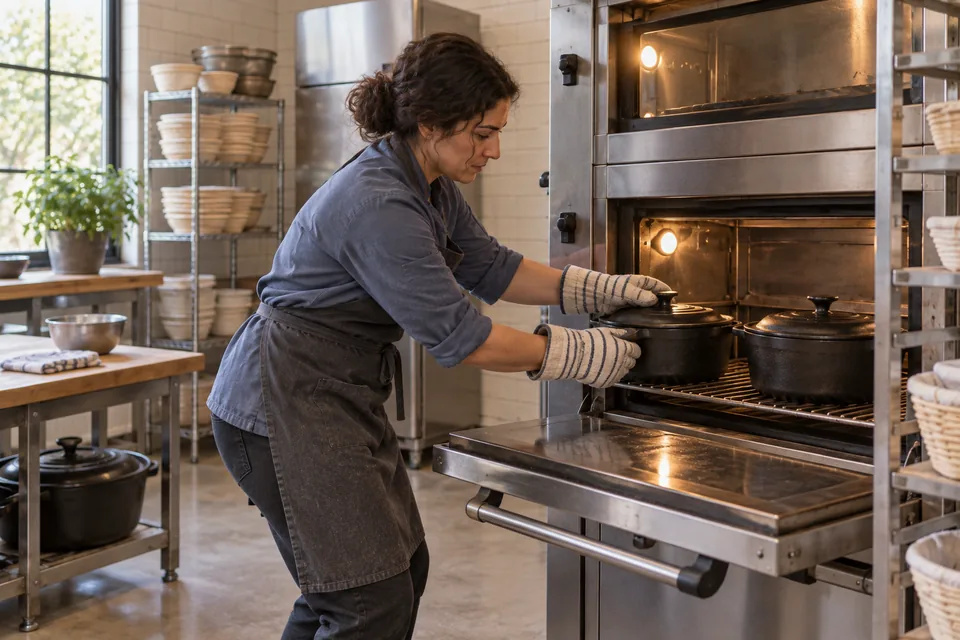
    A baker wearing oven mitts positions two lidded black Dutch ovens on an oven rack.
    06 Preheat during proofHeat the covered pots thoroughly while the loaves finish proofing.
  7. 07 · Load and bake

    245°C throughout

    Use: Proofed loaf

    Invert the loaf onto a lightly floured counter, then carefully lower it seam UP into the hot pot, avoiding the hot sides. No scoring is needed: the seam opens naturally. Use mitts for the pot and lid. Bake covered 30 minutes, then uncovered 20–25 min. Check from 15 minutes uncovered.

    Ready when: Crust at least medium-dark brown all around.
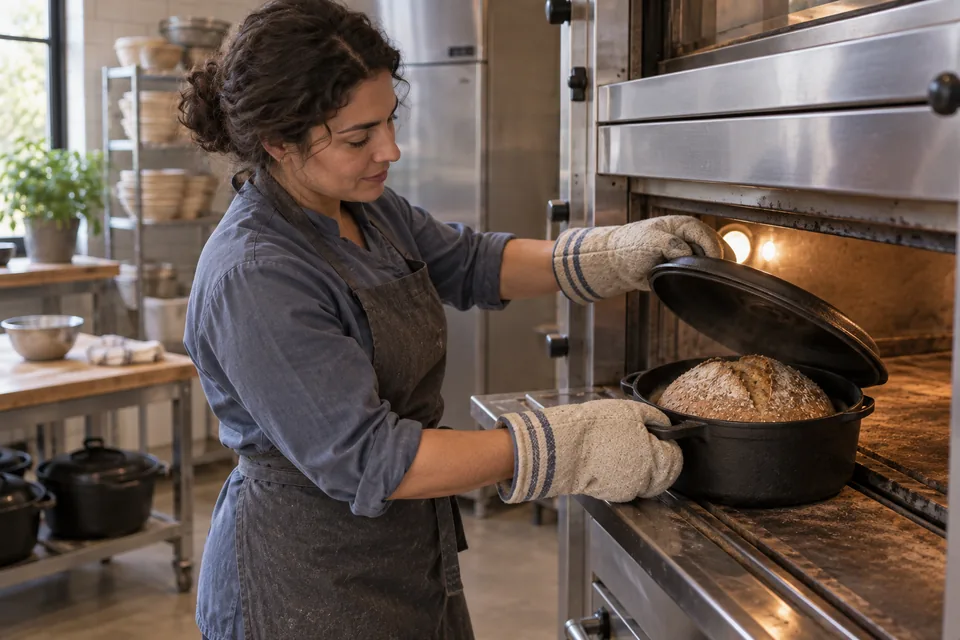
    A baker uses oven mitts to uncover a mixed-grain round loaf in a black Dutch oven.
    07 Load and bakeAfter the covered stage, lift the lid with mitts and let the naturally opened crust brown.
  8. 08 · Cool

    At least 20 min

    Use: Baked loaves

    Turn the bread out and cool on a rack with air beneath it. Wait at least 20 minutes before slicing; allow longer if the center is still very hot.

    Ready when: Crumb begins to set; crust stays aired on the rack.
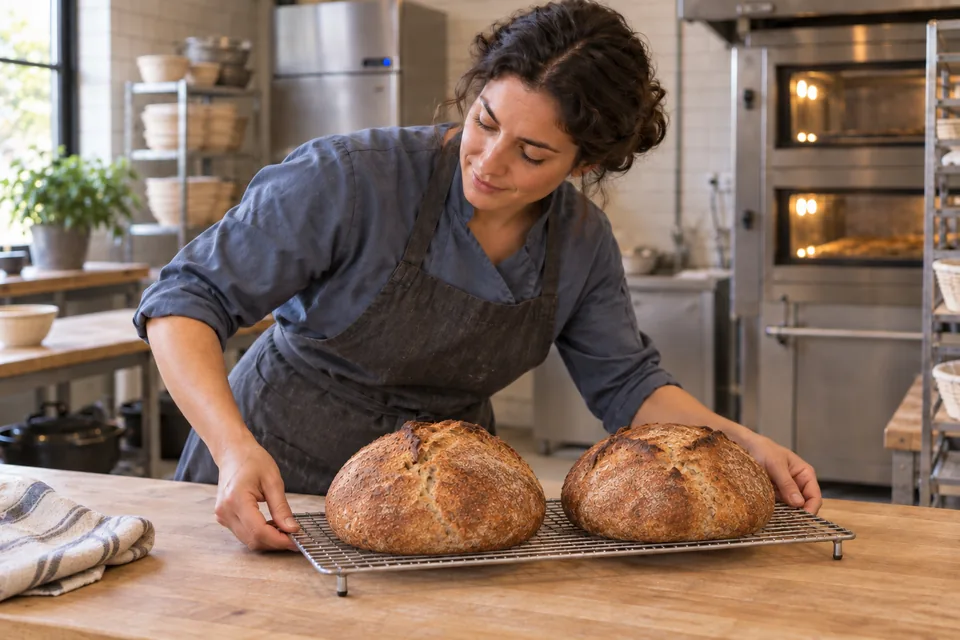
    A baker positions two intact mixed-grain round loaves with plain, naturally split crusts on a wire rack.
    08 CoolLet both loaves cool with air underneath so the crumb can set.

What to look for

StageLook and feelNeeds attention
Mature bigaAbout tripled, slightly domed and dotted with gas bubbles, with a ripe fermented aroma.Using a quiet, underdeveloped build or waiting until it has collapsed well past peak.
Bulk doughAbout 3 times its initial volume. Folds should give increasing support.Tearing the dough during folds or judging only by time.
ProofA gentle finger dent returns slowly and incompletely.Waiting until the whole loaf is fragile or collapses at a touch.

Troubleshooting

If you seeLikely causeWhat to do nowNext time
Biga is ready too earlyThe room was warmer than the reference recipe’s overnight reference temperature.Use the build at its mature stage if possible; do not deliberately leave it collapsing for hours.Use a cooler location or adjust the next build’s water temperature and timing.
Little rise by the stated timeCooler dough or room; weak or inaccurate yeast dose.Check dough temperature and expansion. Allow more time in a gently warm place; continue only when the recipe’s volume cue is reached.Weigh yeast carefully and record final dough temperature; adjust the next batch’s water temperature.
Loaf spreads or collapses at loadingFinal proof went too far or shaping left insufficient tension.Load gently and bake promptly; expect reduced height.Begin checking early, particularly in warmth. Shape with moderate tension and refrigerate a second loaf while the first bakes.
Dark bottom but pale upper crustUneven oven heat or a rack too close to the bottom element.Check oven temperature and finish by crust color while monitoring the base.Use the middle rack and a fully heated pot; verify actual oven temperature.

Recipe notes

  • The P ingredients are part of the total formula. The D row saying “all of P” is a transfer, not another portion of flour, water or yeast.
  • Plan the overnight rise for 18–21°C; warmer rooms shorten preferment maturity and dough rise.
  • The biga is 68% hydration. Use the entire prepared build; its listed transfer weight is rounded.
  • Use the entire biga build, about 840 g.
  • The sample schedule uses the earliest end of the 3–4 hour bulk range; shape later if the dough has not tripled.
Show ingredient flow
The established baker holds one half of a round whole-wheat loaf near her body; its matching half rests on the board.
Half whole-wheat bread with a naturally aerated crumb.

Recipe

Half whole-wheat bread with biga

Half-white, half-whole-wheat bread built with a white-flour biga; suited to focaccia.

How do I make it?

  1. Make the firm overnight dough

    12–14 h at 18–21°C

    Make the biga, a firm dough that rises before the main mix: take about 44.4 mL from the measured group P water to wet the group P yeast in a cup, wait a few minutes and stir. Add this to the group P flour, rinse the cup with a little more of the measured group P water, then add all the remaining group P water. Pinch through the dough with your thumb and forefinger and alternate with folds until mixed, then cover at 18–21°C.

    A baker tilts a clear tub containing a cohesive, aerated ivory biga with a domed porous surface.
    The ripe biga should hold a soft dome and show gas bubbles while remaining a cohesive dough.

    Ready when: About three times bigger, slightly rounded on top and dotted with bubbles, with a fermented smell.

  2. Mix the main dough

    A few minutes

    Mix the group D flour, salt and yeast, add the group D water and mix briefly. Add all the prepared biga, the firm dough made in the first step. With a wet hand, alternate 5–6 pinches through the dough using your thumb and forefinger with folds until the old and new dough are evenly combined.

    Viewed from above, a baker pinches through uniform light-beige dough with fine wholegrain flecks.
    Pinch the mature white-flour biga into the fresh whole-wheat dough until no separate lumps remain.

    Ready when: Evenly mixed dough with no lumps of the prepared overnight mixture.

  3. Fold and let rise

    3–4 h from end of final mix

    Give the dough 3–4 gentle rounds of folding during the first 1½ hours of its first rise. Each time, wet your hand, lift one edge just until it resists and fold it across; repeat around 4–5 edges until the dough firms, then turn it folded-side down. Let it relax between folding rounds, and keep it covered between rounds and for the rest of the rise.

    A side-on baker lifts a connected edge of light-beige flecked dough in a tub.
    Fold gently to build strength while keeping the dough connected and untorn.

    Ready when: About 3 times its starting size.

  4. Shape the loaves

    A few minutes

    Gently tip the dough onto a lightly floured counter without tearing it and cut it into two equal pieces. Fold each piece’s edges into the middle, turn the folded side down onto a clean patch without flour, then cup and gently pull it toward you while turning to form a smooth, moderately firm ball. Place each ball folded-side DOWN in a well-floured rising basket, flour the top and cover.

    A baker shapes one light-beige, finely flecked dough round with a second round beside it.
    Divide evenly and cup the two rounds until their surfaces hold gentle tension.

    Ready when: Two moderately firm rounds with no tears on the surface.

  5. Let the loaves rise

    About 1 h; preheat promptly

    Keep the shaped loaves covered as they rise. Gently press a loaf with a floured fingertip to make a small dent: it is ready when the dent slowly rises partway back. If it springs straight back, wait longer; if the dent stays and the loaf feels loose and weak, it may have risen too far.

    A baker presses a small dent into one of two light-beige mixed-grain rounds in baskets.
    The rounds should expand without losing their shape; check with a gentle floured fingertip.

    Ready when: The loaf has grown and feels airy; a finger dent slowly rises partway back.

  6. Heat the oven and pots

    At least 45 min at 245°C

    Heat the heavy lidded pots on the oven’s middle rack until fully hot. If you have only one pot, put the second loaf in the fridge about 20 minutes before baking the first. Reheat the empty pot for 5 minutes before baking the second loaf.

    A baker wearing oven mitts positions two lidded black Dutch ovens on an oven rack.
    Heat the covered pots thoroughly while the loaves finish proofing.

    Ready when: The pots and oven are fully hot.

  7. Bake the bread

    245°C throughout

    Turn the loaf out onto a lightly floured counter, then use oven mitts to lower it folded-side UP into the hot pot without touching the sides. Leave the top uncut—the fold will open as it bakes—and bake with the lid on for 30 minutes. Remove the lid and bake 20–25 minutes more, checking from 15 minutes after removing it.

    A baker uses oven mitts to uncover a mixed-grain round loaf in a black Dutch oven.
    After the covered stage, lift the lid with mitts and let the naturally opened crust brown.

    Ready when: The crust is medium-dark brown or darker all around.

  8. Let it cool

    At least 20 min

    Take the bread out of the pot and set it on a rack so air can pass underneath. Wait at least 20 minutes before slicing, and longer if the middle is still very hot.

    A baker positions two intact mixed-grain round loaves with plain, naturally split crusts on a wire rack.
    Let both loaves cool with air underneath so the crumb can set.

    Ready when: The inside is beginning to firm up while air can reach the crust.

What can go wrong, and how can I fix it?

What you noticeLikely causeWhat to do
Biga is ready too earlyThe room was warmer than the reference recipe’s overnight reference temperature.Use the build at its mature stage if possible; do not deliberately leave it collapsing for hours. Use a cooler location or adjust the next build’s water temperature and timing.
Little rise by the stated timeCooler dough or room; weak or inaccurate yeast dose.Check dough temperature and expansion. Allow more time in a gently warm place; continue only when the recipe’s volume cue is reached. Weigh yeast carefully and record final dough temperature; adjust the next batch’s water temperature.
Loaf spreads or collapses at loadingFinal proof went too far or shaping left insufficient tension.Load gently and bake promptly; expect reduced height. Begin checking early, particularly in warmth. Shape with moderate tension and refrigerate a second loaf while the first bakes.
Dark bottom but pale upper crustUneven oven heat or a rack too close to the bottom element.Check oven temperature and finish by crust color while monitoring the base. Use the middle rack and a fully heated pot; verify actual oven temperature.
Useful recipe notes

The P ingredients are part of the total formula. The D row saying “all of P” is a transfer, not another portion of flour, water or yeast.

Plan the overnight rise for 18–21°C; warmer rooms shorten preferment maturity and dough rise.

The biga is 68% hydration. Use the entire prepared build; its listed transfer weight is rounded.

Use the entire biga build, about 840 g.

The sample schedule uses the earliest end of the 3–4 hour bulk range; shape later if the dough has not tripled.

See the detailed method and ratios in , or follow ingredients through the .

Ingredient proportions & recipe details

Half whole-wheat bread with biga at a glance

Makes
2 loaves, each about 680 g after baking
Heat
245°C conventional
Baking time
30 min covered + 20–25 min uncovered
Dough hydration
80%
Prefermented flour
50% of total flour
Leavening
Yeast
Bulk fermentation
3–4 h from end of final mix · About 3 times its initial volume.
How do the ingredient proportions compare?

Core dough totals include the flour and water in the portion of starter or preferment used. Do not add them again. Toppings, fillings and dusting flour are separate.

Formula componentGramsFlour = 100%
Total flour1000 g100%
Total water800 g80%
Salt22 g2.2%
Instant yeast3.4 g0.3%