Nepedia

Savoury crackers

Small, crisp crackers made with grated cheese and butter. Roll them evenly and let them cool fully so their centres become firm.

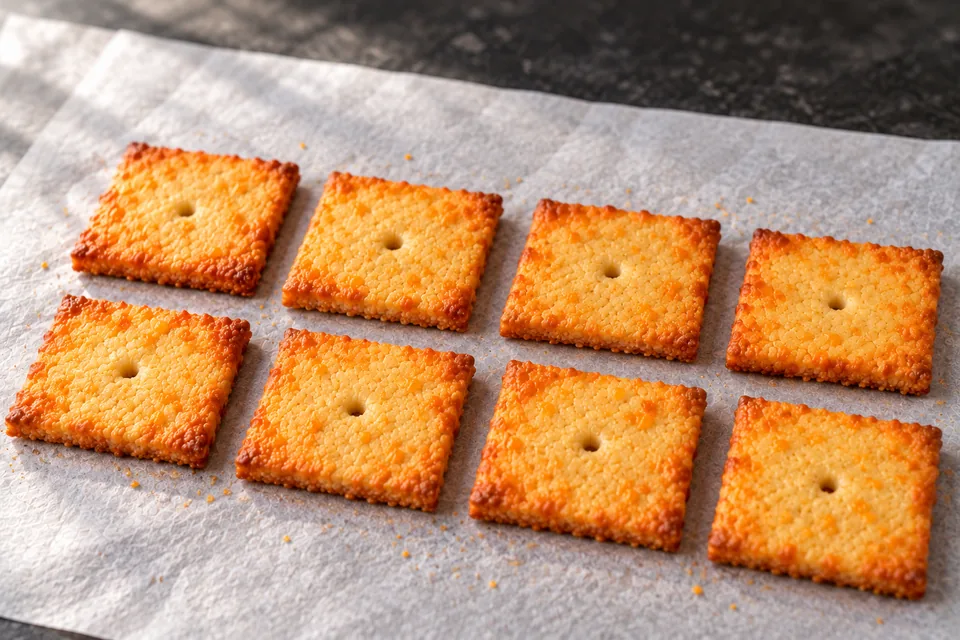
Eight small golden square cheese crackers with single centre holes on parchment.
Makes
128 small crackers, approximately
Heat
175°C conventional
Baking time
18–22 min per tray; 36–44 min for two trays
Cuisine / style
International
View

Cheese crackers

Makes
128 small crackers, approximately
Heat
175°C conventional
Baking time
18–22 min per tray; 36–44 min for two trays
Cuisine / style
International
International · Savoury crackers

Cheese crackers

Small, crisp crackers made with grated cheese and butter. Roll them evenly and let them cool fully so their centres become firm.

Method

  1. 01 · Make the cold cheese dough

    5–8 min

    Use: Mature Cheddar; Plain flour; Cornflour (cornstarch); Fine salt; Unsalted butter; Cold water

    Put the cheese, flour, cornflour and salt into a food processor. Pulse to combine, then add the cold butter and pulse until finely crumbly. Add the water and pulse briefly until the crumbs hold together when squeezed. Stop before the mixture becomes greasy.

    Ready when: A handful forms a cohesive clump; there are no large butter pieces or pockets of dry flour.
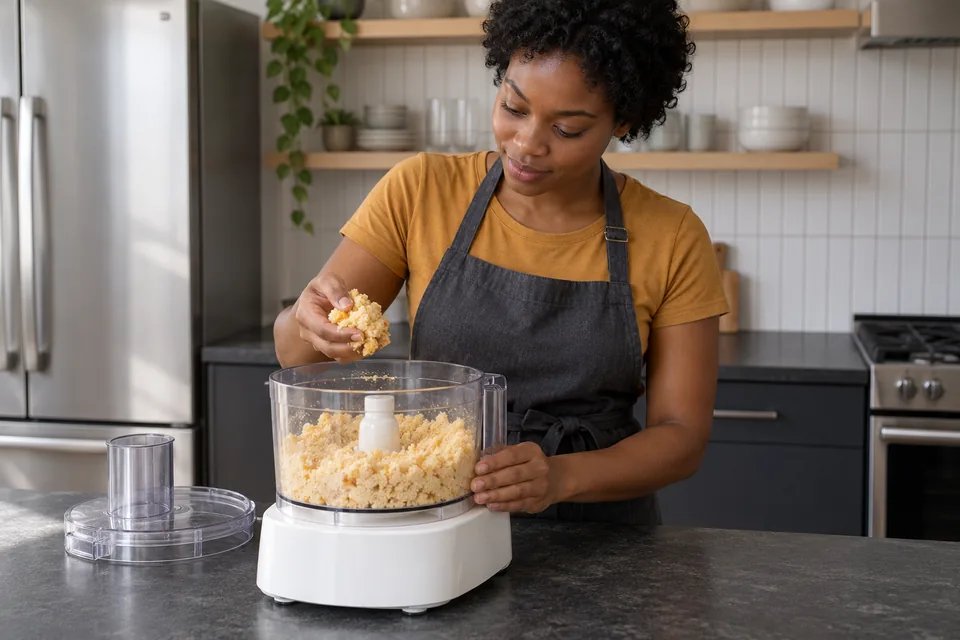
    Baker squeezes a clump of pale golden cheese dough above an open food processor.
    01 Cheese crackers — step 1Pulse until a squeezed handful holds together.
  2. 02 · Divide and chill the dough

    45–50 min

    Use:

    Gather the dough without kneading it. Divide it in half, flatten each piece into a small square and wrap. Refrigerate for 45 minutes. During the last 20 minutes, heat the oven to 175°C conventional.

    Ready when: Both pieces are firm and cool enough to roll without smearing.
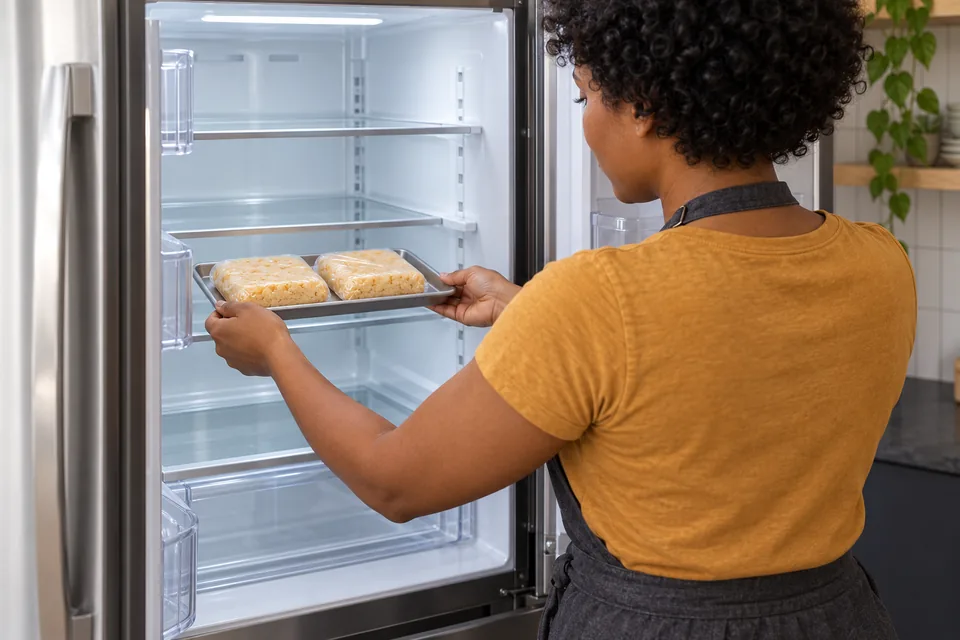
    Baker places two wrapped square slabs of cheese dough on a refrigerator shelf.
    02 Cheese crackers — step 2Divide, flatten and refrigerate the two wrapped pieces.
  3. 03 · Roll two thin sheets

    8–12 min

    Use: Plain flour for rolling

    Line two 30 × 40 cm trays with baking paper. Lightly flour the worktop and rolling pin. Roll each dough piece to about 3 mm thick, aiming for a 24 cm square. Keep the other piece refrigerated while you work; chill any sheet that starts to feel greasy.

    Ready when: The sheets have an even thickness, with no thick centre or paper-thin edges.
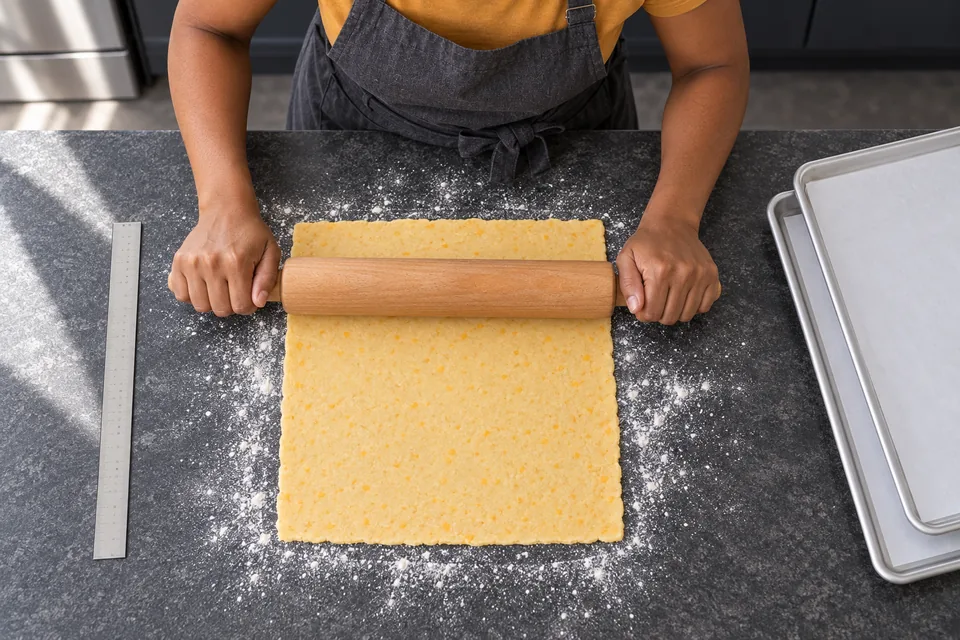
    Baker rolls a thin square of pale golden cheese dough beside two lined trays.
    03 Cheese crackers — step 3Roll each cold piece evenly to about 3 mm.
  4. 04 · Cut and dock the squares

    10–15 min

    Use:

    Cut each sheet into eight strips, then make seven crosscuts at roughly 3 cm intervals to create eight rows, about 64 squares per sheet. Transfer to the trays with small gaps. Pierce each centre with a skewer. Bake irregular edge pieces too, checking them early; keep the waiting tray refrigerated.

    Ready when: The small squares are separate, evenly thin and pierced through the middle.
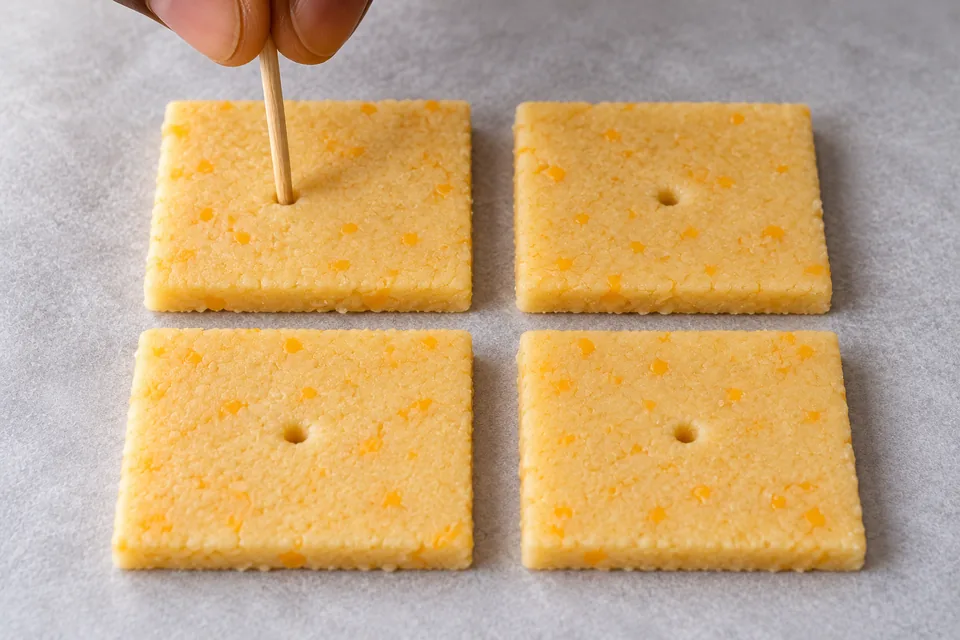
    A wooden skewer pierces the centre of one of four small raw cheese-cracker squares on parchment.
    04 Cheese crackers — step 4Cut small squares and pierce each centre.
  5. 05 · Bake one tray at a time

    36–44 min

    Use:

    Bake one tray at a time for 18–22 minutes. Turn the tray around if it colours unevenly. Remove small or thin pieces as soon as they are ready and continue baking the others.

    Ready when: Edges are golden brown and the centres look dry. A cooled sample should snap; a soft centre needs a little more baking.
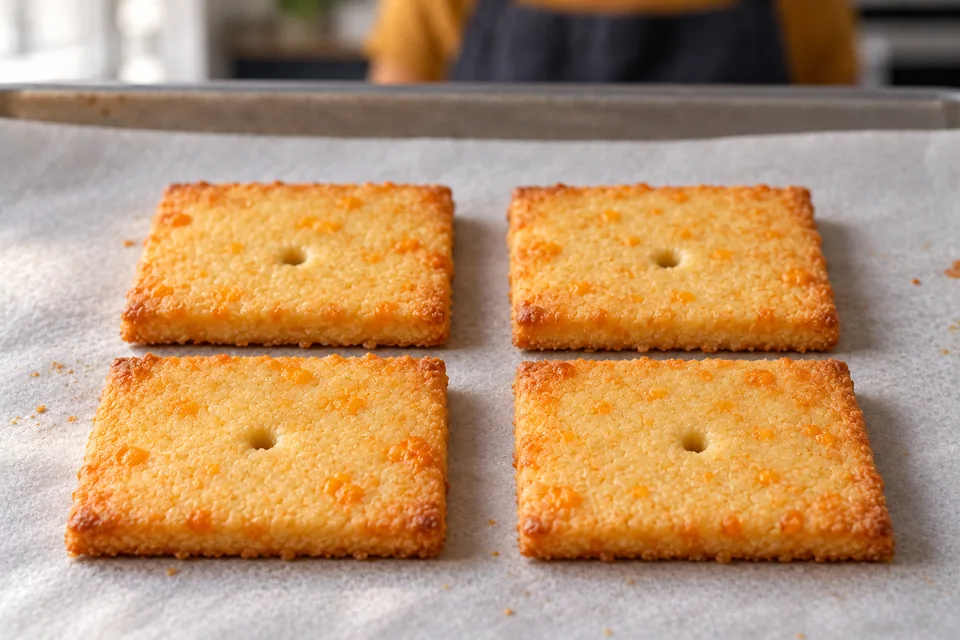
    Four small cheese crackers on parchment have golden-brown edges, dry centres and single centre holes.
    05 Cheese crackers — step 5Bake one tray at a time until the edges are golden and the centres look dry.
  6. 06 · Cool completely and check the centres

    20 min

    Use:

    Leave the crackers on their trays for 20 minutes, until completely cool. Check one from the middle of each tray before packing.

    Ready when: The centres are firm and crisp, with no warmth or steam trapped beneath them.
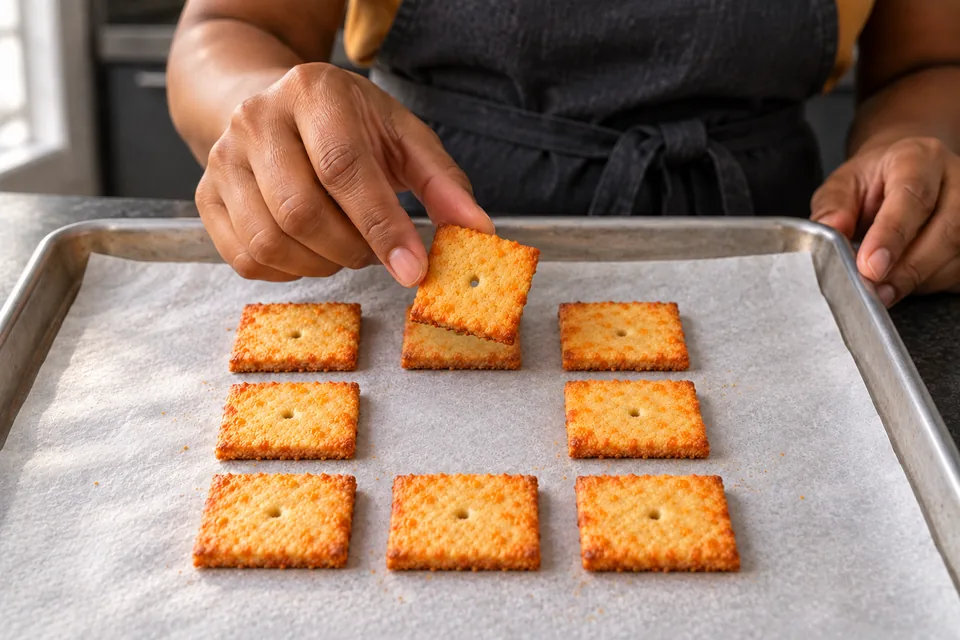
    Baker lifts one small golden cheese cracker above its empty centre space among eight crackers on a lined tray.
    06 Cheese crackers — step 6Cool on the trays and check a middle cracker before packing.

What to look for

StageLook / feel forNeeds attention
Make the cold cheese doughA handful forms a cohesive clump; there are no large butter pieces or pockets of dry flour.
Divide and chill the doughBoth pieces are firm and cool enough to roll without smearing.
Roll two thin sheetsThe sheets have an even thickness, with no thick centre or paper-thin edges.
Cut and dock the squaresThe small squares are separate, evenly thin and pierced through the middle.
Bake one tray at a timeEdges are golden brown and the centres look dry. A cooled sample should snap; a soft centre needs a little more baking.
Cool completely and check the centresThe centres are firm and crisp, with no warmth or steam trapped beneath them.

Troubleshooting

If you see thisLikely causeWhat to do nowNext time
The sheet sticks or looks oily.The butter and cheese have warmed.Refrigerate the dough for 10–15 minutes before rolling again.Work with one portion at a time and use a light dusting of flour.
Edges darken while the middle remains soft.The sheet has thick and thin patches.Remove browned pieces and continue baking the paler ones.Check thickness across the whole sheet before cutting.
The dough crumbles instead of holding together.Flour absorption or cheese moisture varies.Add 2 g cold water at a time and pulse briefly, only until a squeezed clump holds.Weigh the ingredients and avoid adding the rolling flour to the mixing bowl.

Storage: Best eaten on the day. Cool fully before storing at room temperature for up to 3 days. If they soften, spread on a tray and warm at 150°C conventional for 5–8 minutes, then cool completely again.; For a nuttier flavour, replace the Cheddar with 170 g finely grated Gruyère. The crackers will be paler; judge readiness by dry centres and lightly browned edges.; Contains: wheat, milk.; This Nepedia version has not been kitchen-tested.

Ingredient choices & substitutions

No brand is specified.

Match the ingredient’s function and weight. See the flour, gluten, yeast and salt guide.

Other approaches to this recipe
Cook / recipeUseWhat differs

The working ingredients and method form one recipe. Different formulas are compared without averaging their quantities or rise schedules.
Nepedia

Recipe

Cheese crackers

Small, crisp crackers made with grated cheese and butter. Roll them evenly and let them cool fully so their centres become firm.

How do I make it?

  1. Make the cold cheese dough

    5–8 min

    Put the cheese, flour, cornflour and salt into a food processor. Pulse to combine, then add the cold butter and pulse until finely crumbly. Add the water and pulse briefly until the crumbs hold together when squeezed. Stop before the mixture becomes greasy.

    Baker squeezes a clump of pale golden cheese dough above an open food processor.
    Pulse until a squeezed handful holds together.

    Ready when: A handful forms a cohesive clump; there are no large butter pieces or pockets of dry flour.

  2. Divide and chill the dough

    45–50 min

    Gather the dough without kneading it. Divide it in half, flatten each piece into a small square and wrap. Refrigerate for 45 minutes. During the last 20 minutes, heat the oven to 175°C conventional.

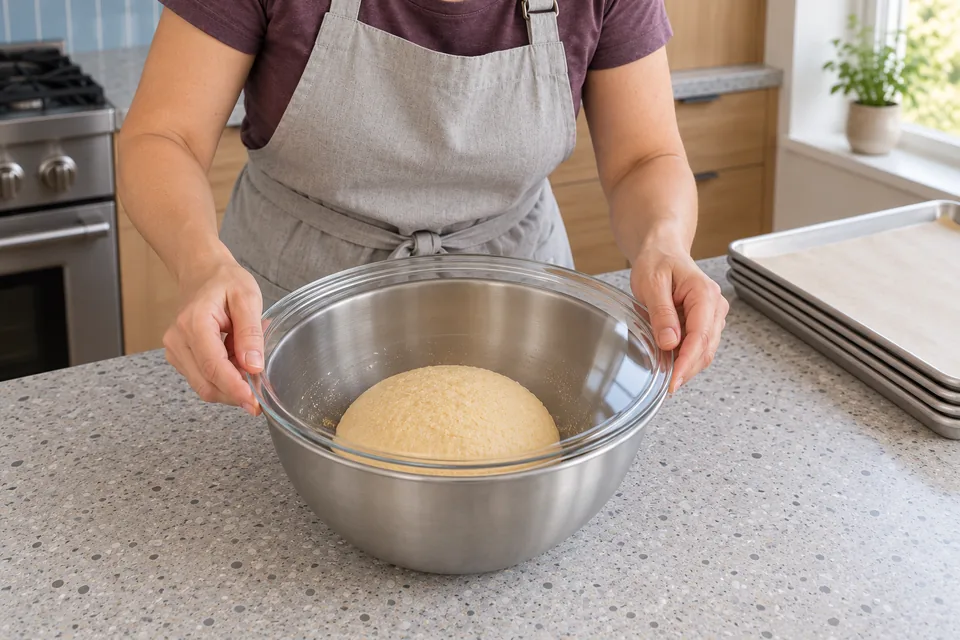
    Baker places two wrapped square slabs of cheese dough on a refrigerator shelf.
    Divide, flatten and refrigerate the two wrapped pieces.

    Ready when: Both pieces are firm and cool enough to roll without smearing.

  3. Roll two thin sheets

    8–12 min

    Line two 30 × 40 cm trays with baking paper. Lightly flour the worktop and rolling pin. Roll each dough piece to about 3 mm thick, aiming for a 24 cm square. Keep the other piece refrigerated while you work; chill any sheet that starts to feel greasy.

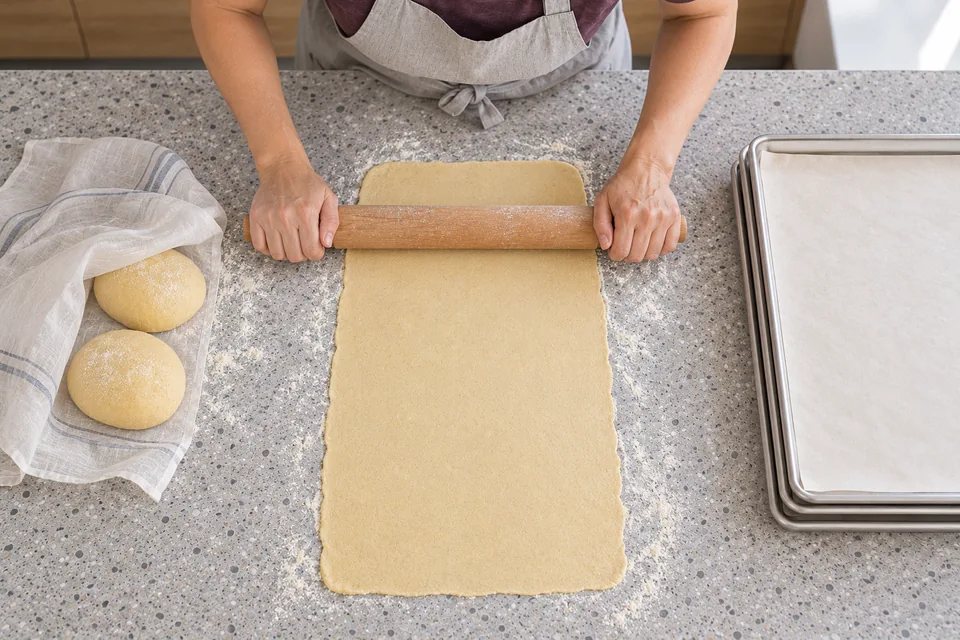
    Baker rolls a thin square of pale golden cheese dough beside two lined trays.
    Roll each cold piece evenly to about 3 mm.

    Ready when: The sheets have an even thickness, with no thick centre or paper-thin edges.

  4. Cut and dock the squares

    10–15 min

    Cut each sheet into eight strips, then make seven crosscuts at roughly 3 cm intervals to create eight rows, about 64 squares per sheet. Transfer to the trays with small gaps. Pierce each centre with a skewer. Bake irregular edge pieces too, checking them early; keep the waiting tray refrigerated.

    A wooden skewer pierces the centre of one of four small raw cheese-cracker squares on parchment.
    Cut small squares and pierce each centre.

    Ready when: The small squares are separate, evenly thin and pierced through the middle.

  5. Bake one tray at a time

    36–44 min

    Bake one tray at a time for 18–22 minutes. Turn the tray around if it colours unevenly. Remove small or thin pieces as soon as they are ready and continue baking the others.

    Four small cheese crackers on parchment have golden-brown edges, dry centres and single centre holes.
    Bake one tray at a time until the edges are golden and the centres look dry.

    Ready when: Edges are golden brown and the centres look dry. A cooled sample should snap; a soft centre needs a little more baking.

  6. Cool completely and check the centres

    20 min

    Leave the crackers on their trays for 20 minutes, until completely cool. Check one from the middle of each tray before packing.

    Baker lifts one small golden cheese cracker above its empty centre space among eight crackers on a lined tray.
    Cool on the trays and check a middle cracker before packing.

    Ready when: The centres are firm and crisp, with no warmth or steam trapped beneath them.

What can go wrong, and how can I fix it?

What you noticeLikely causeWhat to do
The sheet sticks or looks oily.The butter and cheese have warmed.Refrigerate the dough for 10–15 minutes before rolling again. Work with one portion at a time and use a light dusting of flour.
Edges darken while the middle remains soft.The sheet has thick and thin patches.Remove browned pieces and continue baking the paler ones. Check thickness across the whole sheet before cutting.
The dough crumbles instead of holding together.Flour absorption or cheese moisture varies.Add 2 g cold water at a time and pulse briefly, only until a squeezed clump holds. Weigh the ingredients and avoid adding the rolling flour to the mixing bowl.
Useful recipe notes

Storage: Best eaten on the day. Cool fully before storing at room temperature for up to 3 days. If they soften, spread on a tray and warm at 150°C conventional for 5–8 minutes, then cool completely again.

For a nuttier flavour, replace the Cheddar with 170 g finely grated Gruyère. The crackers will be paler; judge readiness by dry centres and lightly browned edges.

Contains: wheat, milk.

This Nepedia version has not been kitchen-tested.

See the detailed method and ratios in , or follow ingredients through the .

Ingredient proportions & recipe details

Cheese crackers at a glance

Makes
128 small crackers, approximately
Heat
175°C conventional
Baking time
18–22 min per tray; 36–44 min for two trays
Cuisine / style
International
How do the ingredient proportions compare?

Percentages compare each listed weight with the combined flour weight (100%). These are ingredient ratios, not dough hydration; milk, eggs and fillings contain other ingredients as well as water.

Formula componentGramsFlour = 100%
Mature Cheddar170 g136%
Plain flour125 g100%
Cornflour (cornstarch)4 g3.2%
Fine salt1.5 g1.2%
Unsalted butter85 g68%
Cold water30 g24%

Sesame and semolina crackers

Makes
72 triangles, approximately
Heat
180°C conventional
Baking time
15–22 min per tray;45–66 min for three trays
Cuisine / style
International
International · Savoury crackers

Sesame and semolina crackers

Thin, crisp triangles with a dense sesame topping. A short rest makes the semolina dough easier to roll without pulling back.

Method

  1. 01 · Mix and knead the firm dough

    8–12 min

    Use: Strong white bread flour; Fine semolina; Fine salt; Olive oil; Water; Whole milk

    Mix the bread flour, fine semolina and salt in a bowl. Add the olive oil, water and milk and stir until no loose flour remains. Knead for about 5 minutes. If dry crumbs remain, add water 5 g at a time, just until the dough becomes firm and pliable.

    Ready when: The dough bends without breaking and is firm rather than sticky; its surface may still feel slightly grainy.

    Baker kneads a firm pale semolina dough in a steel bowl beside three nested trays.
    01 Sesame and semolina crackers — step 1Knead until the dough is firm and pliable.
  2. 02 · Rest,prepare trays and heat the oven

    30 min

    Use:

    Cover the dough and leave it at room temperature for 30 minutes. Heat the oven to 180°C conventional during the last 20 minutes. Line three 30 × 40 cm trays with baking paper.

    Ready when: The dough feels more supple and a small flattened piece does not spring back sharply.

    Hands cover a steel bowl holding a compact firm semolina dough.
    02 Sesame and semolina crackers — step 2Cover and rest the dough before rolling.
  3. 03 · Roll three thin sheets

    12–18 min

    Use: Plain flour for rolling

    Divide the dough into three equal pieces, about 190 g each. Keep two covered while rolling the first on a lightly floured worktop. Aim for a 28 × 36 cm rectangle about 1.5 mm thick. Brush off loose flour and move it onto a lined tray. Repeat with the other pieces.

    Ready when: Each sheet is evenly thin, with no thick central patch; small edge irregularities are fine.

    Baker rolls one thin rectangular sheet while two covered dough portions wait beside three trays.
    03 Sesame and semolina crackers — step 3Roll three evenly thin sheets.
  4. 04 · Brush,coat with sesame,cut and dock

    10–15 min

    Use: Medium egg; Sesame seeds

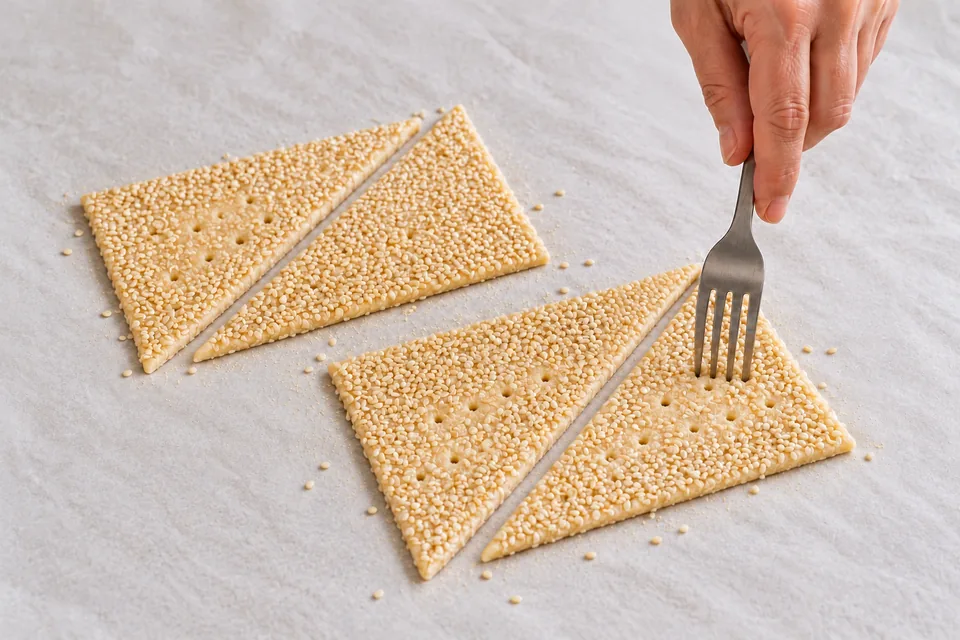
    Beat the egg and brush each sheet lightly. Scatter the sesame seeds evenly over all three sheets and press gently so they stick. Cut each sheet into twelve rectangles, roughly 7 × 12 cm, then cut each rectangle diagonally to make 24 triangles. Pierce with a fork and nudge pieces slightly apart. Discard unused egg wash.

    Ready when: A close layer of sesame adheres to the surface; the cuts reach through the dough and the pieces have tiny gaps.

    A fork pierces a thin raw sesame-coated right triangle beside three matching triangles on parchment.
    04 Sesame and semolina crackers — step 4Pierce the sesame-coated triangles and separate them slightly.
  5. 05 · Bake each tray until crisp

    45–66 min

    Use:

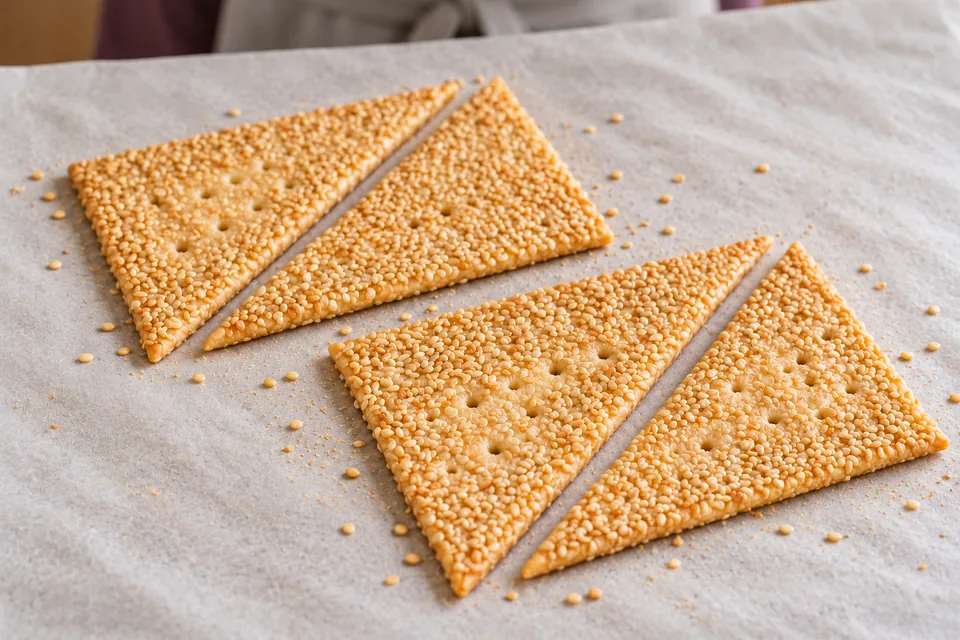
    Bake one tray at a time for 15–22 minutes. Keep the waiting trays covered. Turn the tray around if the edges colour first. Remove any golden, dry pieces while the paler ones finish.

    Ready when: The crackers and seeds are golden rather than dark brown. A briefly cooled piece snaps instead of bending, with no leathery centre.

    Four thin right-triangle crackers and their sesame seeds are golden on parchment.
    05 Sesame and semolina crackers — step 5Bake one tray at a time until golden and dry.
  6. 06 · Cool completely

    20 min

    Use:

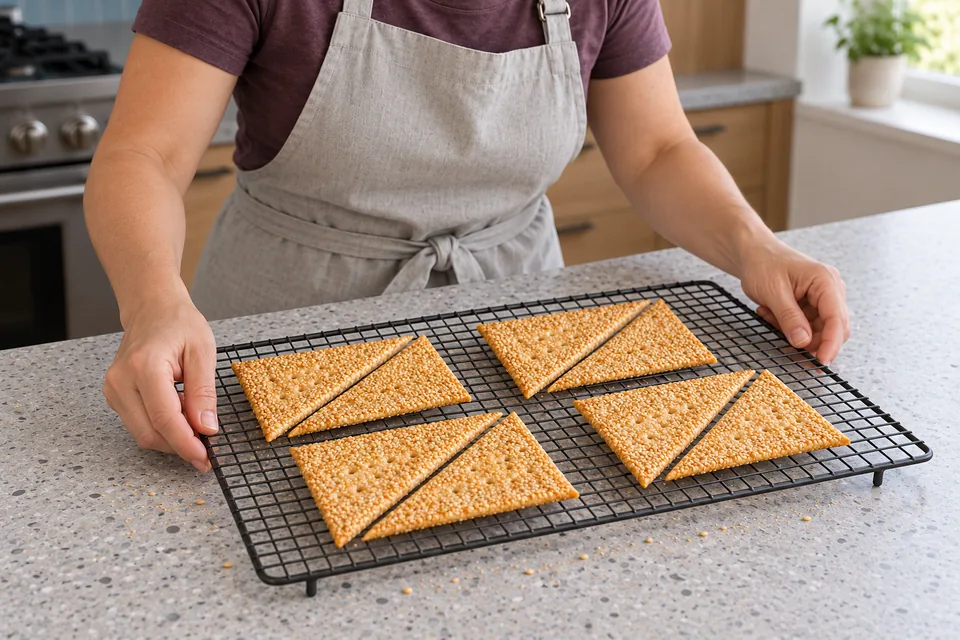
    Move the crackers to racks and cool for 20 minutes before serving or storing. Let loose sesame fall away rather than packing it with the crackers.

    Ready when: The triangles are fully cool and brittle, with no trapped warmth beneath them.

    Eight thin golden sesame-coated right triangles cool in four pairs on a wire rack.
    06 Sesame and semolina crackers — step 6Cool on racks before serving or storing.

What to look for

StageLook / feel forNeeds attention
Mix and knead the firm doughThe dough bends without breaking and is firm rather than sticky; its surface may still feel slightly grainy.
Rest,prepare trays and heat the ovenThe dough feels more supple and a small flattened piece does not spring back sharply.
Roll three thin sheetsEach sheet is evenly thin, with no thick central patch; small edge irregularities are fine.
Brush,coat with sesame,cut and dockA close layer of sesame adheres to the surface; the cuts reach through the dough and the pieces have tiny gaps.
Bake each tray until crispThe crackers and seeds are golden rather than dark brown. A briefly cooled piece snaps instead of bending, with no leathery centre.
Cool completelyThe triangles are fully cool and brittle, with no trapped warmth beneath them.

Troubleshooting

If you see thisLikely causeWhat to do nowNext time
The dough shrinks as you roll it.Its gluten is tight or it has not rested enough.Cover the partly rolled sheet and wait 10 minutes before continuing.Give the mixed dough its full covered rest.
The seeds darken before the centres crisp.The sheet is too thick or the oven is hotter than expected.Lower the oven to 160°C and finish drying the centres, checking frequently.Roll uniformly thin and use pale, untoasted sesame.
The dough cracks at its edges.The flour blend is dry or the surface was left uncovered.Knead in 5 g water, cover and rest briefly before rolling again.Keep waiting dough pieces covered and avoid adding excess bench flour.

Storage: Cool fully and keep in an airtight container at room temperature for up to 5 days. If they soften, warm at 150°C conventional for 5–8 minutes and cool fully again before closing the container.; Contains: wheat, milk, egg, sesame.; This Nepedia version has not been kitchen-tested.

Ingredient choices & substitutions

No brand is specified.

Match the ingredient’s function and weight. See the flour, gluten, yeast and salt guide.

Other approaches to this recipe
Cook / recipeUseWhat differs

The working ingredients and method form one recipe. Different formulas are compared without averaging their quantities or rise schedules.
Nepedia
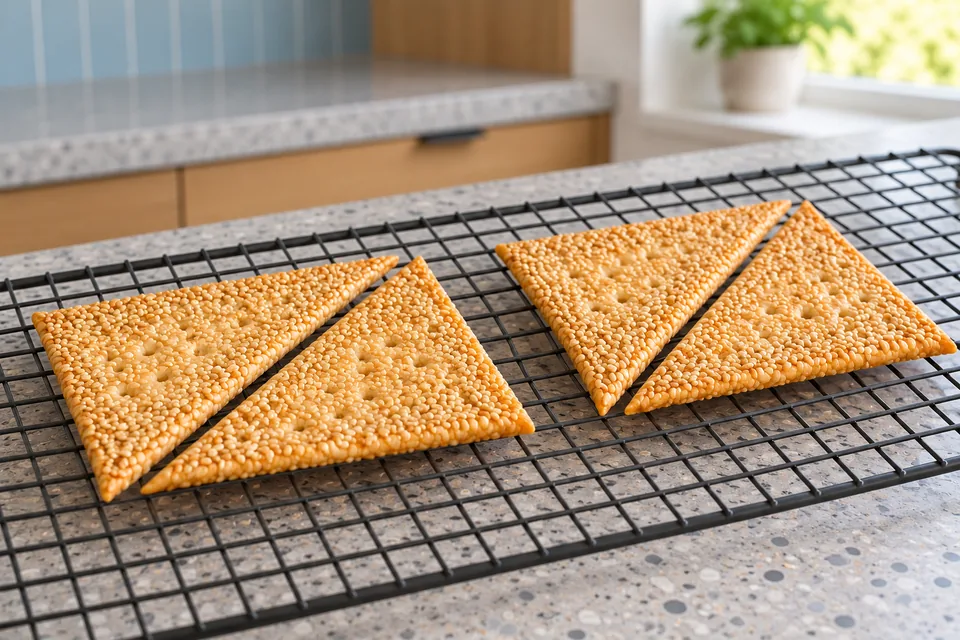
Four thin golden sesame-coated right triangles arranged in two pairs on a cooling rack.
Crisp sesame and semolina triangles.

Recipe

Sesame and semolina crackers

Thin, crisp triangles with a dense sesame topping. A short rest makes the semolina dough easier to roll without pulling back.

How do I make it?

  1. Mix and knead the firm dough

    8–12 min

    Mix the bread flour, fine semolina and salt in a bowl. Add the olive oil, water and milk and stir until no loose flour remains. Knead for about 5 minutes. If dry crumbs remain, add water 5 g at a time, just until the dough becomes firm and pliable.

    Baker kneads a firm pale semolina dough in a steel bowl beside three nested trays.
    Knead until the dough is firm and pliable.

    Ready when: The dough bends without breaking and is firm rather than sticky; its surface may still feel slightly grainy.

  2. Rest,prepare trays and heat the oven

    30 min

    Cover the dough and leave it at room temperature for 30 minutes. Heat the oven to 180°C conventional during the last 20 minutes. Line three 30 × 40 cm trays with baking paper.

    Hands cover a steel bowl holding a compact firm semolina dough.
    Cover and rest the dough before rolling.

    Ready when: The dough feels more supple and a small flattened piece does not spring back sharply.

  3. Roll three thin sheets

    12–18 min

    Divide the dough into three equal pieces, about 190 g each. Keep two covered while rolling the first on a lightly floured worktop. Aim for a 28 × 36 cm rectangle about 1.5 mm thick. Brush off loose flour and move it onto a lined tray. Repeat with the other pieces.

    Baker rolls one thin rectangular sheet while two covered dough portions wait beside three trays.
    Roll three evenly thin sheets.

    Ready when: Each sheet is evenly thin, with no thick central patch; small edge irregularities are fine.

  4. Brush,coat with sesame,cut and dock

    10–15 min

    Beat the egg and brush each sheet lightly. Scatter the sesame seeds evenly over all three sheets and press gently so they stick. Cut each sheet into twelve rectangles, roughly 7 × 12 cm, then cut each rectangle diagonally to make 24 triangles. Pierce with a fork and nudge pieces slightly apart. Discard unused egg wash.

    A fork pierces a thin raw sesame-coated right triangle beside three matching triangles on parchment.
    Pierce the sesame-coated triangles and separate them slightly.

    Ready when: A close layer of sesame adheres to the surface; the cuts reach through the dough and the pieces have tiny gaps.

  5. Bake each tray until crisp

    45–66 min

    Bake one tray at a time for 15–22 minutes. Keep the waiting trays covered. Turn the tray around if the edges colour first. Remove any golden, dry pieces while the paler ones finish.

    Four thin right-triangle crackers and their sesame seeds are golden on parchment.
    Bake one tray at a time until golden and dry.

    Ready when: The crackers and seeds are golden rather than dark brown. A briefly cooled piece snaps instead of bending, with no leathery centre.

  6. Cool completely

    20 min

    Move the crackers to racks and cool for 20 minutes before serving or storing. Let loose sesame fall away rather than packing it with the crackers.

    Eight thin golden sesame-coated right triangles cool in four pairs on a wire rack.
    Cool on racks before serving or storing.

    Ready when: The triangles are fully cool and brittle, with no trapped warmth beneath them.

What can go wrong, and how can I fix it?

What you noticeLikely causeWhat to do
The dough shrinks as you roll it.Its gluten is tight or it has not rested enough.Cover the partly rolled sheet and wait 10 minutes before continuing. Give the mixed dough its full covered rest.
The seeds darken before the centres crisp.The sheet is too thick or the oven is hotter than expected.Lower the oven to 160°C and finish drying the centres, checking frequently. Roll uniformly thin and use pale, untoasted sesame.
The dough cracks at its edges.The flour blend is dry or the surface was left uncovered.Knead in 5 g water, cover and rest briefly before rolling again. Keep waiting dough pieces covered and avoid adding excess bench flour.
Useful recipe notes

Storage: Cool fully and keep in an airtight container at room temperature for up to 5 days. If they soften, warm at 150°C conventional for 5–8 minutes and cool fully again before closing the container.

Contains: wheat, milk, egg, sesame.

This Nepedia version has not been kitchen-tested.

See the detailed method and ratios in , or follow ingredients through the .

Ingredient proportions & recipe details

Sesame and semolina crackers at a glance

Makes
72 triangles, approximately
Heat
180°C conventional
Baking time
15–22 min per tray;45–66 min for three trays
Cuisine / style
International
How do the ingredient proportions compare?

Percentages compare each listed weight with the combined flour weight (100%). These are ingredient ratios, not dough hydration; milk, eggs and fillings contain other ingredients as well as water.

Formula componentGramsFlour = 100%
Strong white bread flour250 g71.4%
Fine semolina100 g28.6%
Fine salt6 g1.7%
Olive oil14 g4%
Water150 g42.9%
Whole milk50 g14.3%