Nepedia

Poolish Pizza Dough · 70% Hydration

A firmer version of the poolish pizza dough, with 200 g final-mix water and one fold.

A plain blistered pizza base checked with a peel on an oven stone.
Makes
5 dough balls, about 344 g each; 30 cm pizzas
Heat
274°C bake; optional broil finish
Baking time
About 5 min bake + 2–3 min broil per pizza

Heat the stone for 30 min after the oven reaches temperature. Broil only with rated equipment and watch continuously; otherwise keep baking to doneness.

View

Poolish Pizza Dough · 70% Hydration

Makes
5 dough balls, about 344 g each; 30 cm pizzas
Heat
274°C bake; optional broil finish
Baking time
About 5 min bake + 2–3 min broil per pizza

Heat the stone for 30 min after the oven reaches temperature. Broil only with rated equipment and watch continuously; otherwise keep baking to doneness.

Pizza dough

Poolish Pizza Dough · 70% Hydration

A firmer version of the poolish pizza dough, with 200 g final-mix water and one fold.

Method

  1. 01 · Poolish

    12–14 hours

    Use: A

    Mix until no dry flour remains. Cover at 18–21°C.

    Ready when: About 3× volume with bubbles breaking at the surface.
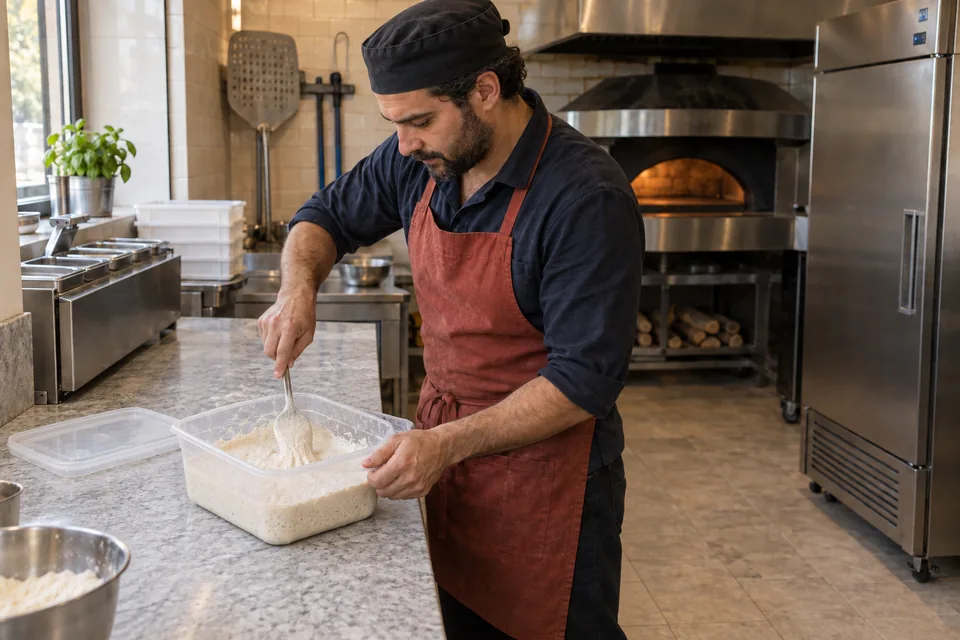
    A loose white poolish stirred in a clear tub.
    01 PoolishMix a loose poolish and cover until bubbles break at the surface.
  2. 02 · Mix

    3–6 minutes

    Use: A + B

    Combine B flour and salt. Pour B water around the poolish to loosen it, then add all poolish and water to the flour. With a damp hand, fold edges over the additions; pinch through the mass with thumb and forefinger 5–6 times. Alternate pinching and folding until uniformly mixed, about 3–6 minutes. Rest briefly, then fold again.

    Ready when: Even, cohesive dough; no dry flour.
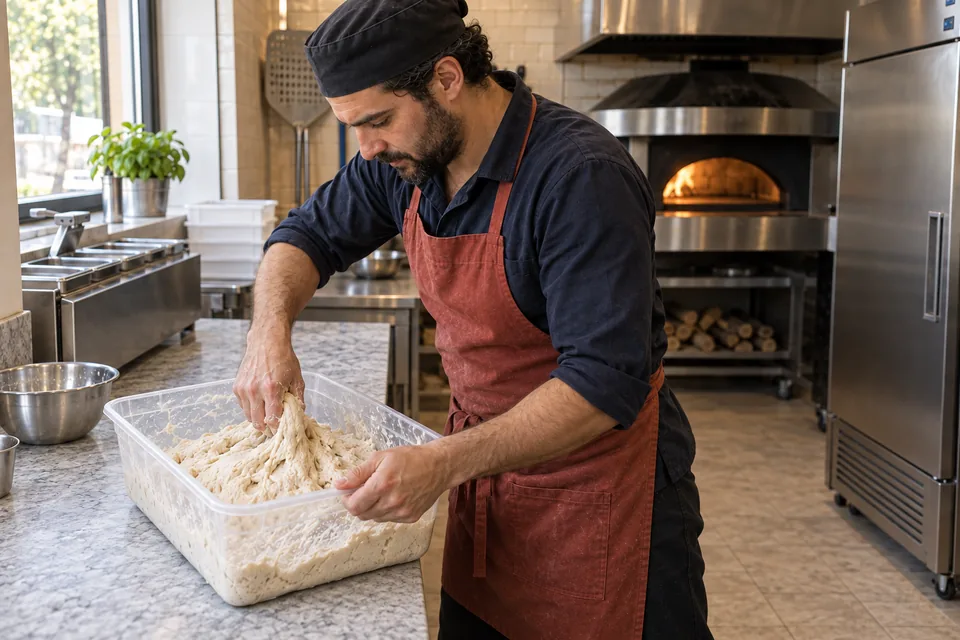
    A damp hand pinching and folding white pizza dough in a tub.
    02 MixAlternate pinching and folding until the final dough is evenly mixed.
  3. 03 · Fold & bulk

    1 set in first hour; bulk about 6 h

    Use: Mixed dough

    With a damp hand, stretch one edge until resistance, then fold across the dough. Repeat around 4–5 sides; turn the bundle seam down. Cover between sets; let it relax before the next set. Do not tear it or fold during the last bulk hour. After the fold lightly oil the dough and tub.

    Ready when: About 2½× starting volume.

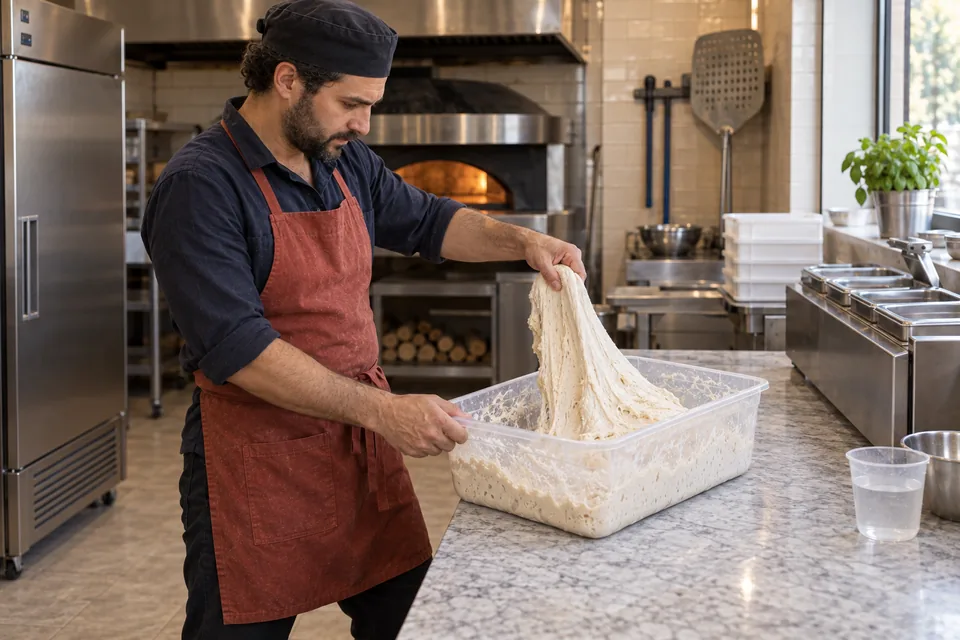
    Pizza cook lifting one connected edge of elastic dough to fold it.
    03 Fold & bulkFold to gentle resistance, then cover and allow the dough to relax.
  4. 04 · Divide & ball

    After bulk

    Use: Fermented dough

    Gently divide into 5 equal pieces. Fold edges inward, turn seam down, then cup and drag on an unfloured patch to tighten. Set apart on a floured tray; lightly oil tops and cover.

    Ready when: Smooth, medium-tight balls retaining gas.
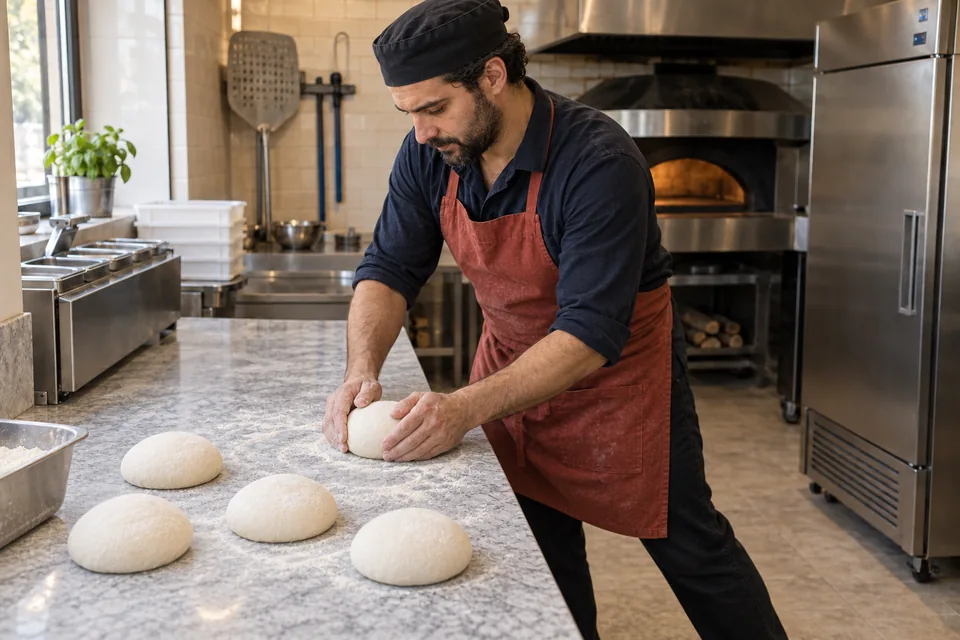
    Five white pizza-dough balls, with the cook rounding one of them.
    04 Divide & ballCup and drag five equal portions into smooth balls that retain their gas.
  5. 05 · Rest & chill

    60 min room rest + ≥30 min cold

    Use: Covered dough balls

    Rest at room temperature, then refrigerate. Keep covered for up to 2 days.

    Ready when: Cold enough to handle; balls remain aerated.
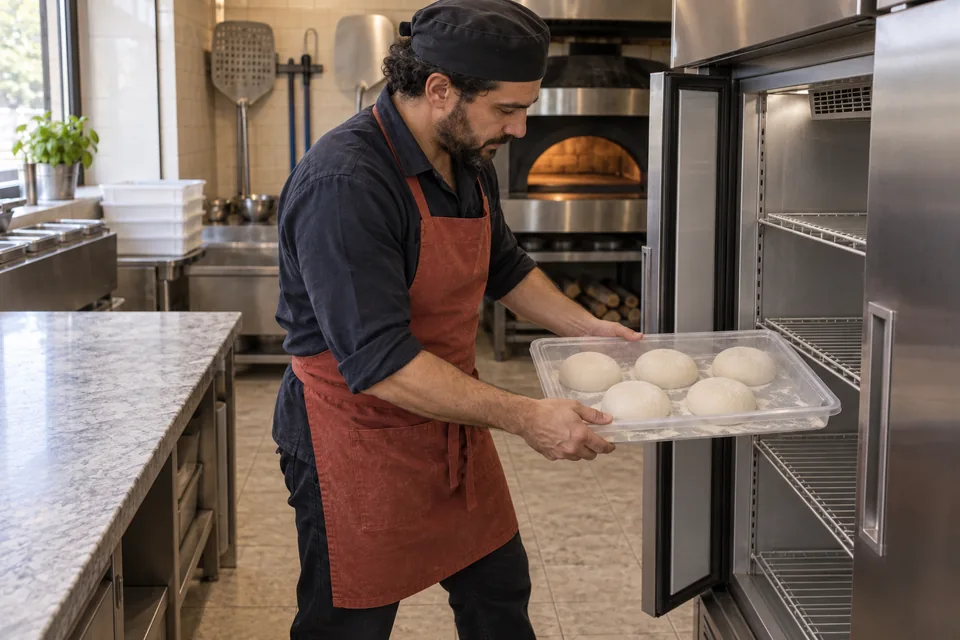
    Cook holding a covered tray of five dough balls beside an open refrigerator.
    05 Rest & chillRest the covered balls, then chill them for easier handling.
  6. 06 · Preheat

    At least oven warm-up + 30 min

    Use: Stone/steel on high rack

    Set stone roughly 20 cm below broiler. Heat at 274°C; allow an extra 30 minutes after oven reaches temperature. If stone and oven permit, use broiler for the last 5 minutes, then switch to bake before loading.

    Ready when: Baking surface fully hot.

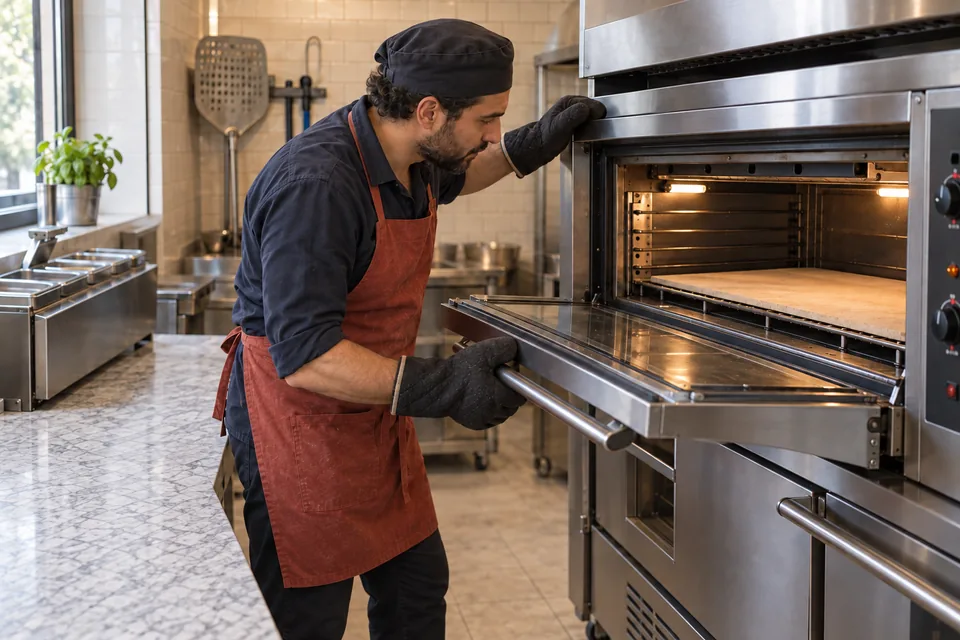
    Cook checking an empty heated stone in a conventional electric oven.
    06 PreheatHeat the empty stone thoroughly, leaving the specified clearance above it.
  7. 07 · Stretch

    Just before each bake

    Use: One cold dough ball

    Flour both sides. Press the centre, leaving a raised 2.5 cm rim; stretch over fists, rotating to 30 cm. Put on floured peel and check it slides before adding modest toppings.

    Ready when: Thin, untorn centre; airy rim; free sliding on peel.
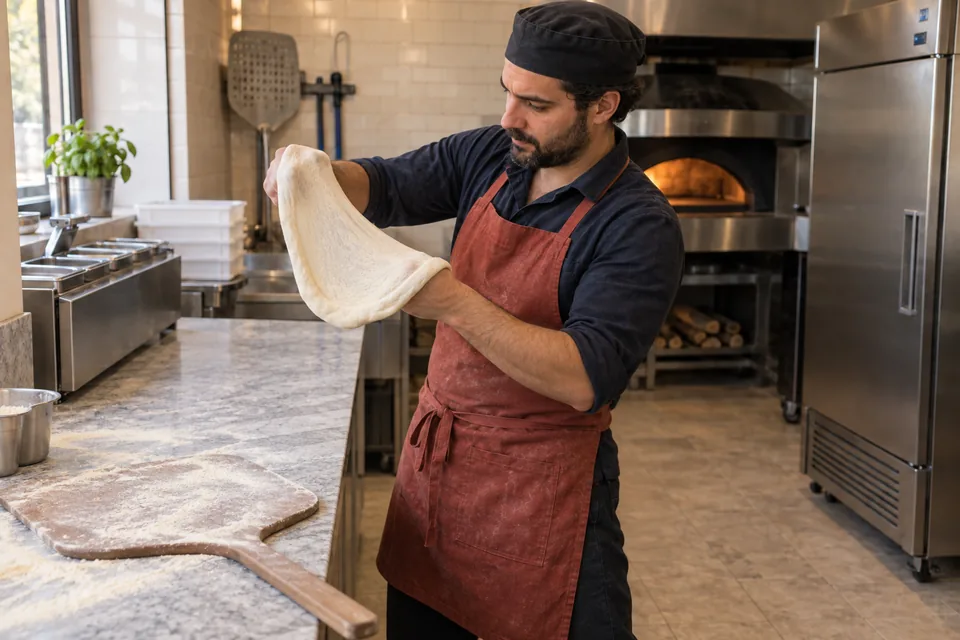
    Cook stretching a thin pizza base over his closed hands.
    07 StretchStretch the centre over your fists while keeping an airy rim.
  8. 08 · Bake

    About 5 min bake + 2–3 min broil at 274°C

    Use: Shaped pizza

    Slide onto stone and bake; finish under broiler only if equipment is rated for it, watching constantly. Without broiler, continue baking to the same visual cues.

    Ready when: Firm browned underside, coloured rim and cooked toppings.
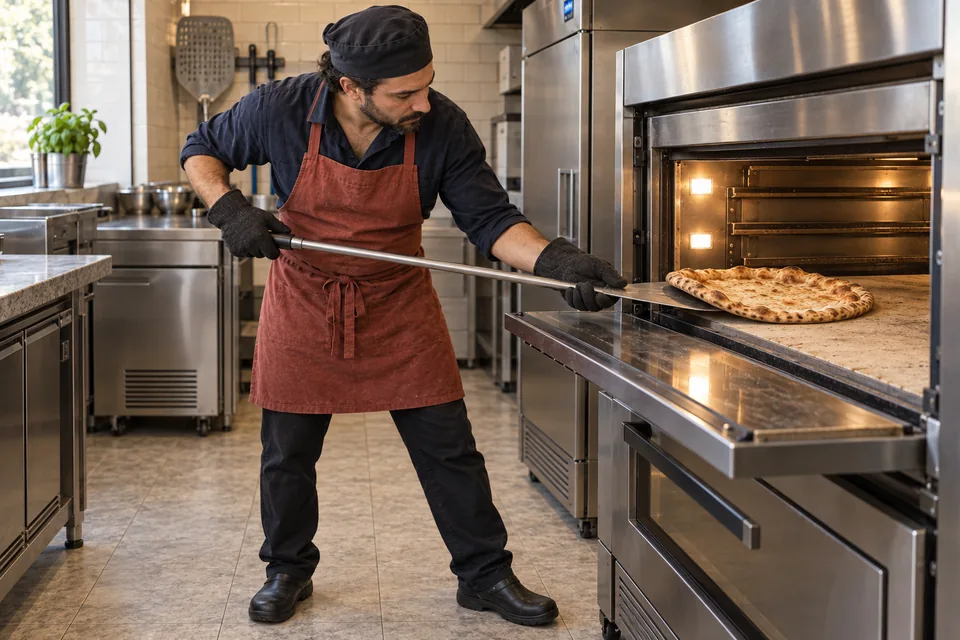
    A plain blistered pizza base checked with a peel on an oven stone.
    08 BakeCheck for a browned rim and firm underside; a plain base is shown here.

What to look for

StageLook and feelNeeds attention
StretchDough extends without ripping; raised rim stays airy.If it retracts strongly, rest briefly covered before continuing.
BakeBase is browned as well as the rim.A coloured top with a pale, floppy centre needs more bottom heat or fewer wet toppings.

Troubleshooting

If you seeLikely causeWhat to do nowNext time
Pizza sticks to peelDough is wet, peel underfloured, or topped pizza waited too long.Lift an edge and add a little flour; check sliding before launch.Shape and top each pizza only when the oven is ready.
Dough tears while stretchingIt was forced cold/tight or weakened by excess fermentation.Rest a tight ball briefly; patch a small hole by pinching.Use gentle stretching and maturity cues.

Recipe notes

  • Use all of the poolish, about 1,000 g including its small yeast dose.
  • Prepare toppings separately using a pizza or focaccia recipe.
Show ingredient flow

Recipe

Poolish Pizza Dough · 70% Hydration

A firmer version of the poolish pizza dough, with 200 g final-mix water and one fold.

How do I make it?

  1. Make the overnight mixture

    12–14 hours

    Make the poolish, a mixture that rises before the main dough: mix the ingredients in group A until no dry flour remains. Cover and leave at 18–21°C.

    A loose white poolish stirred in a clear tub.
    Mix a loose poolish and cover until bubbles break at the surface.

    Ready when: About 3× its starting size, with bubbles popping at the surface.

  2. Mix the dough

    3–6 minutes

    Mix the group B flour and salt, pour the group B water around the prepared poolish to loosen it, then add all the poolish and water to the flour. With a damp hand, fold the edges over and pinch through with your thumb and forefinger 5–6 times; alternate pinching and folding until evenly mixed, about 3–6 minutes. Rest briefly, fold again and aim for a dough temperature of 24°C.

    A damp hand pinching and folding white pizza dough in a tub.
    Alternate pinching and folding until the final dough is evenly mixed.

    Ready when: Evenly mixed dough that holds together, with no dry flour.

  3. Fold and let rise

    1 folding round in first hour; first rise about 6 h

    Wet your hand, lift one edge just until it resists and fold it across; repeat around 4–5 sides, then turn the dough folded-side down without tearing it. After this one round of folding, lightly oil the dough and its container. Cover and leave it to rise, with no folding during the final hour.

    Pizza cook lifting one connected edge of elastic dough to fold it.
    Fold to gentle resistance, then cover and allow the dough to relax.

    Ready when: About 2½× its starting size.

  4. Make five dough balls

    After the first rise

    Gently cut the dough into 5 equal pieces and fold each piece’s edges into the middle. Turn folded-side down onto a patch without flour, then cup and pull it toward you to make a firm ball without squeezing out all the air. Space the balls apart on a floured tray, lightly oil their tops and cover.

    Five white pizza-dough balls, with the cook rounding one of them.
    Cup and drag five equal portions into smooth balls that retain their gas.

    Ready when: Smooth, moderately firm balls that still contain air bubbles.

  5. Rest, then refrigerate

    60 min room rest + ≥30 min cold

    Let the covered dough balls rest at room temperature, then put them in the fridge. Keep them covered and use within 2 days.

    Cook holding a covered tray of five dough balls beside an open refrigerator.
    Rest the covered balls, then chill them for easier handling.

    Ready when: The balls are cold enough to handle and still feel airy.

  6. Heat the oven

    At least oven warm-up + 30 min

    Put the baking stone roughly 20 cm below the grill/broiler and heat the oven to 274°C. Once the oven reaches that temperature, give it another 30 minutes to heat the stone. If your oven and stone are suitable for grilling/broiling, use that setting for the last 5 minutes, then switch back to bake before adding the pizza.

    Cook checking an empty heated stone in a conventional electric oven.
    Heat the empty stone thoroughly, leaving the specified clearance above it.

    Ready when: The baking surface is fully hot.

  7. Stretch the pizza base

    Just before each bake

    Flour both sides of one cold dough ball and press the centre, keeping a raised edge 2.5 cm wide. Stretch it over your fists while turning it until it is 30 cm across. Put it on a floured baking peel—the flat paddle for sliding it into the oven—and check that it slides freely before adding a light layer of toppings.

    Cook stretching a thin pizza base over his closed hands.
    Stretch the centre over your fists while keeping an airy rim.

    Ready when: A thin centre without tears, a puffy edge and a base that slides freely on the baking paddle.

  8. Bake

    About 5 min bake + 2–3 min broil at 274°C

    Slide the pizza onto the stone and bake. Finish under the grill/broiler only if your equipment is suitable, and watch it the whole time. Otherwise, keep baking until the base, edge and toppings reach the same signs of doneness.

    A plain blistered pizza base checked with a peel on an oven stone.
    Check for a browned rim and firm underside; a plain base is shown here.

    Ready when: A firm, browned underside, browned edge and cooked toppings.

What can go wrong, and how can I fix it?

What you noticeLikely causeWhat to do
Pizza sticks to peelDough is wet, peel underfloured, or topped pizza waited too long.Lift an edge and add a little flour; check sliding before launch. Shape and top each pizza only when the oven is ready.
Dough tears while stretchingIt was forced cold/tight or weakened by excess fermentation.Rest a tight ball briefly; patch a small hole by pinching. Use gentle stretching and maturity cues.
Useful recipe notes

Use all of the poolish, about 1,000 g including its small yeast dose.

Prepare toppings separately using a pizza or focaccia recipe.

See the detailed method and ratios in , or follow ingredients through the .

Ingredient proportions & recipe details

Poolish Pizza Dough · 70% Hydration at a glance

Makes
5 dough balls, about 344 g each; 30 cm pizzas
Heat
274°C bake; optional broil finish
Baking time
About 5 min bake + 2–3 min broil per pizza
Dough hydration
70%
Prefermented flour
50% of total flour
Leavening
Yeast
Bulk fermentation
1 set in first hour; bulk about 6 h · About 2½× starting volume.
How do the ingredient proportions compare?

Core dough totals include the flour and water in the portion of starter or preferment used. Do not add them again. Toppings, fillings and dusting flour are separate.

Formula componentGramsFlour = 100%
Total flour1000 g100%
Total water700 g70%
Salt20 g2%
Instant yeast0.4 g0%