Nepedia

Ciabatta

Two broad, flour-dusted loaves with an open crumb and a crisp crust. An overnight preferment develops the dough before gentle folding and shaping the next day.

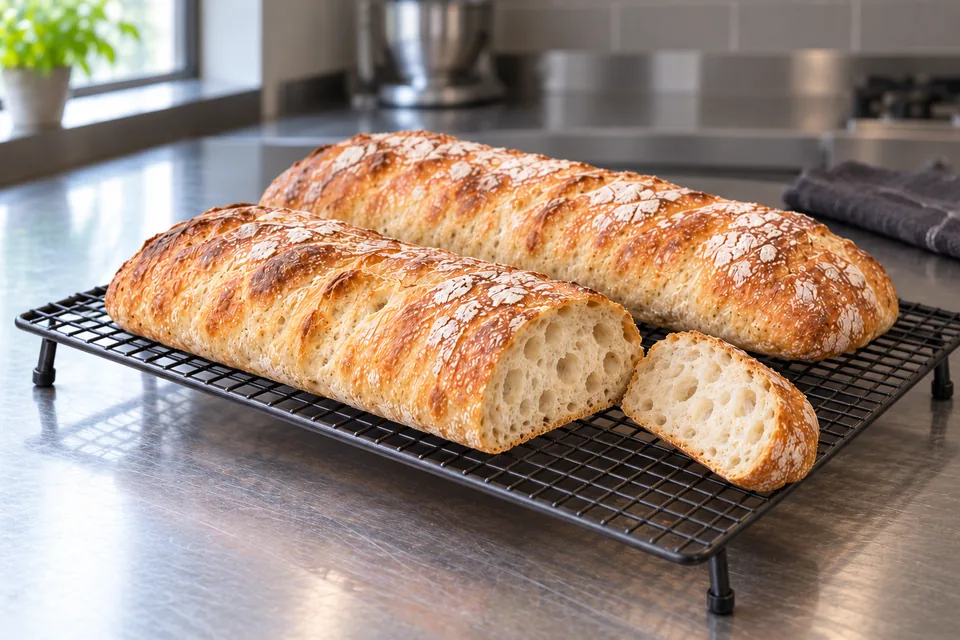
Two golden ciabatta loaves on a rack, one cut to show irregular open holes.
Makes
2 loaves
Heat
230°C conventional
Baking time
25–30 min
Cuisine / style
Italy
View

Ciabatta

Makes
2 loaves
Heat
230°C conventional
Baking time
25–30 min
Cuisine / style
Italy
Italy · Ciabatta

Ciabatta

Two broad, flour-dusted loaves with an open crumb and a crisp crust. An overnight preferment develops the dough before gentle folding and shaping the next day.

Method

  1. 01 · Mix and ferment the biga

    720–960 min

    Use: Bread flour; Water; Instant yeast

    The evening before baking, stir the biga flour, 190g cool water and 0.5g instant yeast until no dry flour remains. Cover the bowl and leave it at 18–21°C for 12–16 hours.

    Ready when: The preferment expands, shows many bubbles and smells pleasantly fermented. Use it while it is still airy, before it collapses.
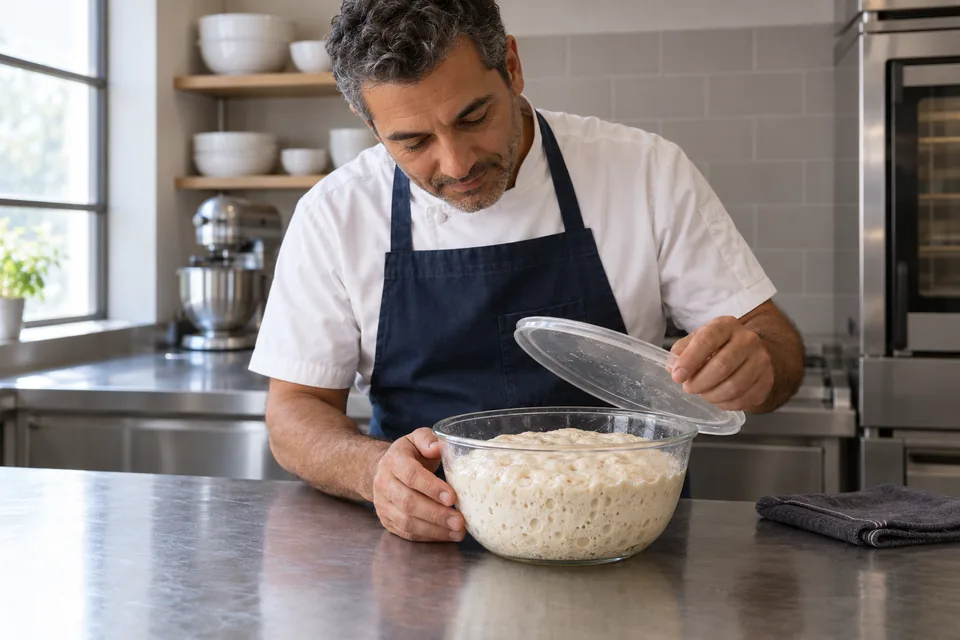
    Baker lifting a clear lid from a bowl of bubbly preferment.
    01 Make and ripen the prefermentUse the preferment while it is expanded and bubbly.
  2. 02 · Mix the final dough

    10–15 min

    Use: Water; Bread flour; Instant yeast; Fine salt

    Put all the ripe biga and the 185g final water in a mixer bowl and loosen them together. Add the final flour, 3g instant yeast and salt. Mix with a dough hook on low until combined, then at the manufacturer’s recommended dough speed for about 5–8 minutes.

    Ready when: The dough is sticky and elastic. A lifted edge stretches into a thin sheet before it tears; it will not form a dry, firm ball.
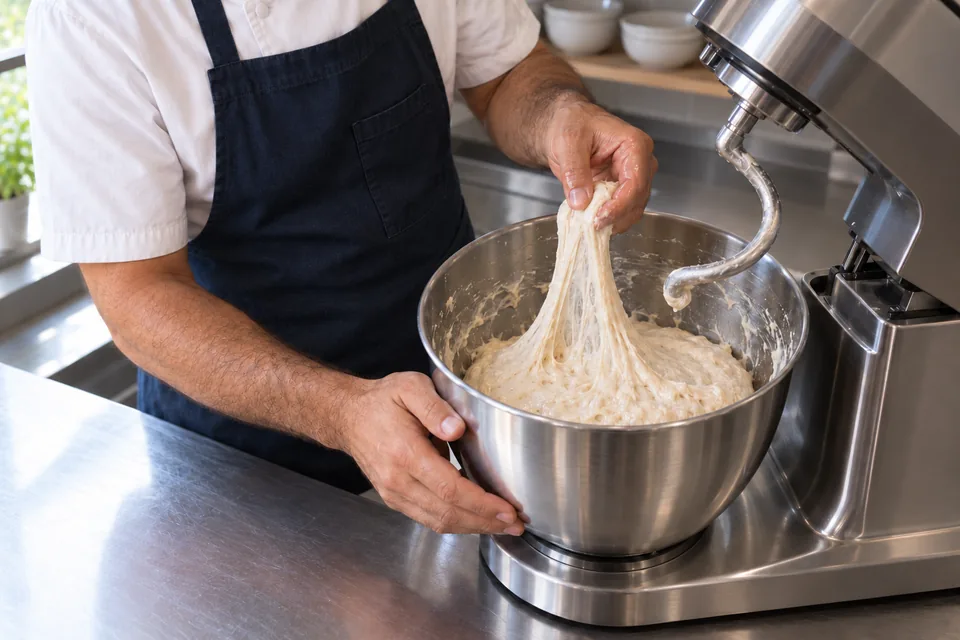
    Wet elastic ciabatta dough stretching above the stand mixer bowl beneath a raised dough hook.
    02 Develop the wet doughMix until the wet dough is sticky and elastic.
  3. 03 · Let the dough rise, then fold

    60–65 min

    Use: Olive oil for the container

    Coat a 3-litre straight-sided container with the 5g olive oil. Scrape in the dough, cover it and leave at about 22–25°C for 1 hour. Wet your hands, lift one side of the dough and fold it over the centre. Repeat from the other three sides.

    Ready when: The dough has begun to swell and becomes a more rounded, supported mass after folding.
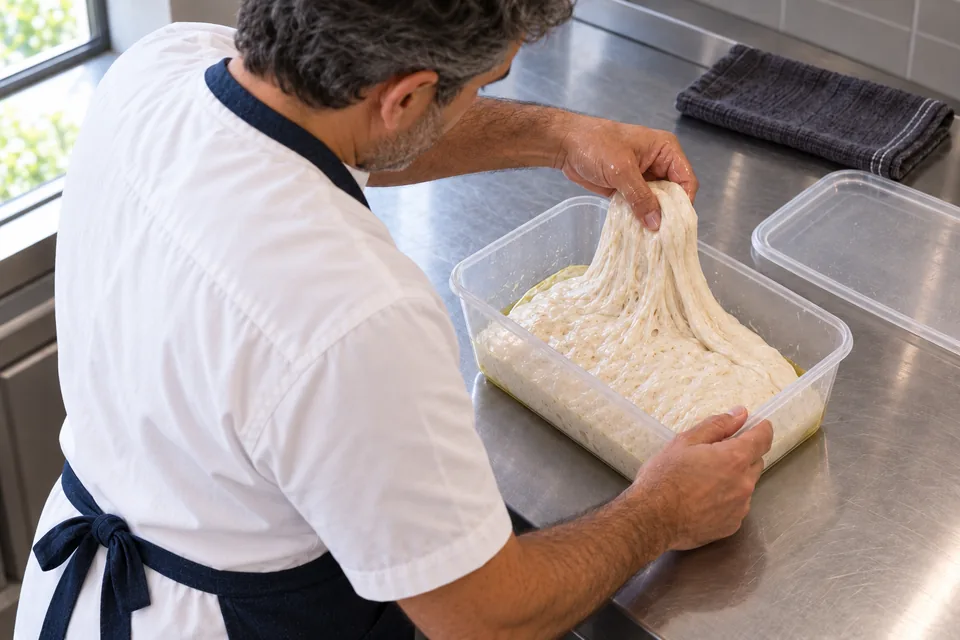
    Wet hands lifting a stretchy side of ciabatta dough in a straight-sided container.
    03 Fold the expanding doughLift and fold the dough from each side with wet hands.
  4. 04 · Finish the bulk rise

    45–60 min

    Use:

    Cover the container again and leave the dough for another 45–60 minutes, or until it is roughly twice its initial volume. Avoid stirring or pressing it down.

    Ready when: Bubbles are visible at the sides and surface, and the dough trembles gently when the container moves.
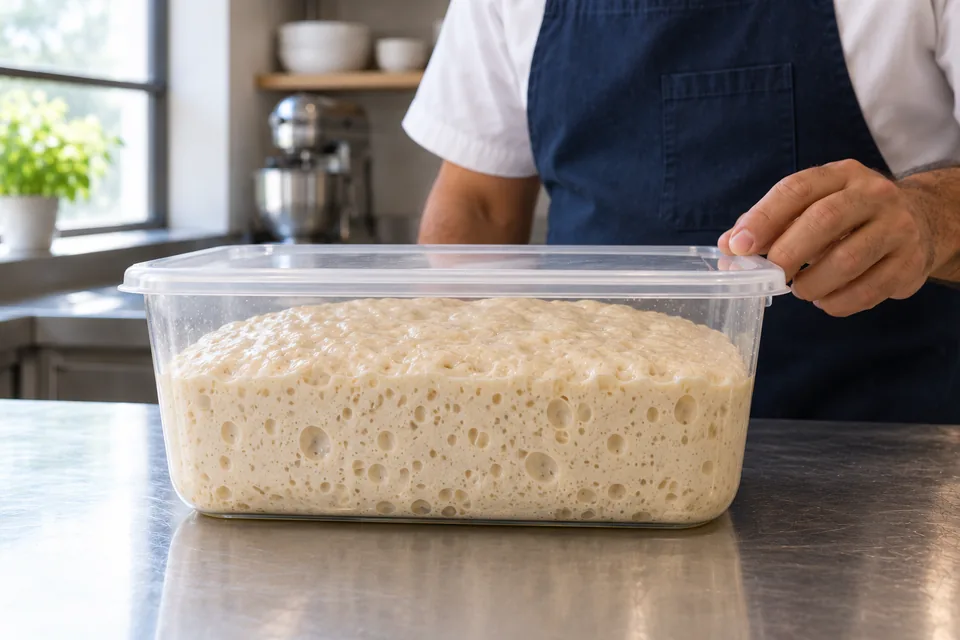
    Bubbly expanded ciabatta dough beneath the clear lid of a straight-sided container.
    04 Finish the bulk riseLet the covered dough become well aerated before dividing.
  5. 05 · Divide and shape the loaves

    10 min

    Use: Bread flour for shaping

    Line a 30 × 40cm tray with baking paper. Use the shaping flour to coat the worktop and scraper. Ease out the dough without punching it down, dust the top and gently spread it to about 20 × 25cm. Cut it lengthways into two broad strips and move them onto the tray with at least 5cm between them.

    Ready when: The two pieces retain visible bubbles and have a loose, slightly irregular slipper shape.
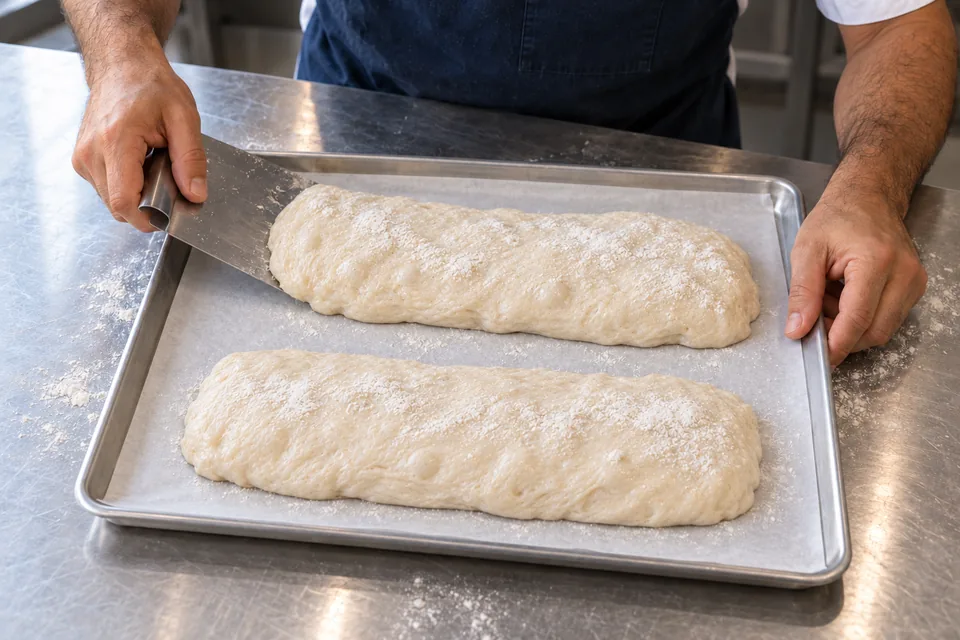
    Two flour-dusted raw ciabatta loaves spaced apart on a parchment-lined tray.
    05 Divide into two loavesDivide gently into two broad loaves and leave a clear gap.
  6. 06 · Proof the loaves and heat the oven

    60–120 min

    Use:

    Cover the loaves with a deep tray or food-safe cover that does not touch the dough. Let them rise for 60–120 minutes at about 22–25°C. During the last 30 minutes, heat the oven to 230°C conventional with a heavy baking sheet on the middle rack and an empty, heat-safe metal steam tray below it.

    Ready when: The loaves look inflated and delicate. A very light fingertip dent fills slowly, rather than immediately springing back.
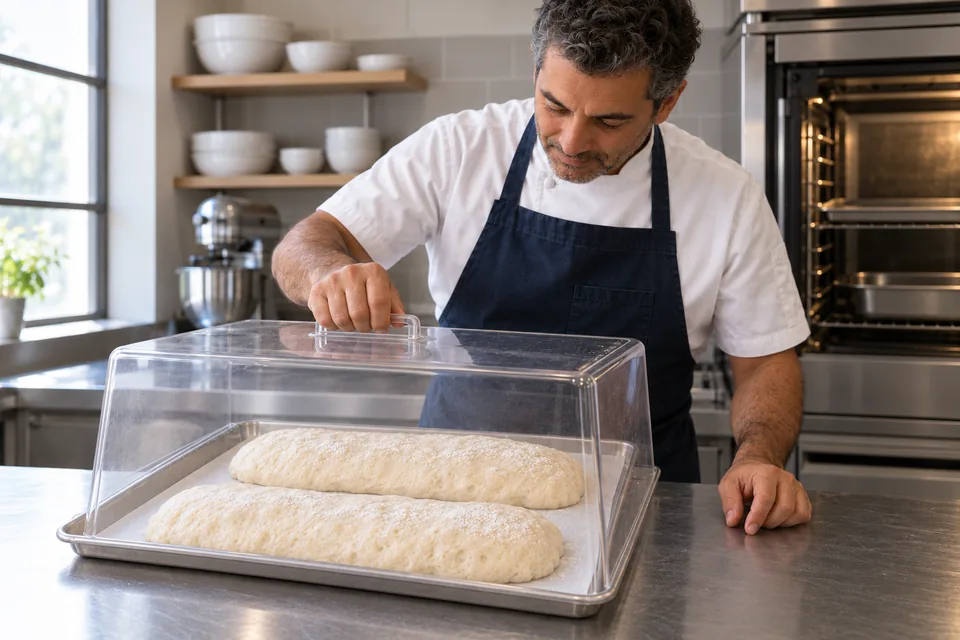
    Two proofed ciabatta loaves beneath a high clear cover beside an oven with separate metal trays.
    06 Proof the loaves and preheatProof the covered loaves until inflated and delicate.
  7. 07 · Bake with steam

    25–30 min

    Use: Hot water for steam

    Slide the loaves and their paper onto the hot baking sheet. Pour the 150ml hot water into the separate metal steam tray, keeping your face and hands clear of the steam, then close the oven. Bake for 25–30 minutes, until the crust is a deep golden brown and the loaves feel light for their size.

    Ready when: The bottoms are firm, the crust has no broad pale patches, and the loaves hold their shape when lifted.
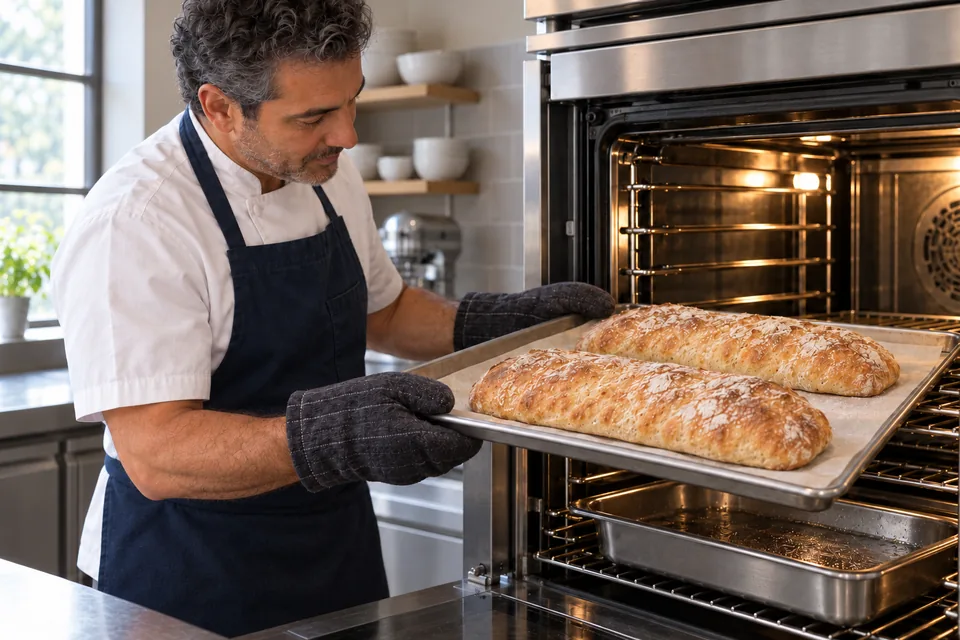
    Baker drawing a sheet with two golden ciabatta loaves from the oven, with a separate metal tray below.
    07 Bake until goldenBake until both loaves have a firm, deep golden crust.
  8. 08 · Cool before slicing

    60 min

    Use:

    Transfer the loaves to a rack and leave them uncovered for at least 1 hour before cutting. Keep space underneath so moisture can escape.

    Ready when: The crust feels dry and the crumb holds its structure when sliced, rather than smearing against the knife.
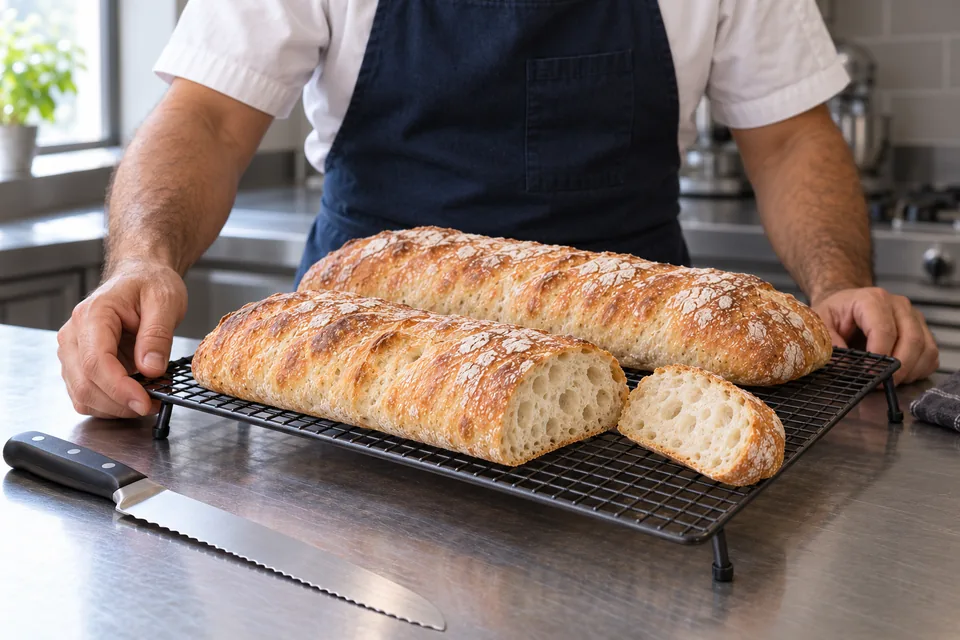
    Two ciabatta loaves on a cooling rack, one with a matching cut slice showing an open crumb.
    08 Cool before slicingCool the loaves uncovered before cutting.

What to look for

StageLook / feel forNeeds attention
Mix and ferment the bigaThe preferment expands, shows many bubbles and smells pleasantly fermented. Use it while it is still airy, before it collapses.
Mix the final doughThe dough is sticky and elastic. A lifted edge stretches into a thin sheet before it tears; it will not form a dry, firm ball.
Let the dough rise, then foldThe dough has begun to swell and becomes a more rounded, supported mass after folding.
Finish the bulk riseBubbles are visible at the sides and surface, and the dough trembles gently when the container moves.
Divide and shape the loavesThe two pieces retain visible bubbles and have a loose, slightly irregular slipper shape.
Proof the loaves and heat the ovenThe loaves look inflated and delicate. A very light fingertip dent fills slowly, rather than immediately springing back.
Bake with steamThe bottoms are firm, the crust has no broad pale patches, and the loaves hold their shape when lifted.
Cool before slicingThe crust feels dry and the crumb holds its structure when sliced, rather than smearing against the knife.

Troubleshooting

If you see thisLikely causeWhat to do nowNext time
The dough spreads into a puddle instead of holding a loose mound.Gluten development is incomplete, the flour is weak, or the dough is overfermented.Before the final bulk rise, give it one extra fold and reassess after 20 minutes. If already fully proofed, bake it as it is rather than kneading flour into it.Use bread flour, weigh the water and follow dough expansion rather than a fixed clock.
The crumb is dense with few large holes.The dough was pressed flat during dividing or baked before the final proof was ready.Finish baking and use the loaf for toast or sandwiches; lost gas cannot be restored after baking.Handle the dough with a scraper and wait for inflated, slow-springing loaves before baking.
The crumb seems gummy.The loaf was cut while hot or removed before the interior set.If still whole and pale, return it to the oven for 5–10 minutes. Otherwise let it cool fully before judging the crumb.Bake to a firm, golden crust and cool uncovered for at least 1 hour.
The biga has collapsed long before mixing.The room was warmer than the specified range or fermentation ran too long.For the most predictable result, make a fresh preferment and use it at the bubbly, expanded stage.Choose a cooler location and check it before the end of the stated time range.

Storage: Cool completely before storing. Keep at room temperature for up to 2 days, or wrap and freeze for up to 1 month. A sealed bag softens the crust; refresh a thawed loaf at 180°C conventional for 8–10 minutes and let it stand briefly before slicing.; Contains: wheat.; This Nepedia version has not been kitchen-tested.

Ingredient choices & substitutions

No brand is specified.

Match the ingredient’s function and weight. See the flour, gluten, yeast and salt guide.

Other approaches to this recipe
Cook / recipeUseWhat differs

The working ingredients and method form one recipe. Different formulas are compared without averaging their quantities or rise schedules.

Nepedia

Recipe

Ciabatta

Two broad, flour-dusted loaves with an open crumb and a crisp crust. An overnight preferment develops the dough before gentle folding and shaping the next day.

How do I make it?

  1. Mix and ferment the biga

    720–960 min

    The evening before baking, stir the biga flour, 190g cool water and 0.5g instant yeast until no dry flour remains. Cover the bowl and leave it at 18–21°C for 12–16 hours.

    Baker lifting a clear lid from a bowl of bubbly preferment.
    Use the preferment while it is expanded and bubbly.

    Ready when: The preferment expands, shows many bubbles and smells pleasantly fermented. Use it while it is still airy, before it collapses.

  2. Mix the final dough

    10–15 min

    Put all the ripe biga and the 185g final water in a mixer bowl and loosen them together. Add the final flour, 3g instant yeast and salt. Mix with a dough hook on low until combined, then at the manufacturer’s recommended dough speed for about 5–8 minutes.

    Wet elastic ciabatta dough stretching above the stand mixer bowl beneath a raised dough hook.
    Mix until the wet dough is sticky and elastic.

    Ready when: The dough is sticky and elastic. A lifted edge stretches into a thin sheet before it tears; it will not form a dry, firm ball.

  3. Let the dough rise, then fold

    60–65 min

    Coat a 3-litre straight-sided container with the 5g olive oil. Scrape in the dough, cover it and leave at about 22–25°C for 1 hour. Wet your hands, lift one side of the dough and fold it over the centre. Repeat from the other three sides.

    Wet hands lifting a stretchy side of ciabatta dough in a straight-sided container.
    Lift and fold the dough from each side with wet hands.

    Ready when: The dough has begun to swell and becomes a more rounded, supported mass after folding.

  4. Finish the bulk rise

    45–60 min

    Cover the container again and leave the dough for another 45–60 minutes, or until it is roughly twice its initial volume. Avoid stirring or pressing it down.

    Bubbly expanded ciabatta dough beneath the clear lid of a straight-sided container.
    Let the covered dough become well aerated before dividing.

    Ready when: Bubbles are visible at the sides and surface, and the dough trembles gently when the container moves.

  5. Divide and shape the loaves

    10 min

    Line a 30 × 40cm tray with baking paper. Use the shaping flour to coat the worktop and scraper. Ease out the dough without punching it down, dust the top and gently spread it to about 20 × 25cm. Cut it lengthways into two broad strips and move them onto the tray with at least 5cm between them.

    Two flour-dusted raw ciabatta loaves spaced apart on a parchment-lined tray.
    Divide gently into two broad loaves and leave a clear gap.

    Ready when: The two pieces retain visible bubbles and have a loose, slightly irregular slipper shape.

  6. Proof the loaves and heat the oven

    60–120 min

    Cover the loaves with a deep tray or food-safe cover that does not touch the dough. Let them rise for 60–120 minutes at about 22–25°C. During the last 30 minutes, heat the oven to 230°C conventional with a heavy baking sheet on the middle rack and an empty, heat-safe metal steam tray below it.

    Two proofed ciabatta loaves beneath a high clear cover beside an oven with separate metal trays.
    Proof the covered loaves until inflated and delicate.

    Ready when: The loaves look inflated and delicate. A very light fingertip dent fills slowly, rather than immediately springing back.

  7. Bake with steam

    25–30 min

    Slide the loaves and their paper onto the hot baking sheet. Pour the 150ml hot water into the separate metal steam tray, keeping your face and hands clear of the steam, then close the oven. Bake for 25–30 minutes, until the crust is a deep golden brown and the loaves feel light for their size.

    Baker drawing a sheet with two golden ciabatta loaves from the oven, with a separate metal tray below.
    Bake until both loaves have a firm, deep golden crust.

    Ready when: The bottoms are firm, the crust has no broad pale patches, and the loaves hold their shape when lifted.

  8. Cool before slicing

    60 min

    Transfer the loaves to a rack and leave them uncovered for at least 1 hour before cutting. Keep space underneath so moisture can escape.

    Two ciabatta loaves on a cooling rack, one with a matching cut slice showing an open crumb.
    Cool the loaves uncovered before cutting.

    Ready when: The crust feels dry and the crumb holds its structure when sliced, rather than smearing against the knife.

What can go wrong, and how can I fix it?

What you noticeLikely causeWhat to do
The dough spreads into a puddle instead of holding a loose mound.Gluten development is incomplete, the flour is weak, or the dough is overfermented.Before the final bulk rise, give it one extra fold and reassess after 20 minutes. If already fully proofed, bake it as it is rather than kneading flour into it. Use bread flour, weigh the water and follow dough expansion rather than a fixed clock.
The crumb is dense with few large holes.The dough was pressed flat during dividing or baked before the final proof was ready.Finish baking and use the loaf for toast or sandwiches; lost gas cannot be restored after baking. Handle the dough with a scraper and wait for inflated, slow-springing loaves before baking.
The crumb seems gummy.The loaf was cut while hot or removed before the interior set.If still whole and pale, return it to the oven for 5–10 minutes. Otherwise let it cool fully before judging the crumb. Bake to a firm, golden crust and cool uncovered for at least 1 hour.
The biga has collapsed long before mixing.The room was warmer than the specified range or fermentation ran too long.For the most predictable result, make a fresh preferment and use it at the bubbly, expanded stage. Choose a cooler location and check it before the end of the stated time range.
Useful recipe notes

Storage: Cool completely before storing. Keep at room temperature for up to 2 days, or wrap and freeze for up to 1 month. A sealed bag softens the crust; refresh a thawed loaf at 180°C conventional for 8–10 minutes and let it stand briefly before slicing.

Contains: wheat.

This Nepedia version has not been kitchen-tested.

See the detailed method and ratios in , or follow ingredients through the .

Ingredient proportions & recipe details

Ciabatta at a glance

Makes
2 loaves
Heat
230°C conventional
Baking time
25–30 min
Cuisine / style
Italy
Dough hydration
75%
Prefermented flour
50% of total flour
Leavening
Yeast
Bulk fermentation (including folding)
105–125 min · Bubbles are visible at the sides and surface, and the dough trembles gently when the container moves.
How do the ingredient proportions compare?

Core dough totals include the flour and water in the portion of starter or preferment used. Do not add them again. Toppings, fillings and dusting flour are separate.

Formula componentGramsFlour = 100%
Total flour500 g100%
Total water375 g75%
Salt10 g2%
Instant yeast3.5 g0.7%