Your body is made of tiny parts called cells. They are like very small rooms that build everything alive! 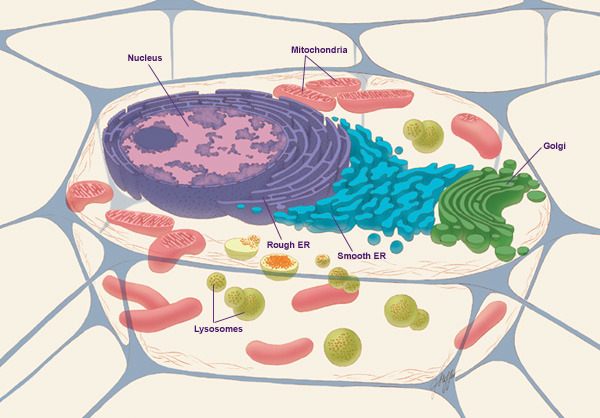

Every living thing, from a tiny bug to a giant tree, is made of cells. The word "cell" comes from a Latin word that means "small room." 

Cells are the basic building blocks of all living organisms. They were discovered in 1665 by Robert Hooke, who thought they looked like the small rooms in a monastery. 
Scientists group life into two types: prokaryotes and eukaryotes. Prokaryotes, like bacteria, are very simple and do not have a nucleus (a center to hold DNA). While most are tiny, one amazing bacterium called Thiomargarita magnifica is 1 cm long and can be seen with the naked eye! Eukaryotes, which include plants and animals, are more complex. 
The cell is the fundamental structural and functional unit of all life. The term "cell" was coined by Robert Hooke in 1665 when he observed a thin slice of cork under a microscope and saw structures that reminded him of a monastery's small rooms.
Organisms are divided into two main groups: prokaryotes and eukaryotes. Prokaryotes, such as bacteria and archaea, are single-celled and lack a membrane-bound nucleus. Instead, their DNA is located in a region called a nucleoid. 
Animal cells are enclosed by a semipermeable cell membrane that protects the cell and controls what enters and leaves. 
Cells must perform several vital processes to survive and help an organism grow. During replication, a mother cell divides into two daughter cells. Bacteria do this through a simple process called binary fission, while eukaryotic cells use a more complex process called mitosis. 
The cell is the basic structural, functional, and biological unit of all known organisms. Derived from the Latin word 'cellula' (small room), cells were first described by Robert Hooke in 1665 after he examined cork tissue.
Prokaryotes, including the domains Bacteria and Archaea, are characterized by their lack of a membrane-bound nucleus. Their genetic material typically consists of a single circular chromosome located in the nucleoid.
Eukaryotic cells, which make up animals, plants, and fungi, are significantly more complex and can be 2 to 100 times larger than prokaryotes. Their defining feature is the membrane-bound nucleus, which houses the cell's linear chromosomes. 

The cell membrane, or plasma membrane, is a selectively permeable lipid bilayer described by the fluid mosaic model. 
Cellular life is defined by complex processes including metabolism, signaling, and replication. DNA replication occurs during the S phase of the cell cycle, ensuring that daughter cells receive a full genome during mitosis. 
The history of life on Earth began with the emergence of cells approximately 4 billion years ago. 

🖼️ Images & Media (24)


+ 12 more
✨ What else?
Related topics you might enjoy
🪜 Step back
Simpler topics to build understanding