The atmosphere is the air around our planet. It is like a big, warm blanket that keeps us safe. 
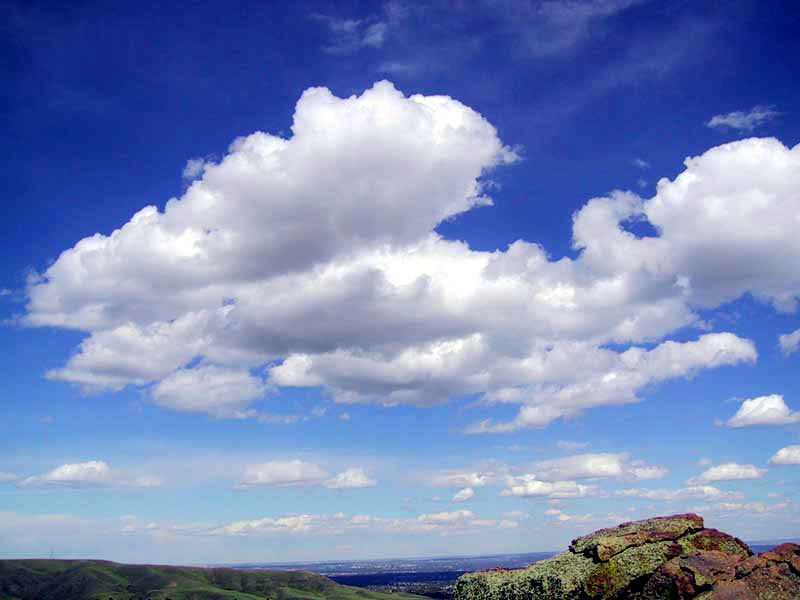
The atmosphere is a layer of gases that surrounds Earth. It is held in place by gravity. Most of the air is made of nitrogen and oxygen, which we need to breathe. 

Earth's atmosphere is a mix of gases, mostly nitrogen (78%) and oxygen (21%). It is held close to the planet by gravity and gets thinner as you go higher. 

Earth's atmosphere is a complex envelope of gases and particles that surrounds our planet. It is essential for life, providing the oxygen we breathe and the carbon dioxide plants need for photosynthesis. The atmosphere is composed of 78.08% nitrogen, 20.95% oxygen, and 0.93% argon, along with trace gases like carbon dioxide and water vapor.
The atmosphere is organized into five distinct layers. The troposphere (0–12 km) is the lowest layer and contains 80% of the atmosphere's mass. This is where clouds form and weather happens. Above it lies the stratosphere (12–50 km), home to the ozone layer. Unlike the troposphere, where it gets colder as you go up, the stratosphere actually gets warmer because the ozone absorbs ultraviolet solar radiation.
Higher up is the mesosphere (50–80 km), the coldest place on Earth, where temperatures can drop to -85°C. This is where most meteors burn up. Next is the thermosphere (80–700 km), where the International Space Station orbits.
The atmosphere serves as a protective buffer. It shields us from high-energy radiation and most meteoroids. It also regulates temperature through the greenhouse effect. Greenhouse gases like carbon dioxide and methane trap heat, preventing it from escaping back into space. Without this effect, Earth's average temperature would be a freezing -18°C instead of the comfortable 15°C we enjoy today.
Atmospheric pressure is the weight of the air above you. At sea level, this pressure is about 101,325 pascals. As you climb higher, the air becomes less dense and the pressure drops. In fact, 99% of the atmosphere's mass is found below 30 km. 

The atmosphere of Earth is a dynamic layer of mixed gases, known as air, retained by the planet's gravity. It is a critical component of Earth's life-support system, acting as a protective buffer that shields the surface from ultraviolet radiation and meteoroids, while regulating temperature through heat retention. The study of these processes is known as atmospheric science or aerology.
The chemical composition of dry air is remarkably consistent up to about 100 km. It consists of 78.08% nitrogen, 20.95% oxygen, 0.93% argon, and 0.04% carbon dioxide. However, air also contains variable amounts of water vapor, averaging 0.4% across the entire atmosphere. Trace gases, including methane, nitrous oxide, and ozone, play disproportionately large roles in the planet's climate and chemistry.
The atmosphere is stratified into five primary layers defined by their temperature gradients. The troposphere (0 to 12 km) is the densest layer, containing approximately 80% of the atmospheric mass and nearly all its water vapor. It is characterized by a decrease in temperature with altitude, which promotes the vertical mixing that drives weather systems.
The middle and upper atmosphere consist of the mesosphere, thermosphere, and exosphere. The mesosphere (50 to 80 km) is the coldest region, where temperatures drop to -85°C and noctilucent clouds of ice particles can form. The thermosphere (80 to 700 km) experiences extreme temperature increases—up to 1500°C—due to the absorption of X-rays and UV radiation, though the air is so rarefied it would not feel hot to the touch. This layer hosts the International Space Station and the spectacular aurora borealis.
Physical properties like pressure and density decrease exponentially with altitude. The total mass of the atmosphere is approximately 5.15 x 10^18 kg. Interestingly, 50% of this mass is concentrated within the first 5.6 km of the surface. The Kármán line, located at 100 km, is the internationally recognized boundary of space, though atmospheric effects like drag can affect satellites at much higher altitudes.
The atmosphere's optical properties are responsible for the colors we see. Rayleigh scattering causes shorter blue wavelengths to scatter more than red ones, giving the sky its blue hue. At sunset, the light must travel through more atmosphere, scattering away the blue and leaving the vibrant reds and oranges. 
Earth's atmosphere has evolved significantly over 4.5 billion years. The primordial atmosphere was likely hydrogen and helium, which were lost to space. A second atmosphere of nitrogen and carbon dioxide formed through volcanic outgassing. The "Great Oxygenation Event" about 2.4 billion years ago, driven by cyanobacterial photosynthesis, introduced free oxygen, eventually allowing complex life to evolve. 
🖼️ Images & Media (21)


+ 9 more
✨ What else?
Related topics you might enjoy